

 Preview
 Buy Print
 Send
Send Share
Share


 Download
 Similars
 X-Ray
X-Ray Diaporama
The Floor Scrapers aka The Floor Strippers


A Snapshot of Urban Life: The Story Behind “The Floor Scrapers”
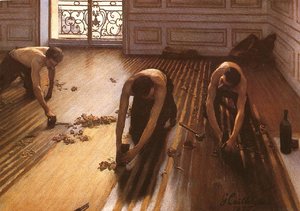
Gustave Caillebotte’s “The Floor Scrapers,” also known as “The Floor Strippers,” isn't merely a depiction of three men diligently working; it’s a remarkably astute and quietly revolutionary observation of Parisian urban life in the late 19th century. Painted in 1875, this work stands as one of the earliest representations of the burgeoning working class within the city – a subject largely absent from the art world at the time. Unlike the romanticized portrayals of peasants found in works by Millet or Courbet, Caillebotte offers a starkly realistic and unidealized view of those toiling beneath the glittering façade of modern Paris. The painting’s significance lies not in grand narratives or moralizing judgments, but rather in its meticulous documentation of everyday labor – a testament to the burgeoning industrialization reshaping the city's social fabric.
Impressionistic Realism: A Unique Artistic Blend
Caillebotte’s style in “The Floor Scrapers” is a fascinating synthesis of Impressionist techniques and a commitment to realism. He was deeply influenced by his early exposure to photography, adopting its precise framing, careful perspective, and ability to capture fleeting moments – elements that informed his approach to painting. However, unlike the purely optical focus of many Impressionists, Caillebotte retains a strong sense of solidity and detail. The figures are rendered with a remarkable level of accuracy, their postures and movements conveying a palpable sense of fatigue and concentration. Notice how he uses broken brushstrokes and subtle shifts in light and shadow to create an atmosphere of quiet intensity, avoiding the overly bright or vibrant palette often associated with Impressionism.
The composition itself is carefully constructed. The room, seemingly a dining area, provides a contained space for this intimate scene. The partially covered rug suggests a sense of order amidst the work, while the scattered bottles hint at the men’s brief respite. Caillebotte masterfully uses light to draw our attention – it falls primarily on the workers themselves, highlighting their efforts and emphasizing their presence within the room.
Historical Context: A New Vision of Labor
“The Floor Scrapers” emerged during a period of profound social change in Paris. The city was experiencing rapid industrialization, leading to an influx of workers from rural areas seeking employment. This shift created a new urban proletariat – individuals who were largely invisible in the art world’s traditional subjects. Caillebotte's decision to depict these laborers was groundbreaking, challenging the prevailing artistic conventions that favored idealized representations of peasant life. As research indicates, this painting is considered one of the first depictions of urban labor, marking a significant departure from previous artistic portrayals of working-class individuals.
The work’s creation coincided with Caillebotte's own evolving perspective as an observer of modern Paris. His father’s textile business and his own legal training provided him with a unique vantage point to witness the transformations occurring within the city, fueling his desire to document these changes through his art.
Symbolism and Emotional Resonance
While Caillebotte deliberately avoided injecting moralizing or political commentary into “The Floor Scrapers,” the painting nevertheless carries a powerful emotional resonance. The men’s focused expressions and tireless efforts evoke a sense of dignity and resilience in the face of arduous labor. There's an inherent quiet strength conveyed by their posture, suggesting a stoic acceptance of their circumstances. The scene isn’t romanticized; it simply presents a truthful depiction of honest work. It invites us to contemplate the unseen realities of urban life and the individuals who contribute to its functioning – often overlooked but undeniably essential.
Gustave Caillebotte (1848 – 1894)
Gustave Caillebotte (1848-1894): Discover the realist & Impressionist paintings of Parisian life by this French master, known for 'Paris Street; Rainy Day' and unique perspectives.
Musée d'Orsay (Paris, France)
Discover the Musée d'Orsay in Paris! Housed in a stunning former railway station, explore an unparalleled collection of Impressionist & Post-Impressionist masterpieces by Monet, Van Gogh & more.
About this artwork
- Title: The Floor Scrapers aka The Floor Strippers
- Artist: Gustave Caillebotte
- Format: Landscape
- Copyright status: Public domain
- Where to see it: Musée d'Orsay
- Medium: Acrylic On Canvas
- Period: 19th Century
- Creative period: Mature Period
- Main color: Phthalo Green
- Purpose: Statement
Quick Facts
- Artistic style: Realist Impressionism
- Subject or theme: Working class
- Title: The Floor Scrapers
- Year: 1875
- Medium: Oil on canvas
- Influences: Photography
- Notable elements: Urban labor
QR Code


