

 Preview
 Buy Print
 Send
Send Share
Share


 Download
 Similars
 X-Ray
X-Ray Diaporama
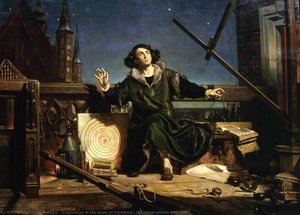
Copernicus in the tower at Frombork, or Conversations with God
 Oil On Canvas
- WallArt
- Romanticism
 1872
1872 221.0 x 315.0 cm
 Jagiellonian University
The Visionary Canvas: Jan Matejko’s “Copernicus in the Tower at Frombork”
Jan Matejko's "Copernicus in the Tower at Frombork, or Conversations with God" isn’t merely a painting; it’s a potent distillation of intellectual fervor and spiritual contemplation. Completed in 1873, this monumental oil on canvas transports us to the heart of Renaissance Poland, capturing a pivotal moment not just in astronomical history but also in the nation's burgeoning sense of self-awareness. The scene unfolds within the austere yet majestic confines of Frombork Cathedral’s tower, a location imbued with both religious significance and scientific curiosity – a perfect embodiment of the painting’s central theme: the harmonious intersection of faith and reason.
A Masterpiece of Romantic Drama
Matejko, a towering figure in 19th-century Polish art, masterfully employs the tenets of Romanticism to elevate this historical subject. The painting pulsates with dramatic lighting – a chiaroscuro effect that sculpts the figures and emphasizes the solemnity of the scene. The deep blues and purples of the night sky contrast sharply with the warm hues of Copernicus’s study, creating a visual tension that mirrors the intellectual struggle he embodies. Notice how Matejko uses loose brushstrokes to convey movement and emotion, imbuing the composition with a sense of dynamism rarely found in earlier historical paintings. The figures are rendered with an almost theatrical intensity, their gestures and expressions conveying profound thought and perhaps even a touch of awe.
The Anatomy of Inquiry: Symbolism and Detail
Beyond its dramatic impact, “Copernicus” is rich in symbolic detail. Nicolaus Copernicus himself, depicted as a man of quiet contemplation, sits at his desk surrounded by the tools of his trade – astronomical instruments, charts, and open books. The globe, prominently displayed, speaks to his revolutionary heliocentric model of the universe, challenging the established geocentric view. A partially visible diagram of the solar system hints at the complex calculations he undertook. The inclusion of a skullcap suggests the weight of religious tradition alongside the pursuit of scientific truth. Even the brick wall in the background serves as a grounding element, anchoring the scene within the physical reality of Frombork and reminding us of the earthly context of this extraordinary intellectual journey.
A Legacy Forged in Faith and Reason
The painting’s creation coincided with the 400th anniversary of Copernicus' birth, a moment of national pride for Poland. Matejko’s decision to portray Copernicus not as a triumphant discoverer but as a man engaged in dialogue with something greater than himself—perhaps even God—resonates deeply within Polish cultural identity. The painting became a symbol of the nation’s intellectual and spiritual heritage, embodying the spirit of inquiry and the courage to challenge established dogma. Its eventual acquisition by the Jagiellonian University – a bastion of learning since the 14th century – underscores its enduring significance as a testament to the power of human intellect and the pursuit of knowledge. Today, this magnificent work continues to inspire contemplation on the relationship between science, faith, and the boundless mysteries of the universe.
Jan Matejko (1838 – 1893)
Explore the dramatic historical paintings of Jan Matejko (1838-1893), Poland's national painter. Known for epic scenes like 'Battle of Grunwald' & 'Union of Lublin', his Romanticism vividly portrays pivotal Polish moments.
Jagiellonian University (Kraków, Poland)
Discover Jagiellonian University in Kraków, Poland – Central Europe’s oldest university! Explore its rich history, Collegium Maius, Copernicus' *De revolutionibus*, medieval art & scientific instruments. A journey through academic excellence!
About this artwork
- Title: Copernicus in the tower at Frombork, or Conversations with God
- Artist: Jan Matejko
- Year: 1872
- Original dimensions: 221.0 x 315.0 cm
- Format: Landscape
- Copyright status: Public domain
- Where to see it: Jagiellonian University
- Movement: Romanticism
- Medium type: WallArt
- Keywords: matejko , science , tower
Quick Facts
- Title: Copernicus in the Tower
- Year: 1873
- Artist: Jan Matejko
- Dimensions: 221 x 315 cm
- Medium: Oil on canvas
- Notable elements: Astronomer, Cathedral
- Influences:
- Copernicus
- Renaissance
QR Code


