

 Preview
 Buy Print
 Send
Send Share
Share


 Download
 Similars
 X-Ray
X-Ray Diaporama
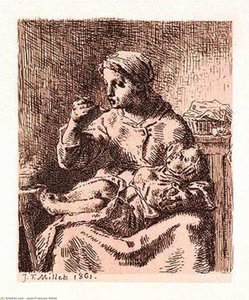
The porridge
 Etching
- Realist Movement
 1861
1861 27.0 x 18.0 cm
Jean-François Millet (1814 – 1875)
Jean-François Millet (1814-1875): French Realist painter of the Barbizon School, celebrated for poignant depictions of peasant life like 'The Gleaners' & 'The Angelus'. Explore his legacy.
A Moment of Quietude: The Essence of Millet’s “The Porridge”
Jean-François Millet's "The Porridge," painted in 1861, isn’t merely a depiction of domestic life; it’s a profound meditation on labor, poverty, and the enduring dignity of rural existence. This etching, rendered in stark black and white, captures a fleeting yet intensely felt moment within a humble farmhouse kitchen. The scene unfolds with remarkable intimacy: a woman, her head veiled – perhaps for warmth or modesty – sits patiently feeding her infant child, nestled securely in her arms. Her posture is one of quiet devotion, radiating a tenderness that transcends the simple act of nourishment. The composition is deliberately restrained, focusing entirely on this intimate tableau and minimizing any extraneous detail. Millet masterfully uses negative space to draw our attention to the central figures, creating an atmosphere of serene contemplation.
Realism Rooted in the Soil: Millet’s Artistic Vision
Millet's artistic journey was inextricably linked to his origins. Born in Gruchy, a small Norman village steeped in agricultural tradition, he witnessed firsthand the arduous realities of peasant life. This upbringing wasn’t simply a backdrop; it formed the very bedrock of his artistic vision. Unlike many artists of his time who sought to elevate rural subjects through idealized portrayals, Millet chose to depict them with unflinching honesty and respect. He meticulously observed the textures of roughspun clothing, the weathered faces of laborers, and the rhythms of daily toil – all rendered with a remarkable sensitivity to detail. His early training at the École des Beaux-Arts in Paris initially steered him towards academic painting, but he quickly rejected these conventions, forging his own path toward a more direct and emotionally resonant style.
The etching technique itself is crucial to understanding Millet’s intent. The stark contrasts of light and shadow heighten the drama of the scene, emphasizing the figures' forms and creating a sense of immediacy. The deliberate lack of color forces us to focus on the emotional content – the mother’s love, the child’s vulnerability, and the quiet dignity of their shared experience. It echoes the style of printmaking prevalent during that era, particularly its ability to convey narrative with powerful simplicity.
Symbolism Within Simplicity: The Language of Labor
Beyond the immediate depiction of a mother feeding her child, “The Porridge” is laden with symbolic weight. The act of preparing food – specifically porridge – represents sustenance and care, fundamental necessities for survival. The presence of two books in the background subtly hints at education and aspiration, suggesting that even within the confines of rural life, there’s a yearning for knowledge and improvement. The positioning of the books—one to the left, one to the right—could be interpreted as representing the duality of experience: the practical realities of labor versus the intellectual pursuits available through learning. The very act of feeding the child is a powerful symbol of continuity – ensuring the future while honoring the past.
A Legacy of Dignity: Millet’s Enduring Influence
Jean-François Millet's work, including “The Porridge,” played a pivotal role in establishing Realism as a significant artistic movement. His unflinching portrayal of peasant life challenged prevailing social attitudes and offered a sympathetic perspective on the struggles and dignity of those often marginalized by society. His influence can be seen in the works of later artists, particularly Impressionists like Vincent van Gogh, who were deeply moved by Millet’s ability to capture the essence of human experience through simple, direct imagery. Today, reproductions of “The Porridge” continue to resonate with viewers, reminding us of the enduring value of compassion, resilience, and the quiet beauty found in everyday moments. ArtsDot offers meticulously crafted hand-painted reproductions that faithfully capture the spirit and emotional depth of this iconic masterpiece.
About this artwork
- Title: The porridge
- Artist: Jean-François Millet
- Year: 1861
- Original dimensions: 27.0 x 18.0 cm
- Format: Portrait
- Copyright status: Public domain
- Creative period: Mature Period
- Purpose: Statement
- Keywords: simple life , rural life , tenderness
- Color intensity: Balanced
Quick Facts
- Year: 1861
- Notable elements: Mother & child
- Title: The Porridge
- Dimensions: 27 x 18 cm
- Medium: Etching
- Movement: Realism
- Artistic style: Genre scene
QR Code


