

 Preview
 Buy Print
 Send
Send Share
Share


 Download
 Similars
 X-Ray
X-Ray Diaporama
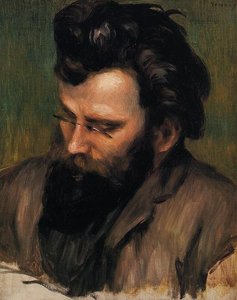
Portrait of Charles Terrasse


Pierre-Auguste Renoir (1841 – 1919)
Explore Pierre-Auguste Renoir's (1841-1919) luminous Impressionist paintings! Discover portraits, Parisian life & feminine beauty in his iconic artworks.
Portrait of Charles Terrasse: A Window into Renoir’s Impressionistic Soul
Pierre-Auguste Renoir's "Portrait of Charles Terrasse," painted in 1895, is more than just a likeness; it’s a carefully constructed moment frozen in time – a testament to the artist’s mastery of capturing fleeting emotion and light. This captivating portrait, currently residing within private collections, offers a profound glimpse into Renoir's approach to Impressionism, revealing his ability to transform everyday subjects into works brimming with atmosphere and subtle psychological depth.
The Subject and the Moment
The subject himself, Charles Terrasse, remains somewhat enigmatic. The painting depicts a man seated, his gaze averted, lost in contemplation. His features – the prominent beard, the spectacles perched upon his nose – are rendered with meticulous detail, yet it’s not merely a photographic representation. Renoir skillfully avoids direct eye contact, creating an intimacy that invites the viewer to share in Terrasse's private thoughts. The posture, slightly slumped and relaxed, suggests a moment of quiet reflection, perhaps boredom or melancholy—emotions Renoir expertly conveys through his brushwork.
Impressionistic Technique: Light, Color, and Texture
Renoir’s technique is the very heart of “Portrait of Charles Terrasse.” He employs loose, visible brushstrokes – a hallmark of Impressionism – to capture the play of light on Terrace's face and clothing. The colors are rich and vibrant, yet blended subtly to create an atmospheric effect rather than sharp outlines. Notice how Renoir uses variations in tone—light reflecting off the dark fabric of his coat, shadows cast by his beard—to build depth and volume. The texture is achieved through a layering of paint, creating a palpable sense of surface and form. This technique wasn’t simply about depicting what was seen; it was about conveying how light *felt* in that particular moment.
Historical Context: The Rise of Impressionism
Painted in 1895, “Portrait of Charles Terrasse” exists within a pivotal period for Renoir and the broader art world. Impressionism had already gained considerable recognition, challenging traditional academic styles with its focus on capturing immediate sensory experience. Renoir was at the forefront of this movement, alongside artists like Monet and Sisley, pushing the boundaries of artistic representation. This portrait reflects the era’s fascination with modern life, portraying a man engaged in a seemingly ordinary activity—sitting and contemplating—but imbued with an emotional resonance that speaks to the anxieties and aspirations of the time. The painting is a tangible link to a revolutionary moment in art history, demonstrating how Impressionists sought to capture not just appearances but also the subjective experience of seeing.
Symbolism and Emotional Impact
Beyond its technical brilliance, “Portrait of Charles Terrasse” possesses a quiet emotional power. The averted gaze invites speculation about Terrace’s inner world, prompting viewers to project their own emotions onto the image. The painting's subdued palette and contemplative subject matter evoke a sense of intimacy and melancholy—a feeling that resonates deeply with the viewer. It is this ability to elicit such profound responses that elevates Renoir’s work beyond mere representation, transforming it into a timeless meditation on human experience.
About this artwork
- Title: Portrait of Charles Terrasse
- Artist: Pierre-Auguste Renoir
- Year: 1895
- Format: Portrait
- Copyright status: Public domain
- Medium: Oil On Canvas
- Color palette: Earthy
- Keywords: bullfighting music , light and color impressionism , portrait art
- Color hue: Green Spectrum
- Color intensity: Monochromatic
Quick Facts
- Year: 1895
- Notable elements or techniques: Light and color; Delicate brushstrokes
- Title: Portrait of Charles Terrasse
- Artist: Pierre-Auguste Renoir
- Influences: Claude Terrasse
- Location: Museum Victoria Art Gallery, Bath, United Kingdom
- Subject or theme: Portraiture; Everyday life
QR Code


