 Preview
 Send
Send Share
Share
 Details

 Download
 Similars
 X-Ray
X-Ray Diaporama
Aristotle
 1476
1476 104.0 x 68.0 cm
 The Louvre
 Read More
Hand Made Oil Reproduction
Hand-painted oil on canvas in your size and frame, made to order by our artists. ( Buy Print Buy Image)




































Pick from our preset sizes that match the artwork's original proportions.

You may enter your own dimensions to fit a specific frame or space. If your selected size does not match the original image's proportions, we will either crop the artwork or extend the painting with additional hand-painted elements. A digital mockup will be sent for your approval before production begins.
Please note that the on-screen preview does not reflect the actual cropping or extension. Only the mockup will accurately show the final composition.
While custom sizes are available, we recommend selecting a dimension from the predefined list to preserve the original proportions.
After order, ArtsDot.com team will email client for instructions and provide a mockup preview
Worldwide Delivery () in 3/4 weeks instead of standard 5 weeks. (24 August). No compromise on quality.

Free Worldwide Express Shipping

High-Quality Linen Canvas

Full Shipping Insurance

Customs Tax Refund Guarantee

True Color Matching Guarantee

60-Day Return Policy (Defects Only)

100% Money-Back Guarantee

Bulk Discount Offer
 Glass option is only available in size under 110 CM

Aristotle
Reproduction Medium
Reproduction Size
-


Total Price
$ 263
Artwork Description
The Artist and His Style
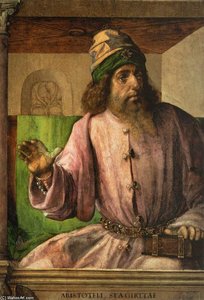
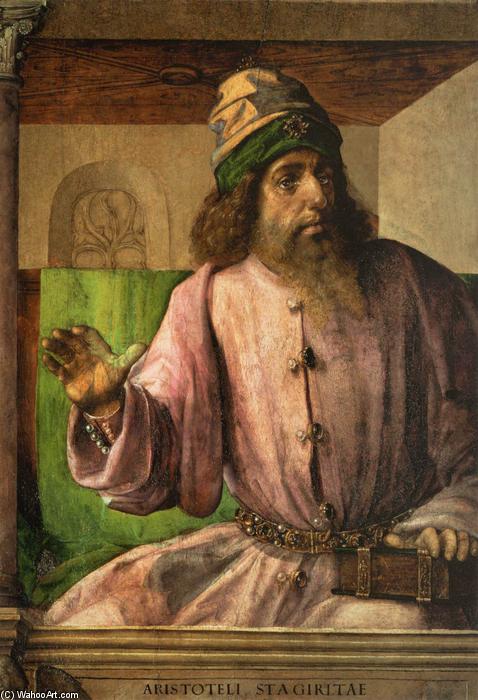
Joos Van Wassenhove (Giusto Da Guanto) was a Flemish painter who was active during the Renaissance period. He is known for his realistic and detailed style, which is evident in his depiction of Aristotle. The artist's use of color and composition creates a sense of depth and dimensionality, drawing the viewer into the scene.The Painting
The painting depicts Aristotle in a contemplative pose, lost in thought as he holds a book or manuscript. His facial expression is one of intense concentration, and his eyes seem to be gazing inward. The artist's attention to detail is evident in the intricate folds of Aristotle's robes and the delicate features of his face. Key Features:- The painting's use of color and composition creates a sense of depth and dimensionality.
- The artist's attention to detail is evident in the intricate folds of Aristotle's robes and the delicate features of his face.
- The painting is a remarkable example of Renaissance art, showcasing the artist's skill and technique.
The painting Aristotle by Joos Van Wassenhove (Giusto Da Guanto) is a masterpiece of Renaissance art that continues to inspire and awe audiences today. Its intricate details, beautiful composition, and historical significance make it a must-see for anyone interested in art and history.
Related Artworks






Artist Biography
The Flemish Master of Two Worlds
In the vibrant tapestry of the fifteenth century, few artists embodied the cultural bridge between Northern Europe and the Italian Peninsula as gracefully as Joos van Wassenhove, known to history by his more lyrical Italian moniker, Giusto da Guanto. Born in the industrious city of Ghent around 1430, this master emerged from the rich tradition of Early Netherlandish painting, a movement defined by its breathtaking devotion to microscopic detail and the luminous possibilities of oil media. While much of his early life remains shrouded in the mists of time, his artistic journey represents a profound dialogue between the meticulous realism of Flanders and the burgeoning humanism of the Italian Renaissance.
The foundations of his skill were likely laid in the workshops of his homeland, where the legacy of Jan van Eyck loomed large. It is widely believed that the seeds of his technical mastery—the ability to render the weight of heavy velvet, the glint of light on precious gems, and the profound psychological depth of a human gaze—were sown through this Northern training. This heritage provided him with a visual vocabulary of intense realism, yet as he traveled south to Italy, his style began to undergo a remarkable metamorphosis. Working under the prestigious patronage of figures such as Federico da Montefeltro, the Duke of Urbino, Giusto began to weave classical motifs into his Flemish framework, creating a unique aesthetic that resonated with the intellectual fervor of the age.
A Synthesis of Symbolism and Humanism
The true brilliance of Joos van Wassenhove lies in his ability to harmonize two seemingly disparate artistic philosophies. On one hand, he retained the Early Netherlandish penchant for symbolic complexity and a subdued, earthy palette that emphasized spiritual gravity. On the other, he embraced the Italian Renaissance fascination with classical antiquity and the dignity of man. This synthesis is nowhere more evident than in his portraits of great thinkers and religious compositions that breathe with a new, humanistic vitality.
His works often serve as windows into the intellectual landscape of the late fifteenth century. In his celebrated depictions of figures such as Aristotle, one can observe a masterful command of composition where the subject is not merely a likeness, but a vessel for philosophical contemplation. Through his brush, the heavy, textured drapery characteristic of Northern art meets a burgeoning sense of structural clarity and spatial awareness. This duality allowed him to create works that were simultaneously grounded in the tangible, material world and elevated by the lofty ideals of Greco-Roman thought.
Legacy of a Renaissance Voyager
Though his active period was relatively concentrated between 1460 and 1480, the impact of Giusto da Guanto’s itinerant career cannot be overstated. He was a true cosmopolitan of the art world, a painter who moved seamlessly between the courts of Flanders and the ducal palaces of Italy. His ability to adapt his Northern technique to suit the tastes of Italian patrons helped facilitate one of the most significant cultural exchanges in art history.
The enduring significance of his oeuvre can be summarized through several key contributions:
- Cultural Integration: He acted as a vital conduit, bringing the sophisticated oil techniques of the North to the Italian peninsula, enriching the local Renaissance tradition.
- Humanist Portraiture: His series of portraits featuring famous men helped establish a genre that celebrated individual intellect and classical virtue.
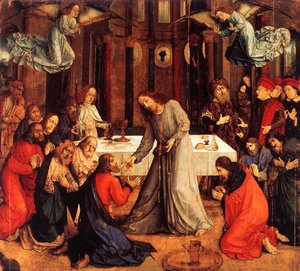
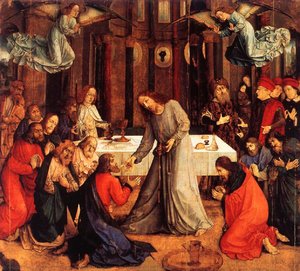
- Technical Mastery: His works, such as The Institution of the Eucharist, remain profound examples of how religious devotion can be expressed through exquisite material detail and symbolic depth.
Today, when we gaze upon his surviving panels in institutions like the Musée du Louvre, we see more than just relics of a bygone era; we witness the birth of a unified European aesthetic. Joos van Wassenhove remains a testament to the power of artistic migration, proving that when different traditions collide, the result is often a masterpiece of unparalleled enduring beauty.
joos van wassenhove (giusto da guanto)
1430 - 1480
Quick Facts
- Artistic Movement Or Style: Early Netherlandish
- Artists Or Movements Influenced By This Artist: ['Renaissance art']
- Artists Who Influenced This Artist:
- Rogier van der Weyden
- Hugo van der Goes
- Date Of Death: 1480
- Full Name: Joos van Wassenhove
- Nationality: Flemish
- Notable Artworks:
- The Institution of the Eucharist
- Aristotle painting
- Place Of Birth: Ghent, Belgium