Showing 8 artworks with Marc Chagall and with 1923 and with Dreamlike Painting
-
Marc Chagall
-
1923
-
Dreamlike Painting
Not available for this selection
- White
- Gray
- Putty
- Quinacridone Magenta
Not available for this selection
- Dreamlike Painting
- Marc Chagall
- Naïve Art
- Primitivism
- Symbolism
- Etching
- Jewish Folklore
- Jewish Art
- Surrealism
- Vitebsk
- Russian Art
- Naive Art
- Lithograph
- 20Th Century Art
- Russian Folklore
- Fine Art Reproduction
- Folklore
- Dead Souls
- Marc Chagall Etching
- Symbolic Art
- Texture
- Expressionism
- Gogol Adaptation
- Nozdryov And Tchitchikov
- Pastel Tones
- Chagall Artwork
- Symbolic Imagery
- Floral Patterns
- Guidance
- Portrait
- Gogol Illustration
- Illustration
- Horse Cart Illustration
- Still Life
- Decorative Etching
- Geometric Shapes
- Vintage Etching
- Black White Drawing
- Woman
- Vitebsk Artist
- Monochrome Gray
- Domestic Scene
- Black And White Printmaking
- Staircase Scene
- Bed Design
- Printmaking
- Dining Scene
- Conflict Illustration
- Wine Bottles
- Landscape Etching
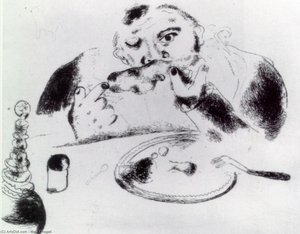
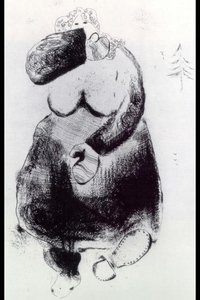
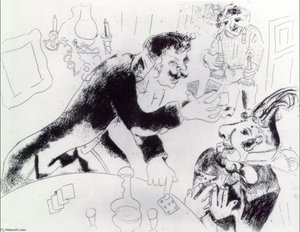
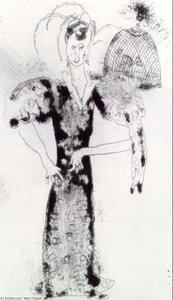
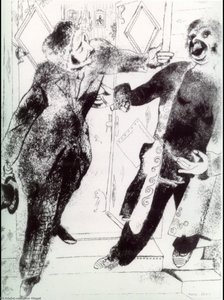
This etching, created around 1923 by Marc Chagall, exemplifies Naïve Art's distinctive aesthetic. Featuring two figures engaged in an altercation on a staircase before a doorway, it utilizes hatching and crosshatching to convey depth and texture. Reflecting Chagall’s fascination with Vitebsk’s cultural blend and Gogol’s ‘Dead Souls,’ the artwork embodies surrealism and dreamlike qualities.
Marc Chagall (1887-1985), born Moishe Shagal in Vitebsk, Belarus, developed a distinctive artistic style blending realism with dreamlike imagery. Influenced by Jewish tradition and Belarusian landscapes, he achieved international acclaim for his paintings, etchings, and stained glass windows—establishing himself as one of the most celebrated artists of the 20th century.
Marc Chagall’s “Nozdryov and Tchitchikov,” created in 1923, embodies Chagall’s distinctive blend of Expressionism and Cubism. This etching illustrates Gogol's novel “Dead Souls” with stylized figures and a dreamlike atmosphere achieved through hatching and crosshatching—a testament to Chagall’s artistic vision.