Showing 24 artworks out of 42 with Marcel Duchamp and with Dadaism

-
Marcel Duchamp
-
Dadaism
Not available for this selection
- Dadaism
- Conceptual Dadaism
- Mechanistic Cubism
- Dada Gesamtkunstwerk
- Conceptual Art
- Cubist Surrealism
- Dada And Beyond
- Dada And Surrealism
- Dadaism And Conceptual Art
- Dadaist Conceptualism
- Dadaist Surrealism
- Expressionism
- Minimalist Expressionism
- Post-Impressionism
- Replica (Ceramic)
- Surrealism
- Blainville-Sur-Mer
- Surrealist Style
- Contemporary Minimalism
- Cubist Avant-Garde
- Cubist Dada Surrealist
- Cubist Influence
- Dada Movement
- See all
- Putty
- White
- Espresso
- Black
- Driftwood
- Sap Green
- Walnut
- Gray
- Rosy Brown
- Bronze
- Phthalo Green
- Sea Green
- Brown
- Celadon
- Khaki
- Dadaism
- Marcel Duchamp
- Modern Art
- Conceptual Art
- Duchamp
- Surrealism
- Sculpture
- Avant-Garde Art
- Readymade
- Art History
- Minimalist Art
- Avant-Garde
- Contemporary Art
- Art
- Minimalism
- Geometric
- Provocative
- Minimalist
- Geometric Composition
- Black And White Photography
- Readymade Art
- Composition
- Geometric Abstraction
- Black And White
- 20Th Century Art
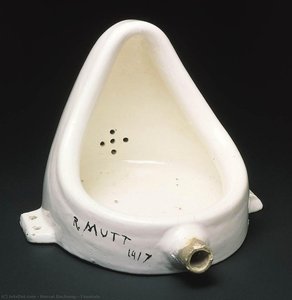
‘Fountain’ represents a radical departure from traditional artistic practices, emphasizing the artist's role as selector rather than creator. Its rejection by the Society of Independent Artists fueled debate about art’s boundaries and continues to inspire discussion.
Duchamp's work was profoundly influenced by Mechanistic Cubism, mirroring the movement's geometric forms and rejecting traditional aesthetics. It embodies Op Art principles, prioritizing visual illusion over realistic representation.
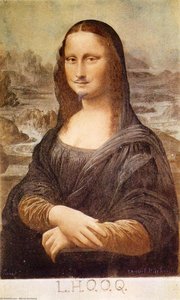
Marcel Duchamp's provocative L.H.O.O.Q. (1919) subverts the Mona Lisa with a mustache, challenging art conventions and embodying Dadaism’s rebellious spirit. Explore its history & legacy!
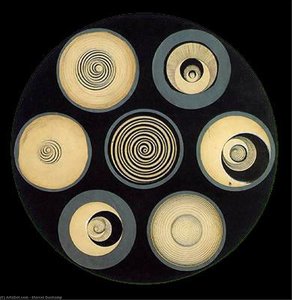
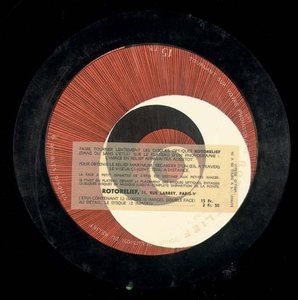
Explore Marcel Duchamp's 'Rotoreliefs (Optical Discs) 2,' a mesmerizing abstract work of geometric art and optical illusion. A pivotal piece in the evolution of modern art.
Marcel Duchamp's 'Water and Gas on All the Floor' challenges art conventions with its readymade form, reflecting Dadaism’s provocative spirit. Own a piece of modern art history – explore this iconic work.
This provocative monochromatic portrait of Marcel Duchamp as his female alter-ego Rrose Sélavy captures the playful ambiguity of Dadaism and invites you to discover this legendary piece of conceptual art.
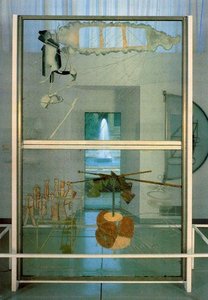
A monumental collage featuring photographs, drawings and notes documenting the creation of "The Bride Stripped Bare by Her Bachelors, Even," exploring themes of reproduction, gender roles and artistic process. Published in 1934, it embodies Dadaist principles.
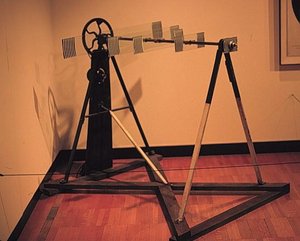
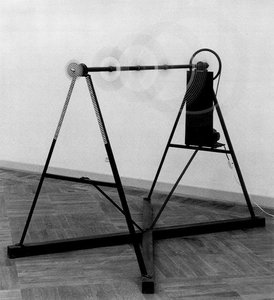
Marcel Duchamp’s "Rotary Demisphere" (1924) embodies Dadaism's rejection of artistic conventions through its assemblage of industrial materials—a rotating wheel atop a metal stand—challenging notions of beauty and craftsmanship.
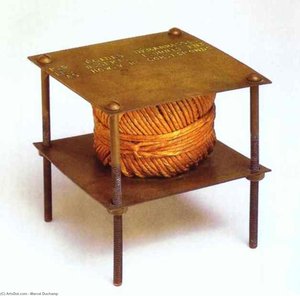
'With Hidden Noise' by Marcel Duchamp embodies the spirit of Dadaism, questioning art’s definition through a simple yet provocative assemblage. Created in 1916, it features brass plates and twine, highlighting Duchamp’s conceptual approach to art and its relationship with the viewer.
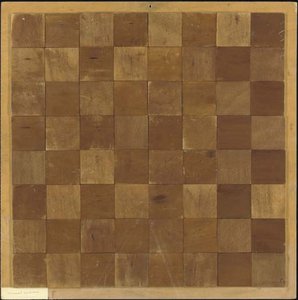
Explore 'Chessboard (Echiquier)' by Marcel Duchamp, a captivating work reflecting his fascination with logic, strategy, and the blurring lines between art and intellect.
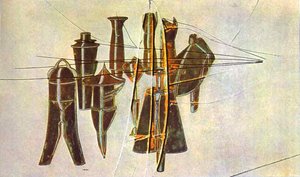
Explore Marcel Duchamp's 'Nine Malic Molds,' a Dadaist masterpiece challenging notions of art and industry. This oil painting, with its grid-like abstraction, invites contemplation on modern society’s mechanization.
Marcel Duchamp’s “Rotating Glass Plate” is a groundbreaking mechanical artwork that disrupts conventional notions of art. Constructed from glass, metal, and wood, it creates an illusion of movement through rotating discs and concentric circles. This piece embodies Dadaist principles and exemplifies Duchamp's exploration of perception and industrial processes.
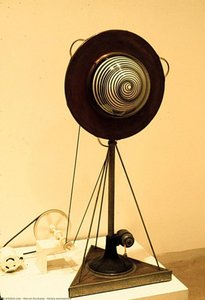
Explore Marcel Duchamp's 'Rotary Demisphere,' a mesmerizing kinetic sculpture from 1925. This unique work challenges perception through optical illusions and mechanical movement, embodying Dadaism’s revolutionary spirit.
This captivating painting by Marcel Duchamp explores themes of contemplation and time through juxtaposed sculptural elements – a glass case containing objects like a chair, bottle, and bowl – alongside an open umbrella drawing. Illuminated by natural light and framed by clocks, the composition invites viewers to consider art’s role in challenging perception.
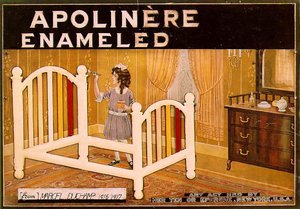
Marcel Duchamp’s serene ‘Apolinère,’ painted in 1916 during Dadaism's rebellious spirit, confronts tradition with minimalist enamel technique and elevates commonplace objects to artistic contemplation—a quiet masterpiece inviting discovery.
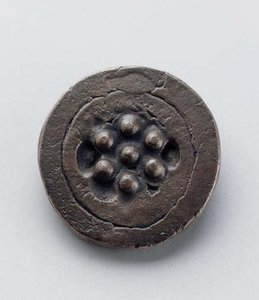
The artwork’s monochromatic gray hue emphasizes its textural qualities—the rough surface of aged metal—contrasting with the geometric simplicity of its form. Its inclusion in the Marcel Duchamp catalogue raisonné underscores its importance as a cornerstone of modern art.