Showing 4 artworks with Victor Vasarely and with Color Theory
-
Victor Vasarely
-
Color Theory
Not available for this selection
- Midnight Blue
- Rosy Brown
- Bronze
- Khaki
Not available for this selection

- Modern Art
- Hungarian Artist
- Victor Vasarely
- Kinetic Art
- Color Theory
- Op Art
- Abstract Painting
- Optical Illusion
- Geometric Abstraction
- Visual Perception
- Avant-Garde Art
- Bauhaus Influence
- Geometric Sculpture
- Bauhaus
- Spatial Harmony
- Reponses À Vasarely
- Surrealism
- Circles
- Chromatic Art
- Colorful Abstraction
- Art Deco Style
- Pastel Colors
- Abstract Expressionism
- Pattern Design
- Symmetry
- Sphere Pattern
- Zebra Print
- Circular Composition
- Visual Illusion
- Geometric Painting
- Contemporary Design
- Yellow Background
Victor Vasarely (1906-1997), born Károly Vaszary in Pécs, Croatia, revolutionized visual perception with his pioneering work in Op Art and kinetic art. Initially pursuing medicine at Eötvös Loránd University, he transitioned to painting in 1927 after encountering Sándor Bortnyik’s Bauhaus-influenced workshop – Műhely. This formative experience instilled him with the principles of functional design
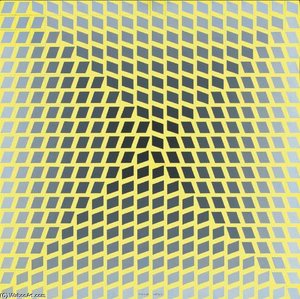
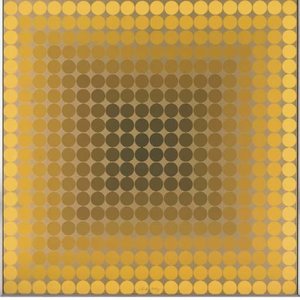
Victor Vasarely's 'Abstract Composition 22' is a striking example of Op Art, characterized by dynamic visual illusions achieved through geometric abstraction. The painting utilizes a bold yellow hue as its dominant color, punctuated by numerous circles arranged in varying sizes and positions—a testament to Vasarely’s pioneering approach to art and design. Founded in Aix en Provence, France, Fondat
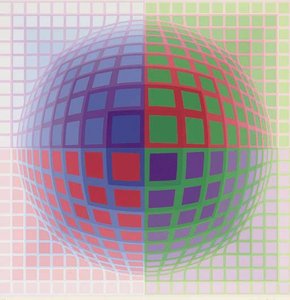
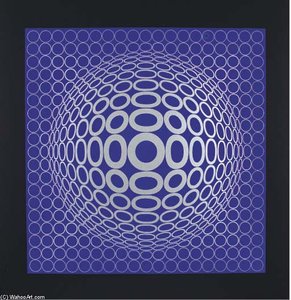
Victor Vasarely profoundly impacted modern art and design by establishing Op Art as a distinct artistic genre. His systematic approach to geometric abstraction—based on mathematical formulas—influenced subsequent artists and designers, shaping visual culture throughout the latter half of the 20th century. The artwork features a large sphere at its center surrounded by smaller spheres or circles,