Preview
 Send
Send Share
Share
 Details

 Download
 Similars
 X-Ray
X-Ray Diaporama
 Stats
StatsVedette
 Acrylic On Canvas
- WallArt
- Late Romanticism
 1865
1865 5.0 x 41.0 cm
 Wawel Royal Castle
 Read More
Hand Made Oil Reproduction
Hand-painted oil on canvas in your size and frame, made to order by our artists. ( Switch to Print Switch to Digital Image)




P118B $10

P118H $10

P118W $10

P438Z $10

P508JH $12

P508YH $12

P805H $10

P805Z $10

P919BZ $10

P919G $10

P919XJ $10

P959ZH $10

P968JZ $12

W106C $8

W218G $10

W218JH $8

W218Y $10

W307PJ $10

W316G $10

W316PJ $8

W316Y $10

W398PJ $8

W4111J $10

W500HY $15

W500JH $15

W692G $12

W849H $8

W940BG $15

W953PJ $8




Pick from our preset sizes that match the artwork's original proportions.

You may enter your own dimensions to fit a specific frame or space. If your selected size does not match the original image's proportions, we will either crop the artwork or extend the painting with additional hand-painted elements. A digital mockup will be sent for your approval before production begins.
Please note that the on-screen preview does not reflect the actual cropping or extension. Only the mockup will accurately show the final composition.
While custom sizes are available, we recommend selecting a dimension from the predefined list to preserve the original proportions.
After order, ArtsDot.com team will email client for instructions and provide a mockup preview
Worldwide Delivery () in 3/4 weeks instead of standard 5 weeks. (15 September). No compromise on quality.

Free Worldwide Express Shipping

High-Quality Linen Canvas

Full Shipping Insurance

Customs Tax Refund Guarantee

True Color Matching Guarantee

100-Day Return Policy (Defects Only)

100% Money-Back Guarantee

Bulk Discount Offer
 Glass option is only available in size under 110 CM

Vedette
Reproduction Medium
Reproduction Size
-


Total Price
$ 263
The Haunting Beauty of “Vedette” – A Portrait of Intensity
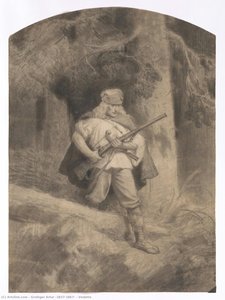
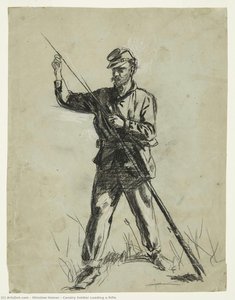
Artur Grottger’s “Vedette,” painted in 1865, is not merely a depiction of a man holding a firearm; it's a profoundly unsettling and intensely human portrait that speaks volumes about the anxieties and uncertainties of its time. Created during a period of immense political upheaval in Poland – a nation partitioned amongst empires – the painting transcends a simple narrative of armed vigilance to become a meditation on power, vulnerability, and the shadowed corners of the male psyche. Grottger, a Ukrainian artist working primarily in Vienna and Kraków, masterfully employed the techniques of crayon drawing, lending the image a remarkable level of detail and a subtly melancholic quality.
The subject himself is shrouded in ambiguity. He’s not a heroic figure charging into battle, but rather a man caught in a moment of quiet contemplation, his gaze fixed directly on the viewer with an unnerving directness. The rifle held loosely in his hand isn't brandished aggressively; it feels like an extension of his own being, a symbol of both protection and potential destruction. The background – a stark, almost oppressive wall – contributes to this sense of confinement and unease. Notice the subtle textures created by Grottger’s meticulous crayon strokes, particularly in the man's clothing and the rough surface of the wall, adding layers of tactile detail that draw us into the scene.
A Glimpse into a Troubled Era
To fully appreciate “Vedette,” it’s crucial to understand the historical context in which it was created. Poland was reeling from the failed January Uprising of 1863-64, a brutal suppression that left deep scars on the national psyche. Grottger, deeply affected by these events and driven by patriotic fervor, channeled his experiences into his art. The painting reflects this turbulent period – a sense of simmering tension, suppressed anger, and a profound awareness of mortality. The inclusion of the second figure in the background, partially obscured, hints at the presence of unseen forces and perhaps even the consequences of violence.
Interestingly, “Vedette” shares thematic resonances with the concept of the ‘vedette’ – a leading female performer in Parisian cabarets of the late 19th century. This figure, often depicted as alluring yet dangerous, embodied both glamour and vulnerability. Grottger's painting can be interpreted as an exploration of similar duality, mirroring the complex roles women played during this era—subjects of both admiration and suspicion.
Symbolism and Emotional Resonance
Beyond its historical context, “Vedette” is rich in symbolic meaning. The rifle itself represents not just military power but also the burden of responsibility and the potential for violence inherent within human nature. The man’s intense gaze suggests a deep introspection, perhaps even a sense of regret or foreboding. The muted color palette – dominated by browns, grays, and blacks – reinforces this atmosphere of somber reflection. The bird perched near the top left corner could symbolize hope amidst despair, or perhaps simply a reminder of fleeting beauty in a world marked by conflict.
The painting’s emotional impact is undeniably powerful. It doesn't offer easy answers or comforting resolutions; instead, it compels us to confront uncomfortable truths about human nature and the consequences of political turmoil. “Vedette” lingers in the mind long after viewing, prompting questions about power, vulnerability, and the enduring legacy of conflict.
A Reproduction Worth Admiring
Reproductions of "Vedette" capture a significant portion of its original impact, offering an accessible way to experience Grottger’s masterful artistry. ArtsDot offers high-quality reproductions in various sizes, allowing you to bring this evocative piece into your home or office. Consider the dimensions carefully – the painting's intimate scale invites close contemplation, while larger formats can create a dramatic focal point within a room. The meticulous detail of Grottger’s crayon drawing is particularly well-suited to digital reproduction, ensuring that the subtle textures and nuanced tones are faithfully preserved.
If you're seeking an artwork that transcends mere decoration and offers a profound reflection on human experience, “Vedette” by Artur Grottger is a compelling choice. It’s a hauntingly beautiful portrait of intensity—a testament to the artist’s skill and his ability to capture the complexities of a troubled era.
Related Artworks


Artist Biography
Early Life and Education
- Born: November 11, 1837, in Otynevychi, Ukraine
- Died: December 13, 1867, in Amélie-les-Bains, France
- His father, Jan Józef Grottger, was a Polish officer and amateur artist.
- Received initial drawing lessons from his father.
- Studied under Jan Kanty Maszkowski in Lviv (1849).
- Attended the School of Fine Arts in Kraków (1852-1854) with Wojciech Korneli Stattler and Władysław Łuszczkiewicz.
Career and Artistic Development
- Studied at the Academy of Fine Arts in Vienna (1854-1859) under Karl Blaas, Karl Mayer, Karl Wurzinger, Peter Geiger, and Christian Ruben.
- Worked as an illustrator for newspapers like Mussustunden and Illustrierte Zeitung in Vienna.
- Traveled extensively throughout Europe, including Munich, Venice, and Hungary, supported by Count Alexander von Pappenheim.
- Developed a distinctive style characterized by late Romanticism, influenced by Caspar David Friedrich.
- Created series of patriotic drawings depicting the January Uprising (1863) and its aftermath: Warszawa I (1861), Warszawa II (1862), Polonia (1863), and Lituania (1864-1866).
- Worked on the series *Wojna* (War) in 1866, intended for the International Exposition of 1867 in Paris.
Major Works and Artistic Significance
- Warszawa I & II: Depict scenes from the November Uprising and its consequences.
- Polonia: A powerful representation of Polish national identity and suffering.
- Lituania: Explores themes of Lithuanian history and culture within a Polish context.
- Wojna (War): A series of drawings examining the horrors and moral decay caused by war, intended for international exhibition.
- His works are considered foundational to Polish martyrological iconography, shaping national memory and aspirations.
Influences and Legacy
- Caspar David Friedrich: Influenced his romantic sensibility and use of landscape.
- Jan Maszkowski & Juliusz Kossak: Early mentors who provided foundational artistic training.
- Count Alexander von Pappenheim: A significant patron who supported Grottger's travels and career.
- His art significantly contributed to the development of Polish Romanticism.
- Grottger’s works are now housed in museums such as the Leopold Museum in Vienna, Austria.
- He remains a celebrated figure in Polish art history for his patriotic themes and artistic skill.
Personal Life and Later Years
- In 1866, he became engaged to Wanda Monné, who served as his muse.
- His deteriorating health led him to Pau, France, where he died in 1867 at the age of 30.
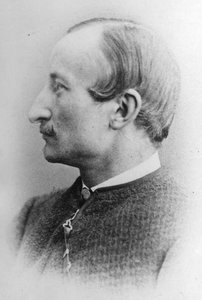
grottger artur (1837-1867)
1837 - 1867 , Ukraine
Quick Facts
- Artistic Movement Or Style: Late Romanticism
- Artists Who Influenced This Artist:
- Jan Kanty Maszkowski
- Hubert Robert
- Thomas Wyck
- Jan Miel
- Alexander Clarot
- Date Of Birth: 11 November 1837
- Date Of Death: 13 December 1867
- Full Name: Artur Grottger
- Nationality: Polish
- Notable Artworks:
- Dirck Hals: The Solo
- Warszawa I
- Warszawa II
- Polonia
- Lituania
- Place Of Birth: Ohtinivka, Ukraine
Related Articles

Monochrome Visions: Exploring the Aesthetic & Historical Significance of Black & White Photography
Explore the rich history & artistic power of black and white photography. From early techniques to iconic masters like Ansel Adams, discover why monochrome continues to captivate art lovers today. Expert insights for collectors.
Mars Black Masterpieces: 10 Iconic Paintings & Timeless Art Decor Ideas
Delve into the power of 'Mars Black' with 10 iconic paintings by masters like Rembrandt & Caravaggio. Explore dramatic chiaroscuro, gothic art, and timeless beauty. Find museum-quality reproductions & elevate your home decor on .

White on Canvas: 10 Masterpieces & Timeless Elegance for Your Home Decor
Explore 10 iconic white paintings by Monet, Whistler & Rothko! Discover the stories behind these serene masterpieces and their impact on art history. Find museum-quality reproductions for your home decor at .

Dark Masterpieces: 10 Iconic Paintings Dominated by Black Tones |
Explore 10 iconic paintings dominated by black tones, from Rembrandt’s chiaroscuro to Goya's dark expressions. Discover the stories behind these masterpieces & find museum-quality art reproductions for your home at .
The Subtleties of White: Exploring Absence, Light & Symbolism in Art History
Explore the profound symbolism & history of white in art! From ancient purity to modern abstraction, discover how artists have used absence & light. Expert insights from ArtsDot.