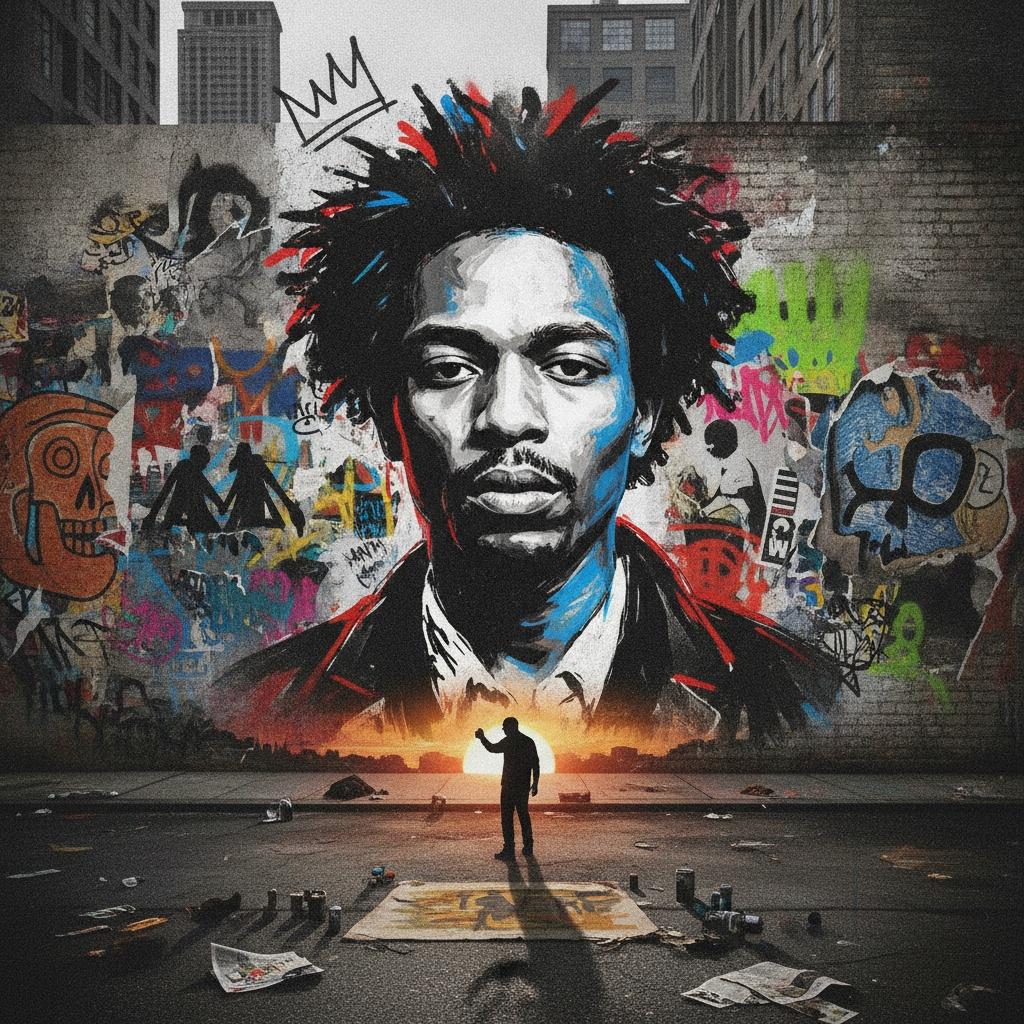
The Genesis of Chaos: From SAMO© Graffiti to the Streets of New York
 Basquiat and Raw Pop: The High-Energy Rebellion of Neo-Expressionism and the Legacy of Urban Street Art
The Genesis of Chaos: From SAMO© to the Streets of New York Basquiat & Raw Pop: The Unfiltered Energy of Neo-Expressionism and the Legacy of Urban Rebellion The Genesis of Chaos: From SAMO© to the Streets of New York Jean-Michel Basquiat: Deconstruct...
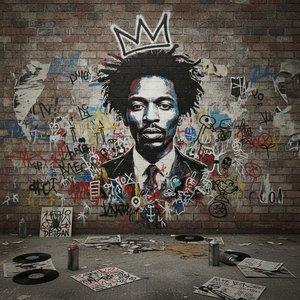
To truly understand the seismic shift that occurred in the late twentieth century, one must look past the polished, white-walled galleries and listen to the rhythmic, chaotic heartbeat of the city streets. Long before Jean-Michel Basquiat became a titan of the international art market, his voice was etched into the very skin of Manhattan. Emerging from the vibrant, often turbulent landscape of 1970s New York, Basquiat did not seek permission from the hallowed halls of academia; instead, he found his medium in the urban sprawl. Alongside Al Diaz, he operated under the enigmatic pseudonym SAMO©, a collaborative project that functioned less as traditional graffiti and more as a poetic intervention.
These were not mere tags or mindless scribbles; they were cryptic, thought-provoking epigrams scrawled across Lower Manhattan, designed to challenge societal norms and question established power structures. This early period was a crucible of creativity, where the energies of disco, punk, and the nascent hip-hop culture converged in a beautiful, messy collision. The streets provided a raw, unfiltered classroom where language, symbol, and social commentary could be tested in real-time. As the boundaries between high culture and street rebellion began to dissolve, Basquiat transitioned from the ephemeral nature of the wall to the permanence of the canvas, carrying with him the grit, the noise, and the unvarnished truth of a city in transition.
Decoding Neo-Expressionism: The Rebellion Against Minimalism
Neo-expressionism is a style of late modernist or early-postmodern painting and sculpture that emerged in the late 1970s. Neo-expressionists were sometimes called Transavantgarde, Junge Wilde or Neue Wilden ('The new wild ones'; 'New Fauves' would be...
As the 1970s gave way to the 1980s, the art world found itself at a crossroads. For years, the cool, detached intellectualism of Minimalism and Conceptual art had dominated the scene, favoring restraint, geometric precision, and emotional distance. However, a new wave of artists—the Neo-Expressionists—rose up to reject this formal austerity. They sought a return to the visceral, the subjective, and the intensely personal. This movement, often referred to as the New Wild Ones, embraced a rough handling of materials and an unapologetic display of raw emotion.
Basquiat became a central figure in this high-energy rebellion. His work embodied the core tenets of Neo-Expressionism: a rejection of formal restraint in favor of an embrace of emotional intensity. This style was characterized by intense subjectivity, where the artist's internal struggle and external observations were layered upon the canvas with aggressive, energetic brushstrokes. It was a movement that celebrated the "imperfect," finding profound beauty in the fragmented, the distorted, and the chaotic. By reintroducing recognizable objects—often in an abstract or deconstructed manner—these artists bridged the gap between the cerebral and the primal, creating a visual language that felt as alive and unpredictable as the urban environments from which they emerged.
A Visual Vocabulary: Symbols, Anatomy, and Urban Identity in Basquiat’s Work
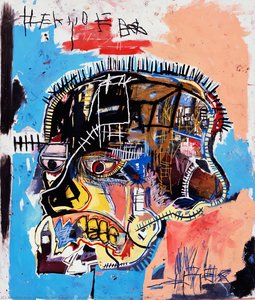 Untitled - Skull, (Broad Collection, LA)
A Haunting Vision of Mortality & Identity Jean-Michel Basquiat’s 1981 work is a visceral and emotionally charged exploration of the human condition, distilled through the powerful imagery of a fragmented skull. This painting, originating from the est...
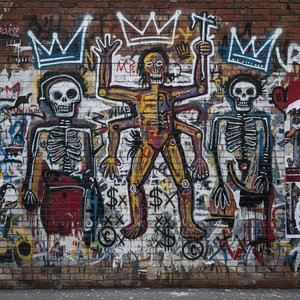
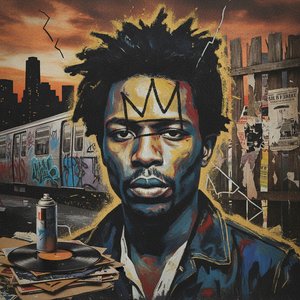
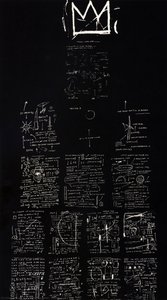
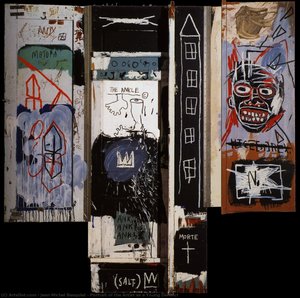
To gaze upon a Basquiat masterpiece is to enter a labyrinth of meaning. His work is far more than a collection of random marks; it is a meticulously constructed visual vocabulary. One cannot discuss his genius without mentioning the recurring motifs that haunt his canvases, most notably the crown. This symbol, appearing frequently, evokes notions of royalty and power, allowing Basquiat to explore themes of identity, achievement, and the reclamation of dignity within the Black community.
Interwoven with these symbols is a profound fascination with human anatomy. Influenced by a childhood encounter with Gray’s Anatomy, Basquiat often integrated skeletal structures, organs, and fragmented limbs into his compositions. This anatomical imagery serves as a visceral reminder of vulnerability and the weight of existence. In works like Untitled (1982), the depiction of a skull is not merely a memento mori; it is an interrogation of life itself. His canvases are often a dense layering of text fragments, geometric shapes, and organic forms—a deliberate attempt to capture the overwhelming influx of information that characterized urban life. Through this synthesis of poetry, drawing, and painting, Basquiat deconstructed identity and power, creating a legacy that remains as intellectually deep as it is visually striking.
The High-Energy Legacy: How Street Art Reshaped Modern Interior Aesthetics
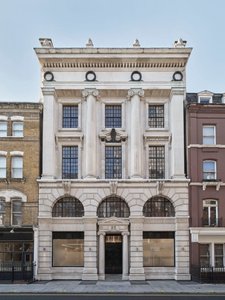 Global Street Art Foundation
A City Unveiled: Exploring the Global Street Art Foundation London pulses with a restless energy, an urban heartbeat that finds its most immediate expression not within hallowed halls, but splashed across the city’s very surfaces. The Global Street A...
The rebellion of the 1980s did more than change museum collections; it fundamentally altered our modern aesthetic sensibilities. The "Raw Pop" energy that Basquiat pioneered has trickled down into the very fabric of contemporary interior design. We see this in the move away from sterile, monochromatic minimalism toward spaces that embrace texture, bold contrasts, and narrative depth. The influence of street art has taught us to appreciate the beauty in the "unpolished"—to find luxury in the layered, the distressed, and the vibrant.
Today, the legacy of urban rebellion is visible in the way we use color and movement to define a room's character. The bold primary colors—red, blue, yellow, and black—that dominated Basquiat’s palette are now staples in modern decor, used to create focal points that command attention. The concept of "urban energy" has become a design goal, where the grit of the city is refined into sophisticated accents. This shift allows for a more democratic approach to beauty, where the spirit of a mural or a street-side stencil can be translated into a high-end, curated atmosphere that feels both worldly and deeply personal.
Bringing the Pulse Home: Curating Raw Energy in Your Living Space
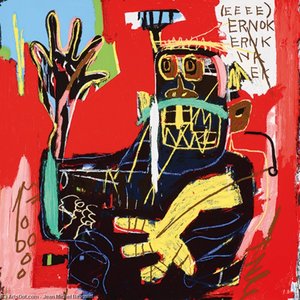 Untitled (ernok)
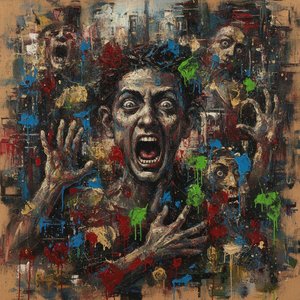
Vibrant Chaos: A Deep Dive into Basquiat's Untitled (ernok) The Essence of Urban Energy Jean-Michel Basquiat's "Untitled (ernok)" is a captivating exploration of urban energy and raw emotion. This abstract masterpiece, characterized by its bold color...
For the modern decorator, bringing this level of intensity into a home requires a delicate balance. You don't need to overwhelm a room with chaos; rather, you can use art to introduce "controlled energy." At ArtsDot.com, we believe that art should be an immersive experience, much like walking through a vibrant city gallery. Whether you are looking for a large-scale centerpiece or a multi-panel set to anchor a staircase, the key is to select pieces that resonate with your personal narrative.
Consider the impact of texture and depth. While mass-produced prints can feel flat, a Handmade Oil Reproduction offers the tactile soul that Neo-Expressionism demands. The visible brushstrokes and the impasto technique create a three-dimensional quality that catches the light and invites contemplation. You might choose to "remix" history by commissioning a custom piece that blends your own memories with the expressive style of Basquiat, or perhaps use our AI Masterpiece Transformation tool to reimagine a personal photo through a Pop Art lens.
By selecting works that celebrate bold colors and intricate details, you can create a home that feels alive. From the heavy, textured strokes of an oil painting on cotton canvas to the sophisticated arrangement of multi-panel layouts, your space becomes a living gallery—a testament to the enduring power of the street's raw, beautiful energy.