Introduction
To step into the presence of religious art is to enter a dialogue with the infinite. For centuries, the canvas and the stone have served as the primary vessels for humanity's most profound questions, capturing the whispers of the divine and the weight of mortal devotion. These works are more than mere decorations; they are windows into the soul of civilization, where light meets shadow to illustrate the struggle between the earthly and the eternal.
Throughout history, religious art has acted as a universal language, transcending linguistic barriers to communicate complex theological narratives and spiritual ecstasy. From the gold-leafed icons of the Byzantine era that shimmered in candlelight to the dramatic, tension-filled compositions of the Baroque period, artists have utilized every tool at their disposal—pigment, texture, and scale—to make the invisible visible. These masterpieces were often commissioned by the highest powers of the church and state, yet they resonate with a deeply personal, human vulnerability that speaks to anyone who has ever sought meaning in the face of mystery.
Today, these artworks remain profoundly impactful, not merely as historical artifacts, but as emotional touchstones. Even in a secular age, the mastery of light in a Renaissance altarpiece or the raw, visceral emotion in a sculptural relief continues to stir the human spirit, evoking awe and contemplation. They remind us of our shared heritage and the enduring power of storytelling through imagery.
In the following selection, we invite you to walk through a curated gallery of transcendence. We will explore ten seminal works that define the genre—each one a testament to the artist's ability to capture the sacred, offering a journey through color, composition, and the timeless pursuit of the divine.
The Calling of Saint Matthew - Caravaggio
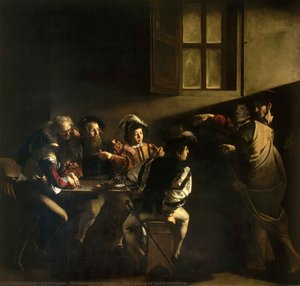 The Calling of Saint Matthew - Caravaggio
In Caravaggio’s 1599 masterpiece, The Calling of Saint Matthew , the divine does not descend in a cloud of glory, but pierces through the mundane via a sharp, cinematic beam of light. This pivotal work of religious art redefines the Baroque era through the mastery of tenebrism —a dramatic interplay of shadow and illumination that captures the exact second Levi, a tax collector, is summoned to a higher calling. The palette is grounded in earthy browns, deep blacks, and muted ochres, making the spiritual encounter feel startlingly human and immediate.
As you observe the figures clustered around the table, notice how Christ’s outstretched hand echoes the grace of Michelangelo, while Matthew’s bewildered gesture invites us into his moment of doubt and transformation. Owning a reproduction of this caliber is more than a decorative choice; it is an inheritance of a profound lineage of taste. Through the textures of heavy fabrics and the stark contrast of light against darkness, Caravaggio brings the sacred into the contemporary space, allowing the weight of history to reside on your own walls.
The Last Supper - Leonardo da Vinci
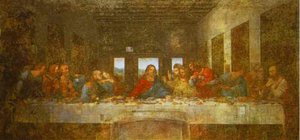 The Last Supper - Leonardo da Vinci
In Leonardo da Vinci’s The Last Supper , the lines of the Renaissance aren’t merely drawn; they are choreographed . This is not a static composition of a biblical event, but a dance frozen in time . As Jesus announces the impending betrayal, the apostles react in waves of shock, denial, and grief, yet Leonardo uses one-point perspective to pull this chaotic human emotion into a state of perfect geometric harmony.
The palette is a somber, contemplative arrangement of muted ochres, deep earths, and soft shadows, all illuminated by a diffused light that seems to emanate from the very architecture itself. Every gesture—from Judas recoiling in the shadows to the calm, central stability of Christ—serves the theme of divine sacrifice amidst human fallibility. This masterpiece stands as a pillar of religious art because it captures the tension between the mortal and the eternal. What if your own space could hold that same profound balance? What if your walls could breathe rhythm and invite such deep, historical resonance into your daily environment?
Assumption of the Virgin - Titian
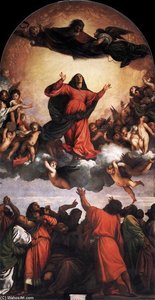 Assumption of the Virgin - Titian
Titian’s Assumption of the Virgin stands as a monumental pillar in our exploration of religious art, representing a pivotal moment where High Renaissance theology meets raw, cinematic emotion. This masterpiece does more than depict a doctrine; it captures the very moment of transcendence. Through his legendary mastery of colorito , Titian utilizes a breathtaking palette of crimson and gold to guide the eye from the earthly awe of the apostles upward into a celestial explosion of light.
Its placement among the greatest religious works is earned through its sheer scale and technical innovation, moving away from static icons toward a dynamic, swirling narrative that feels alive. The painting invites us to contemplate the boundary between the mortal and the divine, using textured brushstrokes and luminous gradations to bridge that gap. For the modern collector or decorator, integrating such a profound work—whether through a large-scale reproduction or a curated multi-panel set—brings a sense of historical prestige and spiritual depth, creating a timeless conversation between classical devotion and contemporary architectural elegance.
The Transfiguration - Raphael
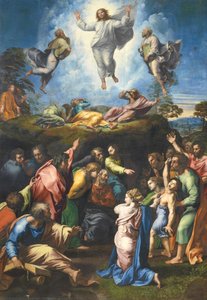 The Transfiguration - Raphael
Imagine standing in the dim, hallowed quiet of a Roman chapel, where the air feels heavy with anticipation, just before a sudden, blinding light breaks the darkness. This is the emotional threshold of Raphael’s The Transfiguration . In this monumental masterpiece, the boundary between the earthly and the divine dissolves. The composition pulls your gaze upward, following the radiant, luminous figure of Christ as he ascends, flanked by the prophetic presence of Moses and Elijah. Below this celestial brilliance, a starkly different reality unfolds: a scene of human struggle, shadows, and the desperate plea for healing.
This work earns its place among the greatest religious art ever created because it captures the profound tension of the human condition—the coexistence of suffering and salvation. Raphael’s masterful use of chiaroscuro does more than just illuminate a biblical event; it creates a spiritual bridge. Bringing such a powerful exploration of light and shadow into a modern space allows one to invite a sense of transcendence and contemplative depth into the everyday, turning a room into a sanctuary of meaning.
Christ Among the Doctors - Albrecht Dürer
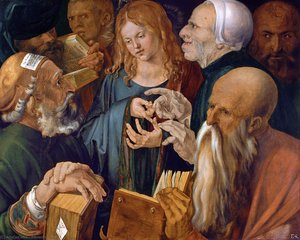 Christ Among the Doctors - Albrecht Dürer
In Albrecht Dürer’s 1506 masterpiece, Christ Among the Doctors , light does not merely illuminate a scene; it acts as a divine narrator. As you stand before this profound piece of religious art, notice how the light is composed like a silent sonata, carving deep shadows into the weathered faces of the scholars to highlight the radiant, youthful wisdom of the young Christ. Dürer uses a warm, earthy palette of ochres and deep reds to create an atmosphere of intense, intellectual intimacy.
The painting captures a pivotal theological dialogue, where the texture of aged skin and heavy drapery contrasts sharply with the luminous presence of the boy. Every meticulous brushstroke serves to bridge the gap between human experience and divine truth. This work is essential to our collection because it doesn't just depict a historical moment; it invents a spiritual atmosphere that breathes life into the canvas. To bring this level of contemplative depth into your own space is to invite a portal of inspiration, where the interplay of shadow and light turns a simple wall into a window toward the sublime.
Crucifix - Cimabue
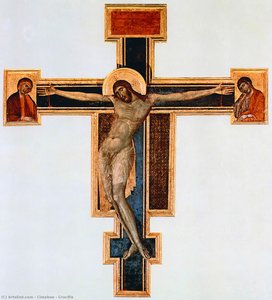 Crucifix - Cimabue
To stand before Cimabue’s Crucifix is to witness the precise moment where the rigid traditions of the Byzantine era began to breathe with human emotion. Created around 1287, this monumental work does not merely depict a religious event; it captures the heavy, visceral transition from flat iconography to the dawn of Renaissance realism. The deep blues, rich golds, and somber reds create a sacred atmosphere, while the subtle modeling of Christ’s form introduces a sense of weight and anatomical presence that was revolutionary for its time.
Its inclusion in our selection of the top religious artworks is essential because it redefined how light and sorrow could be rendered on a wooden panel. The figures of the mourners bring a profound, human grief to the composition, inviting the viewer into a state of contemplation. At ArtsDot.com, we believe such transformative power should not be confined to cathedrals. By offering high-quality, hand-painted reproductions, we allow you to integrate this historical gravity into your own professional or personal sanctuary, turning a corporate space or a private study into a gallery of profound spiritual and artistic depth.
Yellow Christ - Eugène Henri Paul Gauguin
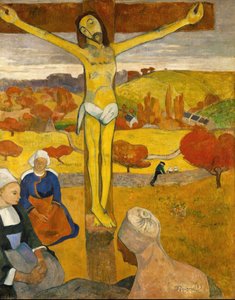 Yellow Christ - Eugène Henri Paul Gauguin
Paul Gauguin’s Yellow Christ stands as a profound pillar in our exploration of religious art, marking a radical departure from the polished, reverent iconography of the past. Created in 1889, this masterpiece moves beyond mere depiction to capture a raw, spiritual questioning. Through his signature Synthetist style, Gauguin utilizes bold, flattened planes of ochre and deep blues, stripping away naturalistic detail to reveal an emotional truth that feels strikingly modern.
The painting earns its place in this collection through its sheer transformative power; it does not just show a crucifixion, but invites us into a dreamlike state of contemplation. The heavy, expressive outlines and the unsettling, yellowish hue of Christ’s form challenge our perceptions of suffering and divinity. For the modern collector or designer, the work offers more than historical significance—it provides a soulful, textured focal point. Its ability to blend primitive strength with symbolic depth makes it an ideal centerpiece for curated spaces seeking to spark a timeless conversation between sacred history and contemporary aesthetic elegance.
The Ghent Altarpiece - Jan van Eyck
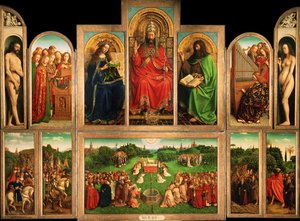 The Ghent Altarpiece - Jan van Eyck
Owning The Ghent Altarpiece by Jan van Eyck isn’t a mere purchase; it is an inheritance of the sublime. As a cornerstone of religious art, this 1432 masterpiece serves as a profound handshake across centuries, bridging the gap between Medieval devotion and Renaissance realism. When viewing this polyptych, one does not simply see paint on wood; one witnesses a lineage of taste defined by Jan van Eyck’s revolutionary mastery of oil glazes.
The work unfolds in a breathtaking tapestry of light and symbolism. The central Adoration of the Mystic Lamb radiates with an ethereal glow, where translucent layers of pigment create textures so vivid—from heavy brocades to soft, human skin—that the sacred feels tangibly present. Every meticulously rendered detail, from the divine figures in the upper register to the earthly congregation below, invites a deep, meditative connection. At ArtsDot.com, we believe this legacy shouldn't be confined to cathedrals. We bring this monumental achievement to your walls, allowing you to host a piece of history where every glance is a nod to the masters.
Annunciation - Leonardo da Vinci
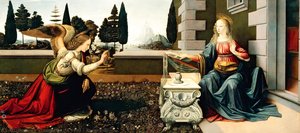 Annunciation - Leonardo da Vinci
In Leonardo da Vinci's Annunciation , the lines are not merely drawn; they are choreographed . This is not a static composition of a biblical event, but a dance frozen in time , where the celestial movement of the Angel Gabriel meets the grounded, meditative stillness of the Virgin Mary. As one of the most profound examples of religious art, it achieves a rare equilibrium between the divine and the earthly.
The scene unfolds within a lush, atmospheric landscape, utilizing Leonardo's signature sfumato to create soft, smoky transitions that make the air itself feel sacred. Deep blues and rich reds define the figures, while the delicate Madonna lily serves as a silent symbol of purity. The architectural loggia provides a structured rhythm, leading the eye toward a distant, hazy horizon. For those seeking to bring this sense of divine serenity into a professional or residential space, this masterpiece demonstrates how art can breathe rhythm into a room, transforming a wall into a window of profound spiritual harmony and technical brilliance.
Scenes from the Passion of Christ (left side) - memling, hans
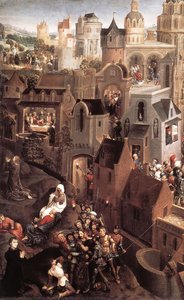 Scenes from the Passion of Christ (left side) - memling, hans
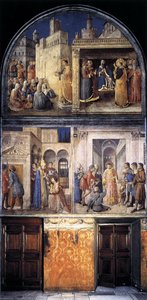
In Scenes from the Passion of Christ (left side) by Hans Memling, the structural harmony of the Northern Renaissance is on full display. The composition is a masterclass in geometric balance, where the sharp, vertical lines of medieval architecture intersect with the organic, flowing drapery of the gathered figures. This intricate layering of shapes creates a profound sense of depth, guiding the eye through a densely populated urban landscape that feels both monumental and intimate.
The artwork’s internal equilibrium—a careful calibration of heavy architectural masses against the delicate, rhythmic movement of the procession—offers a timeless perfection. For the modern collector or decorator, this balance mirrors the principles of contemporary minimalist design; the way Memling uses a grounded, earthy palette of ochre and deep reds to anchor a complex narrative provides a sophisticated focal point that can ground a clean, modern aesthetic. As one of the most significant works in religious art, it captures the emotional gravity of the Passion through a lens of mathematical precision and spiritual devotion.
Conclusion
As we draw the curtain on this journey through sacred imagery, we are reminded that these masterpieces are far more than mere relics of a bygone era or static subjects in a museum gallery. They are living presences, breathing through every layer of pigment and every deliberate stroke of the brush. The profound emotions captured within these works—the quiet reverence of a saint, the dramatic tension of a martyrdom, or the ethereal glow of divine light—transcend the boundaries of time and theology to touch the universal essence of the human spirit.
To stand before such art is to participate in a timeless conversation that has spanned centuries, connecting the hands of long-departed masters with the eyes of modern admirers. These paintings continue to shape our interiors and inspire our creativity, offering a window into the eternal even amidst the noise of the contemporary world. They remind us that beauty, in its most sacred form, remains an anchor for the soul.
We invite you to continue your exploration of these transcendent themes and discover how these historical echoes can find a place within your own space by browsing our full collection . May the light of these great works continue to illuminate your path and inspire wonder in your daily life.