The Enigmatic Life of Mikalojus Konstantinas Čiurlionis: A Pioneer Bridging Art and Music
 Wikipedia: Mikalojus Konstantinas Čiurlionis
Mikalojus Konstantinas Čiurlionis (Polish: Mikołaj Konstanty Czurlanis; 22 September [O.S. 10 September] 1875 – 10 April [O.S. 28 March] 1911) was a Lithuanian composer, painter, choirmaster, cultural figure, and writer in Polish. Čiurlionis contribu...
Mikalojus Konstantinas Čiurlionis (1875-1911) remains a figure shrouded in both brilliance and tragedy. Born into a Poland-speaking Lithuanian family during a period of intense cultural awakening, his short life was one of extraordinary creative output across seemingly disparate disciplines – music and painting. To categorize him solely as either composer or artist feels profoundly inadequate; Čiurlionis wasn’t simply *both*, he embodied a synthesis of the two, translating sonic experiences into visual form and vice versa with an unprecedented sensitivity. His upbringing in Druskininkai, Lithuania, steeped in both Polish romanticism and burgeoning Lithuanian nationalism, laid the foundation for his unique artistic vision. Early musical prodigy quickly blossomed into a formal education at the Warsaw Institute of Music, yet it was during this time that painting began to emerge as an equally compelling force. This wasn’t merely a hobby; it was a parallel exploration, a different language to express the same deeply felt emotions and spiritual yearnings.
Čiurlionis's life was marked by a relentless pursuit of artistic truth, fueled by a profound sense of melancholy and an awareness of his own mortality. He wasn’t content with simply replicating reality; he sought to capture its essence, its underlying emotional architecture. This quest led him down paths that would ultimately position him as one of the pioneers of abstract art in Europe, decades before the movement gained widespread recognition. His dedication to both artistic fields—composing around 400 pieces and creating approximately 300 paintings—is a testament to his unwavering commitment and singular talent.
From Symbolism to Abstraction: Tracing the Evolution of Čiurlionis’s Visual Language
Modernism was an early 20th-century movement in literature, visual arts, performing arts, and music that emphasized experimentation, abstraction, and subjective experience. Philosophy, politics, architecture, and social issues were all aspects of thi...
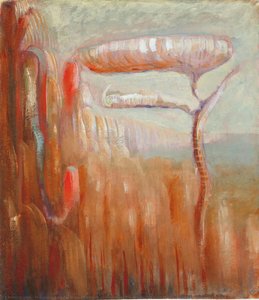
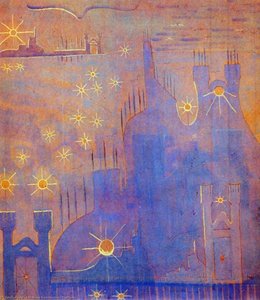
Čiurlionis's early work is firmly rooted in the Symbolist movement, characterized by its emphasis on subjective experience, dreamlike imagery, and a rejection of naturalistic representation. Paintings like those from his “Lithuanian Folk Life” series demonstrate this influence, depicting scenes imbued with a sense of nostalgia and spiritual longing. However, Čiurlionis quickly moved beyond mere imitation of Symbolist tropes. He began to experiment with form and color, gradually stripping away representational elements in favor of pure abstraction. This wasn’t an abrupt shift but rather a gradual evolution driven by his desire to express increasingly complex emotional states.
The influence of Art Nouveau is also palpable in his work, particularly in the flowing lines and decorative motifs that adorn many of his paintings. But even here, Čiurlionis infused his own unique sensibility, imbuing these forms with a sense of cosmic weight and spiritual significance. His use of color was particularly innovative; he employed vibrant hues not to depict realistic scenes but to evoke specific moods and emotions. As he progressed, the figures became less defined, dissolving into swirling patterns and abstract shapes—a visual equivalent of his increasingly complex musical compositions.
Sonic Palettes in Painted Form: The Interplay Between Čiurlionis's Compositions and Paintings
The true genius of Čiurlionis lies in the profound connection between his music and painting. He didn’t simply illustrate his compositions visually; he *translated* them into painted form, capturing their emotional essence and structural complexity on canvas. His series of paintings titled “Funeral Symphony” is perhaps the most striking example of this interplay. Each movement of the symphony corresponds to a distinct painting, creating a synesthetic experience for the viewer—a sense of hearing colors and seeing sounds.
Consider how he used color to represent musical keys or harmonies. Brighter, more saturated hues often corresponded to major chords and uplifting melodies, while darker, muted tones reflected minor keys and somber themes. The geometric forms in his paintings can be seen as visual representations of musical structures—the repetition of motifs mirroring melodic phrases, the interplay of lines reflecting harmonic progressions. This wasn’t a conscious attempt to create a one-to-one correspondence between music and painting; it was an intuitive process driven by his deep understanding of both art forms.
The 'Creation of the World' Series: A Deep Dive into Cosmic Themes and Spiritual Exploration
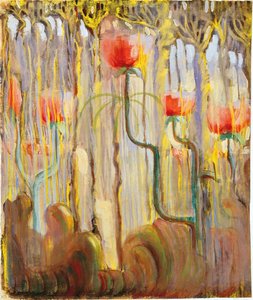
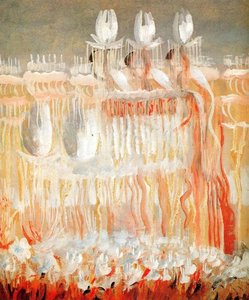 Creation of the World VIII
Discover "Creation of the World VIII" by Mikalojus Konstantinas Čiurlionis! A surreal oil painting blending abstract expressionism & symbolism. Dreamy landscapes, impasto texture, & a unique Lithuanian art piece.
Perhaps Čiurlionis’s most ambitious and profound work is the “Creation of the World” series. This cycle of paintings attempts to depict the entire cosmic process, from the initial void to the emergence of life and consciousness. The paintings are not literal representations of biblical creation stories but rather abstract explorations of fundamental spiritual themes—the birth of the universe, the struggle between order and chaos, the search for meaning in a vast and indifferent cosmos.
Creation of the World VIII, with its swirling nebulae and ethereal light, exemplifies this approach. The impasto texture adds to the sense of dynamism and energy, evoking the raw power of creation. The painting isn’t simply *about* the creation of the world; it *is* a creation—a visual manifestation of Čiurlionis's own spiritual journey. He employs a unique blend of abstract expressionism and symbolism, creating dreamlike landscapes that resonate with a sense of cosmic awe. The series as a whole is a testament to his belief in the power of art to transcend the limitations of language and express the deepest mysteries of existence.
Funeral Symphony as Emotional Landscape: Exploring Grief, Loss, and Transcendence
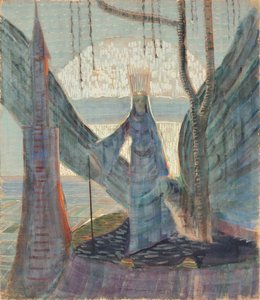
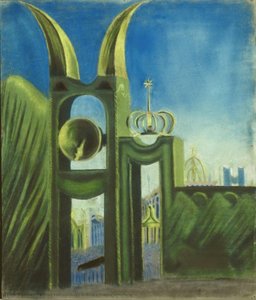 Funeral Symphony (I)
Explore Mikalojus Ciurlionis’ ‘Funeral Symphony (I)’ – a surreal Expressionist cityscape in oil paint. Discover its geometric forms, muted palette & unsettling atmosphere.
The “Funeral Symphony” stands as a poignant reflection on mortality and loss. Composed during a period of personal hardship—the declining health of his fiancée—the symphony is imbued with a sense of profound grief and existential angst. The corresponding paintings are equally haunting, depicting desolate landscapes and fragmented figures that evoke a feeling of isolation and despair.
However, the “Funeral Symphony” isn’t simply an expression of sorrow; it's also a meditation on transcendence. Through his use of muted colors and geometric forms, Čiurlionis creates a sense of unsettling atmosphere, but within this darkness lies a glimmer of hope—a suggestion that even in the face of death, there is beauty and meaning to be found. The paintings are not merely representations of grief; they *are* emotional landscapes—visual embodiments of the complex feelings associated with loss and the search for solace.
Čiurlionis’s Legacy and Influence: A Forefather of Modern Lithuanian Art
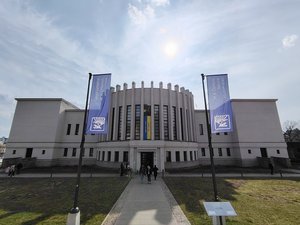 Musée national Mikalojaus Konstantino Čiurlionio d'art
Discover the M. K. Čiurlionis National Art Museum in Kaunas, Lithuania! Explore the mesmerizing world of painter & composer M.K. Čiurlionis – a pioneer of abstract art – alongside Lithuanian folk art and diverse collections across 10 branches.
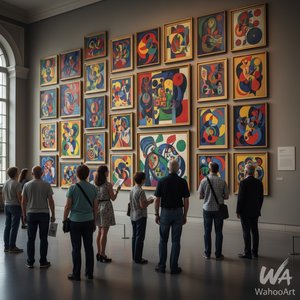
Despite his tragically short life, Mikalojus Konstantinas Čiurlionis left an indelible mark on Lithuanian culture and the broader landscape of modern art. His pioneering work in abstraction paved the way for future generations of artists, inspiring countless others to explore the expressive possibilities of form and color. The M. K. Čiurlionis National Art Museum in Kaunas, Lithuania, houses the largest collection of his paintings, offering visitors a unique opportunity to immerse themselves in his world.
Čiurlionis’s influence extends beyond the realm of visual art; his compositions continue to be performed and celebrated today. He remains a symbol of Lithuanian national identity—a testament to the power of art to transcend political boundaries and connect people across cultures. His legacy is not simply as a painter or composer, but as a visionary artist who dared to explore the deepest mysteries of existence, bridging the gap between sound and sight in a way that continues to captivate and inspire.
Discover the timeless beauty and profound emotional depth of Mikalojus Konstantinas Čiurlionis’s work at ArtsDot.com, where museum-quality reproductions bring his masterpieces into your home.