Early Life & Influences: From St. Thomas to Parisian Beginnings
Jacob Abraham Camille Pissarro’s story is one of remarkable resilience and artistic evolution, beginning far removed from the hallowed halls of Parisian art schools. Born in 1830 on the Caribbean island of St. Thomas – then a Danish colony – his early life was steeped in a vibrant, multicultural world, yet marked by a sense of displacement. His father, a Portuguese Sephardic Jew and merchant, instilled a practical sensibility, while his mother’s Creole heritage offered a connection to the island's diverse landscape and people. This unique upbringing would later inform Pissarro’s commitment to depicting everyday life with honesty and empathy.
Despite his father’s expectations for him to follow a commercial path, young Camille demonstrated an early aptitude for drawing, sketching incessantly during moments of respite from his duties. A pivotal moment arrived with the arrival of Fritz Melbye, a Danish artist who recognized Pissarro's talent and became his first mentor. Melbye encouraged him to pursue painting professionally, leading to a period in Venezuela where Pissarro honed his skills capturing the South American light and scenery. However, it was his eventual relocation to Paris in 1855 that truly set the stage for his artistic awakening.
Paris proved initially challenging. Pissarro studied at both the Académie Suisse and the École des Beaux-Arts, absorbing traditional techniques but finding himself increasingly drawn to the work of Gustave Courbet and Jean-Baptiste-Camille Corot. Corot’s influence was particularly profound; Pissarro considered him a key teacher, adopting his approach to landscape painting – a focus on direct observation and a sensitive rendering of atmospheric effects. These early influences laid the foundation for Pissarro's distinctive style, characterized by its realism and poetic sensibility.
The Birth of Impressionism: Pissarro's Role in a Revolutionary Movement
Impressionism was a 19th-century art movement characterized by visible brush strokes, open composition, emphasis on accurate depiction of light in its changing qualities (often accentuating the effects of the passage of time), ordinary subject matter...
By the 1860s, Paris was undergoing a dramatic transformation, and Pissarro found himself at the heart of a burgeoning artistic rebellion. He befriended artists like Claude Monet, Pierre-Auguste Renoir, and Alfred Sisley, all seeking to break away from the rigid conventions of the Salon system. Together, they began painting *en plein air* – outdoors – capturing fleeting moments of light and color with unprecedented immediacy.
Pissarro was instrumental in organizing the first Impressionist exhibition in 1874, a watershed moment that shocked and scandalized the art world. The term “Impressionism,” initially intended as a derogatory label coined by critic Louis Leroy after viewing Monet’s *Impression, soleil levant*, ironically became the name of this groundbreaking movement. Pissarro's own contributions to these early exhibitions were crucial; he was the only artist to exhibit at all eight Impressionist shows, acting as a stabilizing force and encouraging his colleagues through periods of doubt and rejection.
His commitment wasn’t merely stylistic. Pissarro believed in portraying modern life – the bustling streets of Paris, the quiet dignity of rural laborers – with authenticity and without artifice. He rejected idealized depictions, instead focusing on the everyday realities of the world around him. This dedication to representing the “common man” resonated deeply within the group and helped define the core principles of Impressionism.
A Master of Technique: Pointillism, Landscapes, and Urban Scenes
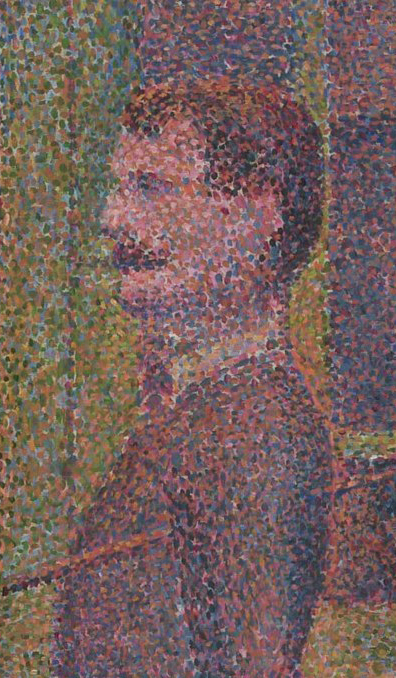 Wikipedia: Pointillism
Pointillism (, also US: ) is a technique of painting in which small, distinct dots of color are applied in patterns to form an image. Georges Seurat and Paul Signac developed the technique in 1886, branching from Impressionism. The term "Pointillism...
While firmly rooted in Impressionism, Pissarro was never afraid to experiment with new approaches. In 1886, he encountered Georges Seurat and Paul Signac, pioneers of a technique known as Pointillism – or Divisionism. Intrigued by their scientific approach to color theory, Pissarro briefly adopted this method, meticulously applying small, distinct dots of pure color to his canvases.
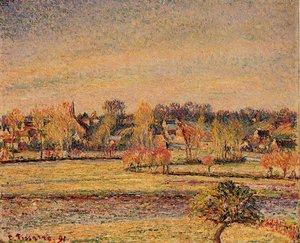
Although he eventually moved away from strict Pointillism, the influence is evident in works like *Meadows at Eragny*, where delicate touches of color create a shimmering effect. Throughout his career, Pissarro’s landscapes remained central to his artistic practice. He found inspiration in the countryside around Pontoise and later in Eragny, capturing the changing seasons and the subtle nuances of light with remarkable sensitivity.
Urban scenes also held a special appeal for Pissarro. He depicted the boulevards of Paris, the bustling markets, and the quiet corners of Montmartre with equal attention to detail. His paintings offer a fascinating glimpse into 19th-century Parisian life, capturing both its energy and its social complexities.
Pissarro as Mentor: Guiding Cézanne, Gauguin & Van Gogh
Beyond his own artistic achievements, Camille Pissarro was revered as a mentor to many of the great Post-Impressionist painters. Paul Cézanne famously called him “a father for me,” seeking his guidance and counsel throughout his career. Pissarro’s wisdom, kindness, and balanced perspective made him a trusted confidant and source of inspiration.
He also played a crucial role in introducing Paul Gauguin to the Impressionist circle, encouraging his artistic development and providing support during challenging times. Perhaps most notably, Pissarro welcomed Vincent van Gogh into his studio in 1887, offering him not only technical advice but also emotional encouragement. Their intense collaboration, though brief, proved formative for both artists.
John Rewald, a leading art historian, aptly described Pissarro as the “dean of the Impressionist painters,” recognizing his pivotal role in fostering artistic innovation and nurturing the talents of future generations. His generosity and unwavering belief in his colleagues cemented his legacy not only as a painter but also as a guiding force within the modern art movement.
Political Engagement & Social Realism in His Art
Pissarro’s commitment to portraying everyday life extended beyond mere aesthetic observation; it was deeply intertwined with his political beliefs. An anarchist at heart, he believed in social justice and equality, and these convictions found expression in his art.
He often depicted the lives of laborers and peasants with dignity and respect, challenging conventional representations that romanticized or ignored their struggles. His paintings offer a glimpse into the realities of working-class life, capturing both its hardships and its resilience. During periods of political unrest, such as the Paris Commune of 1871, Pissarro’s art became even more overtly engaged with social issues.
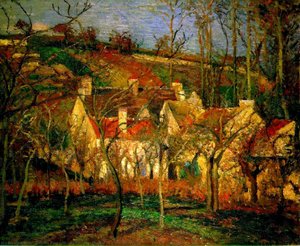
Works like *Frost, View from Bazincourt* – while seemingly idyllic landscapes – can be interpreted as reflections on the harsh realities of rural life. His commitment to portraying the “common man” without artifice or grandeur was a radical act in an era dominated by academic conventions and idealized depictions.
Enduring Legacy: Pissarro's Impact on Modern Painting
Camille Pissarro’s influence on modern painting is immeasurable. His pioneering role in Impressionism, his willingness to experiment with new techniques like Pointillism, and his unwavering commitment to portraying everyday life paved the way for generations of artists.
His mentorship of Cézanne, Gauguin, and Van Gogh ensured that his artistic principles continued to resonate long after his death in 1903. Today, Pissarro’s paintings are celebrated for their beauty, sensitivity, and social consciousness. He remains a vital figure in the history of art, inspiring artists and viewers alike with his vision of a more just and equitable world.
At ArtsDot.com, we offer a curated selection of high-quality reproductions of Camille Pissarro’s masterpieces, allowing you to experience the beauty and depth of his work firsthand. Explore our collection today and discover the enduring legacy of this remarkable artist.