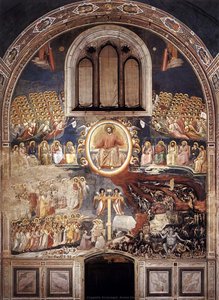
The Dawn of a New Style: Giotto’s Historical Context
 Wikipedia: Giotto
Giotto di Bondone (Italian: [ˈdʒɔtto di bonˈdoːne]; c. 1267 – January 8, 1337), known mononymously as Giotto, was an Italian painter and architect from Florence during the Late Middle Ages. He worked during the Gothic and Proto-Renaissance period. Gi...
The late Middle Ages, a period often characterized by rigid artistic conventions and spiritual symbolism, witnessed a seismic shift with the emergence of Giotto di Bondone (c. 1267 – 1337). Born in Florence during a time of burgeoning city-states and evolving religious fervor, Giotto wasn’t merely an artist; he was a visionary who dared to break from centuries of tradition. To understand his revolution, one must first appreciate the artistic landscape he inherited. Byzantine art, with its flattened figures, opulent gold backgrounds, and emphasis on theological representation rather than naturalistic depiction, dominated the Italian peninsula. Figures existed as icons – windows into the divine – not as relatable human beings. Cimabue, often cited as Giotto’s teacher, embodied this style, creating works of striking beauty but adhering to established norms. However, a growing Franciscan movement began to challenge these conventions, advocating for a more personal and empathetic connection with Christ and his teachings. This shift in spiritual emphasis would profoundly influence Giotto's artistic trajectory.
Florence itself played a crucial role. A thriving center of commerce and intellectual exchange, the city fostered an environment ripe for innovation. Wealthy merchant families, eager to demonstrate their piety and civic pride, became important patrons of the arts, commissioning works that reflected both religious devotion and burgeoning humanism. This demand for art that resonated with contemporary audiences created a space for Giotto’s unique vision to flourish. Giovanni Villani, a Florentine banker and chronicler, famously described Giotto as “the most sovereign master of painting in his time, who drew all his figures and their postures according to nature,” a testament to the radical departure he represented from prevailing artistic standards.
Breaking with Tradition: Realism, Emotion, and Spatial Depth in Giotto's Art
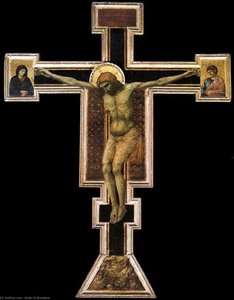 Crucifix
Admire Giotto Di Bondone's iconic Crucifix (1290-1300) – a masterpiece of Proto-Renaissance art, renowned for its emotive chiaroscuro and profound spiritual depth. Own a stunning reproduction at ArtsDot.com.
Giotto’s genius lay not in inventing entirely new concepts but in *reclaiming* lost ones. He looked back to classical antiquity – though perhaps indirectly through Romanesque sculpture – for inspiration in depicting the human form with greater accuracy and weight. Where Byzantine figures appeared ethereal and detached, Giotto's possessed a tangible physicality. This wasn’t simply about anatomical correctness; it was about imbuing his subjects with emotional depth and psychological realism. He achieved this through several key innovations. Chiaroscuro, the dramatic use of light and shadow, became central to his technique, modeling forms and creating a sense of volume previously unseen in Italian painting. His figures weren’t flat planes but three-dimensional beings occupying real space.
Perhaps most strikingly, Giotto introduced a new level of emotional expressiveness into religious art. Faces conveyed grief, joy, contemplation, and even doubt – emotions that resonated with contemporary viewers on a deeply personal level. This was particularly evident in his depictions of the Life of Christ and the Life of St. Francis. He also pioneered techniques to suggest spatial depth, arranging figures within compositions that created a more believable environment. While not employing linear perspective as it would be developed during the Renaissance, Giotto used architectural elements and overlapping forms to create an illusion of recession, drawing the viewer into the scene. A comparison between his *Crucifix* (Rimini) and earlier Byzantine examples reveals this dramatic shift: where the Byzantine crucifix emphasizes theological symbolism, Giotto’s focuses on the human suffering of Christ.
Masterpieces of Narrative: Exploring the Arena Chapel Frescoes
![Legend of St Francis - [16] - Death of the Knight of Celano](/media/artworks/images/thumbnails/83/59/83593bb19f4241089d593124079fe901.jpg) Legend of St Francis - [16] - Death of the Knight of Celano
Legend of St Francis - [16] - Death of the Knight of CelanoExplore Giotto's masterpiece 'Legend of St Francis - Death of the Knight of Celano,' a pivotal Proto-Renaissance fresco depicting Saint Francis's final moments with remarkable realism and emotional depth.
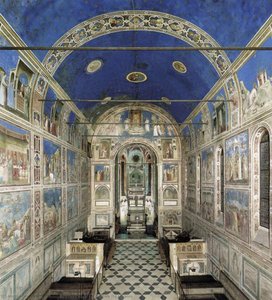
The Scrovegni Chapel in Padua, also known as the Arena Chapel, stands as Giotto's most celebrated masterpiece. Commissioned by Enrico Scrovegni, a wealthy Florentine merchant seeking to atone for his family’s usurious practices, the chapel is entirely covered in frescoes depicting the Life of the Virgin and the Life of Christ. This monumental cycle isn’t merely a collection of isolated images; it's a cohesive narrative unfolding across the walls, designed to guide the viewer through key moments in salvation history.
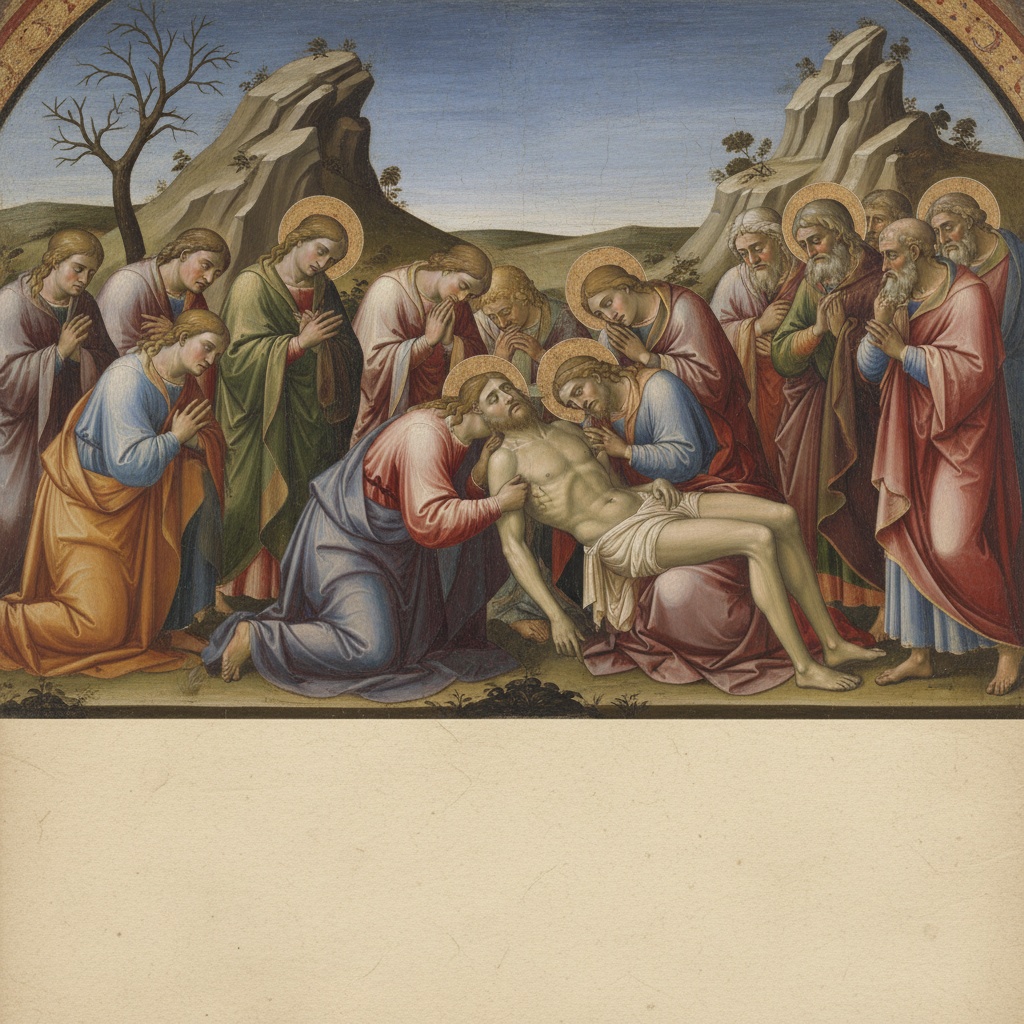
The *Death of the Knight of Celano* is particularly poignant, showcasing Giotto’s ability to convey profound emotion. The scene depicts St. Francis surrounded by his grieving disciples, their faces etched with sorrow and loss. The composition is carefully arranged, drawing attention to the central figure of St. Francis while simultaneously emphasizing the collective grief of those around him. Equally compelling are scenes from Christ's Passion, where Giotto masterfully portrays human drama and suffering. The *Lamentation* scene, for example, is a powerful depiction of Mary cradling the body of Jesus, her anguish palpable to the viewer. The frescoes aren’t simply beautiful; they are deeply moving testaments to faith, loss, and redemption.
Giotto’s Influence on Renaissance Painting and Beyond
Giotto's impact on subsequent generations of artists cannot be overstated. He is widely considered the father of Western painting, initiating a shift away from the Byzantine style towards a more naturalistic and emotionally resonant approach. Artists like Masaccio, Michelangelo, and Raphael all drew inspiration from his work, building upon his innovations in perspective, anatomy, and composition. Masaccio’s *Holy Trinity*, for instance, demonstrates a clear debt to Giotto's pioneering use of spatial depth and realistic figure depiction.
The Enduring Legacy of Renaissance Art, as explored by art historians, highlights the importance of this transition period. Giotto didn’t simply change *how* things were painted; he changed *what* painting could be. He elevated the status of the artist from craftsman to intellectual, demonstrating that art could not only depict religious narratives but also convey profound human emotion and psychological insight. His emphasis on observation and realism laid the groundwork for the scientific study of anatomy and perspective that would characterize the High Renaissance.
Techniques and Materials: A Closer Look at Giotto’s Process
Giotto primarily worked in fresco, a demanding technique requiring meticulous planning and execution. Fresco involves painting directly onto wet plaster, allowing the pigments to bind with the lime as it dries. This process requires speed and precision, as corrections are difficult once the plaster has set. Giotto’s mastery of fresco is evident in the seamless integration of figures and architecture within his compositions. He also employed tempera paint for panel paintings, using egg yolk as a binding medium.
His palette, while not as vibrant as some Byzantine examples, was carefully chosen to convey emotional depth and realism. Earth tones dominated, with subtle variations in color used to model forms and create a sense of volume. He also utilized gold leaf sparingly, reserving it for highlighting key elements and emphasizing the sacred nature of his subjects. The quality of Giotto’s materials – pigments derived from natural sources and carefully prepared plaster – contributed significantly to the longevity and visual impact of his work.
The Enduring Legacy: Giotto in Museums Today
While many of Giotto's original works remain *in situ*—most notably within the Arena Chapel—examples of his art can be found in museums around the world. The Louvre Museum in Paris, the Uffizi Gallery in Florence, and the Museo del Prado in Madrid all house significant collections of Giotto’s paintings and drawings. Visiting these museums offers a unique opportunity to appreciate the artistry and innovation of this groundbreaking painter firsthand.
Today, ArtsDot.com allows art enthusiasts to bring Giotto's masterpieces into their own homes through high-quality reproductions. Whether you choose a handmade oil painting or a museum-quality print, you can experience the beauty and emotional power of Giotto’s work for yourself. His legacy continues to inspire artists and captivate audiences centuries after his death, solidifying his place as one of the most important figures in art history.