Early Life & Artistic Foundations: The Legacy of Jozef Israëls
In art, realism is generally the attempt to represent subject-matter truthfully, without artificiality, exaggeration, or speculative or supernatural elements. The term is often used interchangeably with naturalism, although these terms are not necess...
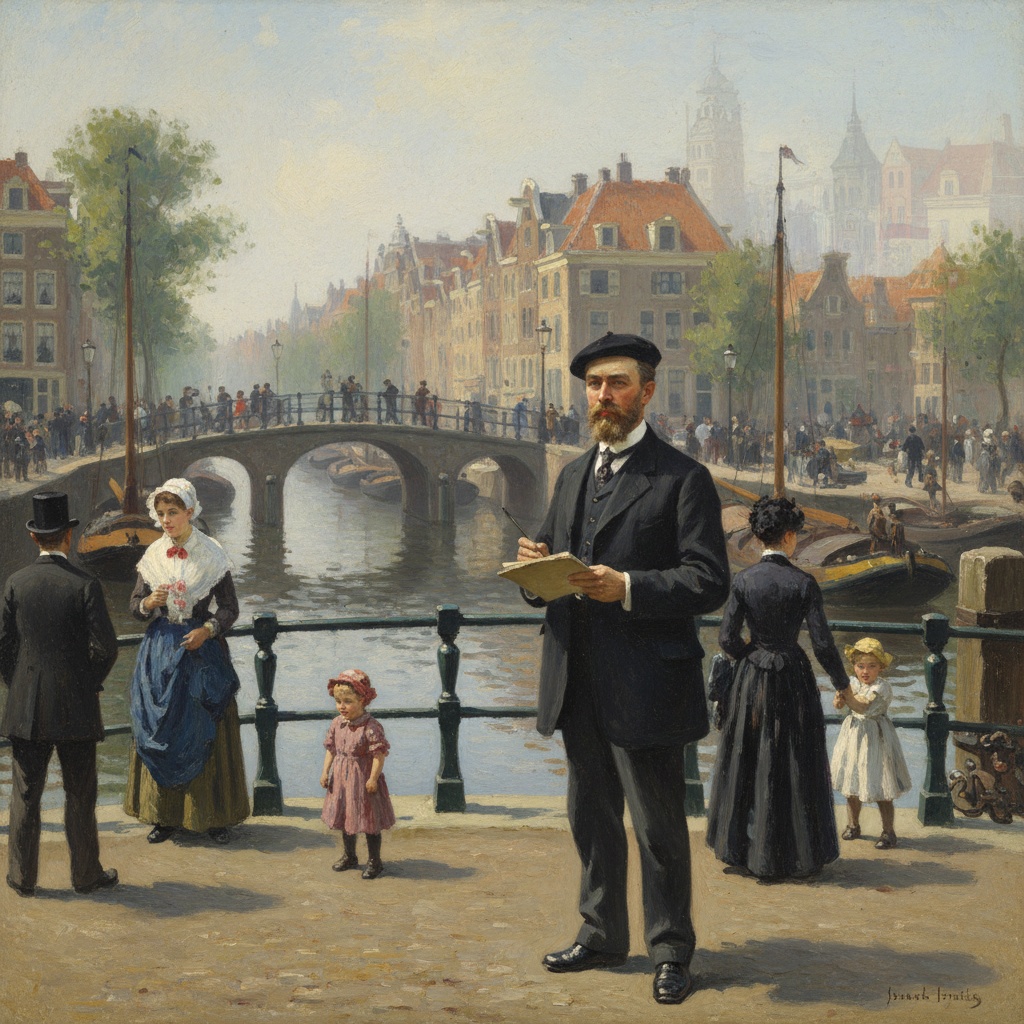
Isaac Lazarus Israëls, born in Amsterdam in 1865, entered a world steeped in artistic tradition. His father, Jozef Israëls, was already a celebrated figure – a leading light of the Hague School and a painter renowned for his deeply empathetic depictions of rural life and the struggles of the working class. This familial legacy wasn’t merely a matter of lineage; it formed the very bedrock of Isaac’s early education and aesthetic sensibility. While Jozef’s work often focused on somber realism, portraying the hardships of fishermen and laborers with poignant detail, young Isaac absorbed not just technique but also a commitment to observing life directly, to finding beauty and meaning in the everyday. His upbringing was one of immersion – annual trips to Paris exposed him to the latest artistic currents, fostering an early awareness of broader European trends. However, it was within his father’s studio that he first learned to wield a brush, mastering the fundamentals of composition, color mixing, and the delicate art of capturing light.
The Amsterdam Impressionists: A Circle of Innovation and Shared Vision
By the 1880s, Isaac found himself drawn into a dynamic circle of artists who would come to define the Amsterdam Impressionist movement. This wasn’t an officially declared school but rather a loose gathering of like-minded painters – including George Hendrik Breitner – united by a desire to break from academic conventions and capture the fleeting moments of modern life. They rejected the idealized landscapes and historical narratives favored by established institutions, instead turning their attention to the bustling streets of Amsterdam, its cafes, dance halls, and working-class neighborhoods. The influence of French Impressionism was palpable, yet these Dutch artists forged a distinct path, characterized by a darker palette and a more direct engagement with social realities. Their shared philosophy – that art should be an expression of personal feeling and immediate experience – resonated deeply with Isaac, who quickly became a prominent voice within the group.
Urban Scenes & Social Commentary: Capturing the Pulse of Dutch City Life
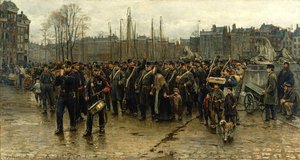
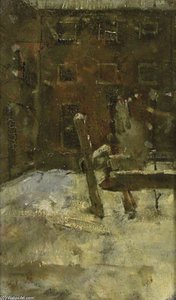 Barrack Yard In Winter
Explore Isaac Israëls’ ‘Barrack Yard In Winter,’ a poignant oil painting capturing urban solitude & texture. Discover realism meets impressionism in this evocative Dutch artwork.
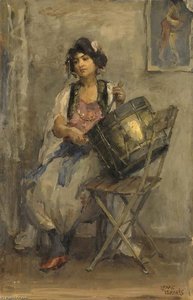
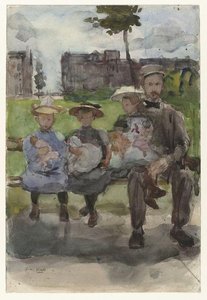
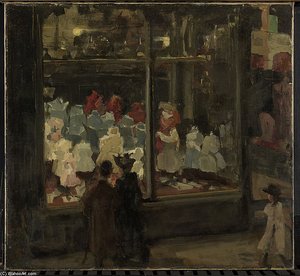
Israëls’s canvases began to reflect this new artistic direction. He eschewed grand historical themes in favor of intimate glimpses into urban life – scenes of pedestrians hurrying along rain-slicked streets, fashionable women trying on clothes in elegant boutiques, and soldiers relaxing in barracks. He possessed a remarkable ability to capture the atmosphere of a place, conveying not just what he saw but also how it *felt* to be present in that moment. His paintings weren’t simply representations; they were evocations – imbued with a sense of movement, energy, and often, a subtle undercurrent of social commentary. Works like ‘Barrack Yard In Winter’ exemplify this approach, depicting the solitude and texture of urban existence with striking realism. He wasn't merely documenting life; he was offering a nuanced portrait of Dutch society at the turn of the century.
Travels to Asia & Beyond: Expanding Horizons and Artistic Influences
Israëls’s artistic journey extended beyond the confines of Amsterdam. His travels, particularly those to the Dutch East Indies (now Indonesia), profoundly impacted his work. These experiences exposed him to new cultures, vibrant colors, and unfamiliar landscapes, broadening his perspective and enriching his palette. While initially focused on documenting colonial life, he gradually moved towards a more nuanced exploration of the people and places he encountered. The influence of Asian art – its emphasis on simplicity, elegance, and spiritual depth – can be detected in some of his later works, adding another layer of complexity to his already distinctive style. These journeys weren’t simply about acquiring new subject matter; they were about a deeper engagement with the world and a willingness to embrace different ways of seeing.
Israels’ Distinct Style: Realism, Impasto, and a Personal Brushstroke
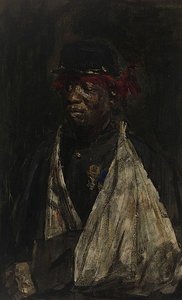 Portrait Of The Wounded Knil-soldier Kees Pop
Explore Isaac Israëls’ poignant 'Wounded Knil-soldier.' A dramatic oil portrait of an elderly Black man, showcasing impasto & expressive realism. Discover a powerful work of 19th-century art.
What truly sets Israëls apart is his masterful technique. He was a skilled realist, capable of capturing minute details with astonishing accuracy. However, he wasn't content to simply replicate reality; he infused his paintings with a dynamic energy through the expressive use of impasto – applying thick layers of paint to create texture and depth. This technique not only added visual richness but also conveyed a sense of immediacy and emotional intensity. His brushstroke was often loose and spontaneous, capturing the fleeting effects of light and movement with remarkable skill. Consider ‘Portrait Of The Wounded Knil-soldier Kees Pop’ – the dramatic oil portrait showcases his impasto & expressive realism, revealing a powerful work of 19th-century art. His style wasn't about meticulous precision; it was about capturing the essence of a subject, conveying its spirit and character with bold confidence.
Legacy and Influence: Israëls' Place in Dutch Art History
Isaac Lazarus Israëls left an indelible mark on Dutch art history. He bridged the gap between the realism of his father’s generation and the burgeoning Impressionist movement, forging a distinctive style that captured the spirit of a changing nation. His paintings offer a compelling glimpse into the social realities of early 20th-century Holland – its bustling cities, its diverse communities, and its complex colonial past. While often overshadowed by his more famous contemporaries, Israëls’s work continues to resonate with audiences today, admired for its honesty, energy, and technical brilliance. His influence can be seen in the works of subsequent generations of Dutch painters who sought to capture the beauty and complexity of modern life. ArtsDot.com offers a curated selection of Israëls’s masterpieces, allowing art enthusiasts to experience the captivating world he created firsthand.