
Early Influences & The Fauvist Foundation
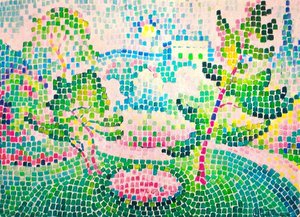
Jean Dominique Antony Metzinger’s artistic journey began not with the fractured planes of Cubism for which he would become renowned, but amidst the vibrant hues and expressive brushwork of late 19th-century France. Born in Nantes in 1883, his early exposure to art was shaped by the Neo-Impressionist movement, a style championed by Georges Seurat and Henri-Edmond Cross. These artists, with their meticulous application of pointillism – tiny dots of color meticulously arranged to create shimmering effects – instilled in Metzinger an appreciation for optical mixing and the scientific underpinnings of perception. However, it was the burgeoning Fauvist movement that truly ignited his creative spirit. Between 1904 and 1907, Metzinger embraced the bold, non-naturalistic color palettes and liberated brushstrokes of artists like Matisse and Derain. This period wasn’t merely an imitation; rather, it served as a crucial stepping stone, allowing him to explore the expressive potential of color independent of representational accuracy. His early works from this time demonstrate a growing fascination with Cézanne's structural approach – a desire to move beyond mere impressionistic rendering and delve into the underlying forms that constituted reality. This nascent interest in dissecting form would prove pivotal, laying the groundwork for his revolutionary contributions to Cubism.
The Birth of Proto-Cubism: Breaking with Tradition
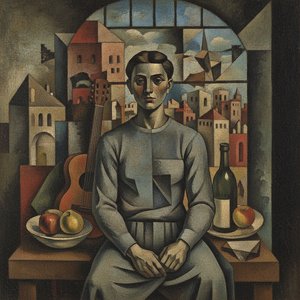
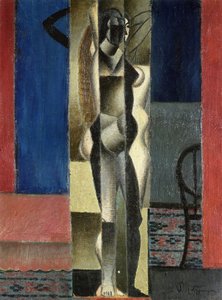
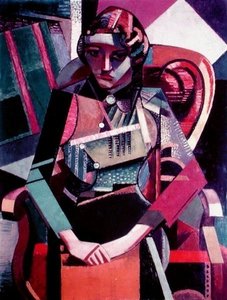 What Will Catch My Eye
Explore Jean Dominique Antony Metzinger’s ‘What Will Catch My Eye,’ a striking Cubist portrait. Bold colors & geometric forms evoke intellectual engagement. A unique study in structure and emotion.
By 1908, Metzinger’s artistic trajectory underwent a dramatic shift. Dissatisfied with the limitations of Fauvism and seeking a more intellectually rigorous approach to painting, he began experimenting with what would become known as proto-Cubism. This wasn't a sudden rupture but rather a gradual evolution fueled by his ongoing dialogue with fellow artists, most notably Albert Gleizes. The key innovation lay in his exploration of “faceting,” the breaking down of objects into geometric components and presenting multiple perspectives simultaneously on a single canvas. This was a radical departure from traditional perspective, which had dominated Western art for centuries. Metzinger wasn’t simply depicting *what* he saw but rather attempting to represent *how* he saw – the totality of an object's form as perceived through movement and time. Paintings from this period reveal fragmented forms, muted tones, and a deliberate rejection of illusionistic space. He began to question the very nature of representation, challenging viewers to actively reconstruct the depicted subject in their minds. This early experimentation wasn’t merely stylistic; it was a philosophical inquiry into the limitations of perception itself.
Co-Authoring Cubism: 'Du Cubisme' and Theoretical Innovation
 Abstract Art's Evolution: A Collector's Guide to Its Impact & Investment Value
Explore the evolution of abstract art with . Discover key movements, influential artists & expert collecting advice. Invest in timeless masterpieces.
Metzinger’s impact extended far beyond his own canvases. In 1910, alongside Albert Gleizes, he co-authored 'Du Cubisme', the first comprehensive theoretical treatise on the burgeoning movement. This groundbreaking work wasn’t simply a description of Cubist techniques; it was an attempt to articulate the underlying principles and philosophical foundations of this revolutionary new art form. “Note sur la Peinture,” Metzinger’s contribution within the book, introduced the concept of “mobile perspective” – the idea that objects should be depicted not from a single fixed viewpoint but rather as they are experienced through movement and successive observations. This challenged the traditional notion of a static, objective reality and emphasized the subjective nature of perception. 'Du Cubisme' provided a crucial framework for understanding the movement’s aims and techniques, solidifying Metzinger’s role not just as an artist but as a leading intellectual force within the avant-garde. The book explained how Cubism sought to represent the totality of form by incorporating multiple viewpoints, breaking down objects into geometric shapes, and emphasizing the interplay between space and time.
Crystal Cubism & the Pursuit of Mathematical Order
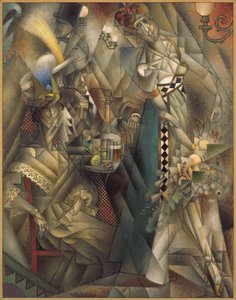
The outbreak of World War I marked a turning point in Metzinger’s artistic development. Disillusioned with the chaos of war, he sought a more structured and rational approach to art, leading to the emergence of Crystal Cubism. This style, characterized by cleaner lines, precise geometric forms, and a deliberate emphasis on mathematical order, represented a departure from the earlier, more fragmented aesthetic of Analytical Cubism. Metzinger believed that mathematics held the key to unlocking a deeper understanding of reality and sought to incorporate its principles into his art. He wasn’t simply creating aesthetically pleasing compositions; he was attempting to construct visual representations of underlying geometric structures. This pursuit of mathematical harmony resonated with contemporary scientific advancements, particularly in the field of quantum mechanics. His collaboration with Albert Gleizes continued during this period, culminating in the influential treatise 'La Peinture et ses lois' (Painting and Its Laws), which further explored the relationship between art, mathematics, and perception.
Metzinger’s Legacy: Simultaneity, Perception, and Modern Art’s Evolution
Jean Dominique Antony Metzinger’s contributions to modern art are profound and far-reaching. His pioneering work in proto-Cubism, his theoretical writings on Cubism, and his exploration of Crystal Cubism fundamentally altered the course of 20th-century painting. He wasn't merely an artist; he was a visionary who challenged conventional notions of representation and perception. The concept of simultaneity – representing multiple viewpoints simultaneously – became a defining characteristic of Cubism and influenced countless artists in subsequent generations. His interest in the fourth dimension, sparked by conversations with scientists like Niels Bohr (who famously displayed Metzinger’s painting 'La Femme au Cheval' in his office), further underscored his commitment to exploring the complexities of space and time. Metzinger’s legacy extends beyond specific stylistic innovations; it lies in his unwavering pursuit of a more intellectually rigorous and philosophically grounded approach to art, paving the way for abstract expressionism and other groundbreaking movements that followed. Discover the enduring impact of this pivotal figure through reproductions available at ArtsDot.com, where you can explore his masterpieces and bring a piece of modern art history into your home.