Early Life & Influences: From Duveneck to Munich
Tonalism was an artistic style that emerged in the 1880s when American artists began to paint landscape forms with an overall tone of colored atmosphere or mist. Between 1880 and 1915, dark, neutral hues such as gray, brown or blue, often dominated c...
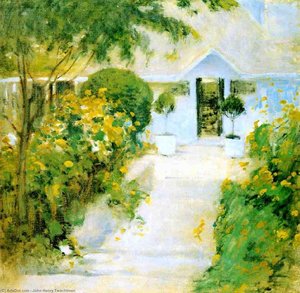
John Henry Twachtman’s artistic journey began not with the shimmering light of Impressionism, but within the more grounded traditions of realism. Born in Cincinnati, Ohio, in 1853, he initially found mentorship under Frank Duveneck, a figure whose emphasis on direct observation and robust technique laid a crucial foundation for the young artist. This early training instilled in Twachtman a respect for form and draftsmanship that would subtly inform his later, more atmospheric works. However, Cincinnati, despite its burgeoning artistic community, felt limiting to Twachtman’s restless spirit. Like many ambitious American artists of the era, he sought further education abroad, embarking on a period of study in Munich in 1875. The Academy there prioritized meticulous detail and a darker palette – a stark contrast to the emerging Impressionist movement taking hold in France. Yet, even within this conservative environment, Twachtman began to develop an individual sensibility, experimenting with looser brushwork and a growing fascination with capturing fleeting moments of light and shadow. His time in Munich wasn’t about adopting a specific style, but rather absorbing technical skills that he would later synthesize with his own unique vision.
The Parisian Interlude: Embracing Tonalism & Soft Light
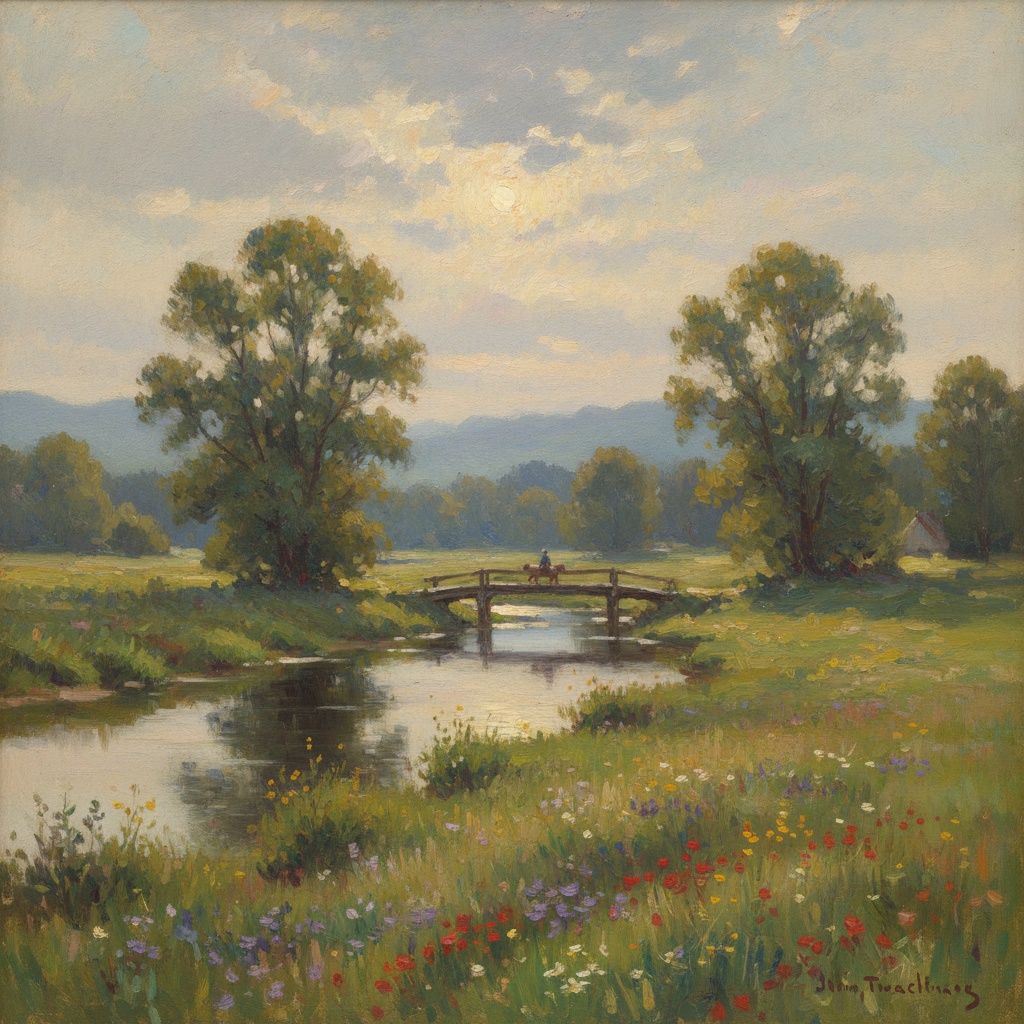
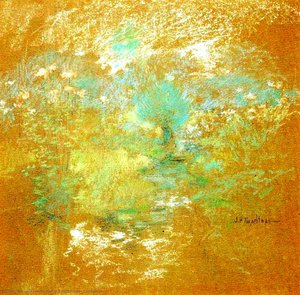
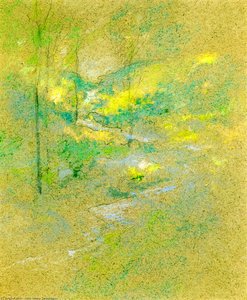 Brook among the Trees
Experience tranquility with John Henry Twachtman's 'Brook among the Trees.' This captivating 1891 pastel showcases Impressionism’s beauty & nature’s serenity.
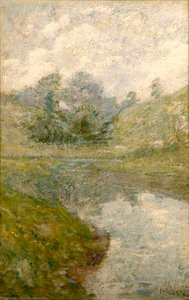
A sojourn to Paris between 1883 and 1885 proved transformative. While not fully embracing the radical tenets of Impressionism, Twachtman found himself deeply drawn to its exploration of light and color. More significantly, he gravitated towards Tonalism – a style characterized by muted palettes, atmospheric effects, and an emphasis on evoking mood rather than precise representation. This period saw a dramatic shift in his work; canvases began to soften, edges blurred, and the focus moved from detailed depiction to capturing the *feeling* of a place. Works like “Arques-la-Bataille,” painted during this time, exemplify this new direction. The scene isn’t about precise topographical accuracy but rather a poetic rendering of light filtering through trees, creating an almost dreamlike quality. This wasn't merely a stylistic change; it reflected Twachtman’s growing desire to express his personal response to the landscape, prioritizing subjective experience over objective reality. He was learning to paint not *what* he saw, but *how* it felt.
Connecticut Years: A Personal Impressionist Vision
 Wikipedia: John Henry Twachtman
John Henry Twachtman (August 4, 1853 – August 8, 1902) was an American painter best known for his impressionist landscapes, though his painting style varied widely through his career. Art historians consider Twachtman's style of American Impressionis...
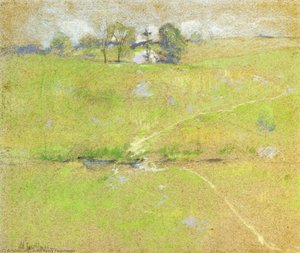
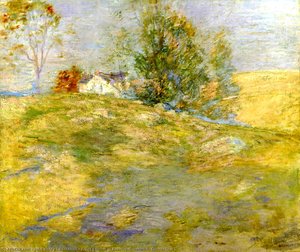
The purchase of a farm in Greenwich, Connecticut, in 1890 marked a pivotal moment in Twachtman’s career. Here, surrounded by the rolling hills and tranquil waterways of New England, he developed his most distinctive style – a uniquely American form of Impressionism infused with Tonalist sensibilities. Unlike many of his contemporaries who sought dramatic landscapes, Twachtman found beauty in the everyday scenes of rural life: snow-covered fields, quiet gardens, and the gentle flow of brooks. He painted these subjects repeatedly, exploring subtle variations in light and atmosphere across seasons and times of day. This wasn’t about grand spectacle but rather a meditative engagement with the natural world. His paintings from this period are characterized by a remarkable intimacy – they feel less like depictions of landscapes and more like personal reflections on the passage of time and the beauty of solitude. The small waterfall on his property became a particularly favored motif, serving as a canvas for countless studies in light and color.
Twachtman and 'The Ten': Defining American Modernism
In 1897, Twachtman joined “The Ten,” a group of ten American artists who broke away from the rigid constraints of traditional art organizations. This collective – including figures like Childe Hassam, Willard Metcalf, and J. Alden Weir – sought to establish an independent platform for exhibiting their work and defining a distinctly American artistic identity. While diverse in their individual styles, The Ten shared a commitment to innovation and a rejection of academic conventions. Twachtman’s presence within the group was vital; his quiet independence and willingness to experiment encouraged others to push boundaries and explore new approaches to painting. Though not explicitly labeled as such at the time, The Ten played a crucial role in paving the way for American Modernism, challenging established norms and fostering a spirit of artistic freedom. Their exhibitions provided a space for artists like Twachtman to showcase their unique visions and connect with a growing audience receptive to new ideas.
Key Works & Lasting Legacy: Reflections, Brooks, and Beyond
Twachtman’s oeuvre is remarkably consistent in its pursuit of atmospheric beauty. Paintings such as “Reflections” (1895) capture the serene tranquility of dock scenes bathed in soft light, while works like “Brook Among the Trees” (1891) showcase his mastery of pastel and his ability to evoke a sense of peaceful contemplation. Even his later paintings, created during summers spent in Gloucester, Massachusetts, demonstrate this unwavering commitment to capturing fleeting moments of beauty. Though he died prematurely in 1902 at the age of 49, Twachtman left behind a significant body of work that continues to resonate with audiences today. His influence on subsequent generations of American landscape painters is undeniable. He wasn’t interested in grand narratives or dramatic statements; instead, he sought to capture the subtle poetry of everyday life, reminding us to find beauty in the quiet corners of the world. ArtsDot.com offers a curated selection of high-quality reproductions of Twachtman's masterpieces, allowing you to experience the atmospheric beauty of his work firsthand and bring a touch of American Impressionism into your home. Explore our collection today and discover the enduring legacy of this pivotal artist.