The Fracture of Perspective: The Birth of a Revolution
--- title: Cubism | Tate author: Clarrie Wallis url: https://www.tate.org.uk/art/art-terms/c/cubism hostname: tate.org.uk description: Tate glossary definition for cubism: A revolutionary new approach to representing reality in art invented by artist...
To understand the seismic shift that Cubism brought to the twentieth century, one must first envision the world as it was perceived before 1907. For centuries, Western art had been anchored by the Renaissance ideal of a single, fixed viewpoint—a window into a three-dimensional reality governed by linear perspective and the illusion of depth. However, as the dawn of the new century arrived, a period marked by rapid industrialization and the mind-bending scientific revelations of Einstein, the traditional canvas began to feel insufficient. The artists who would become the architects of Cubism felt a profound need to move beyond mere imitation of nature.
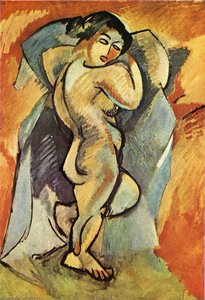
The movement emerged not as a sudden rupture, but as an intellectual evolution born in the vibrant, often chaotic, studios of Paris. It was a rejection of the Impressionist obsession with fleeting light and the Fauvist embrace of unbridled color, seeking instead a more permanent, structural truth. By dismantling the subject, these pioneers sought to capture what the eye knows rather than just what the eye sees. This was an era where reality itself was being redefined by technology and physics, and art responded by breaking the very concept of the "viewpoint" into a thousand shimmering fragments.
Analytical Cubism: Deconstructing the Subject into Geometric Planes
 Portrait of Georges Braque
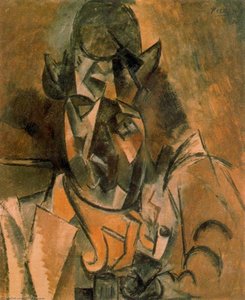
Subject and Composition The artwork, "Portrait of Georges Braque," created by Pablo Picasso in 1910, presents an intimate depiction of the artist's close friend and fellow pioneer of Cubism, Georges Braque. The portrait is not a traditional represent...
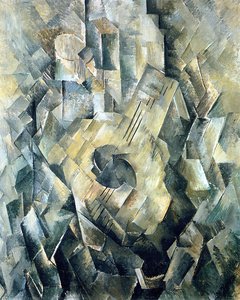
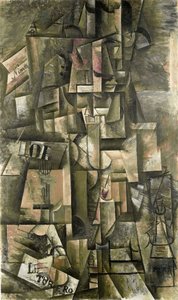
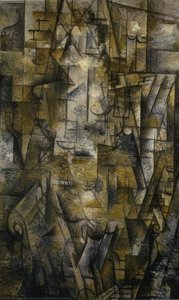
As the movement matured into what we now call Analytical Cubism, the canvas became a site of intense intellectual dissection. During this phase, roughly between 1908 and 1912, the works of Pablo Picasso and Georges Braque reached a level of complexity that challenged even the most seasoned observers. The goal was to analyze the subject—be it a portrait, a musical instrument, or a still life—by breaking it down into its fundamental geometric components. Faces were no longer soft flesh but interlocking planes; objects were no longer solid masses but a series of transparent, overlapping facets.
In masterpieces such as Picasso’s Portrait of Georges Braque (1910), the viewer witnesses this deconstruction in its most pure form. The palette is intentionally restrained, dominated by somber ochres, grays, and browns. This monochromatic approach was a deliberate choice to prevent color from distracting the eye from the true subject: the structural rhythm of the composition. By stripping away the emotional weight of vibrant hues, the artists forced a focus on the interplay of light and shadow across fractured surfaces. The subject is presented from multiple perspectives simultaneously, allowing the viewer to experience the object in its entirety, rotating around it mentally even as they gaze upon a flat surface.
Synthetic Cubism: Reconstructing Reality Through Texture and Collage
 Guitar 5
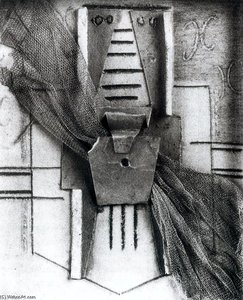
A Fragmented Vision of Form: Analyzing Picasso’s “Guitar” Pablo Picasso's "Guitar" (1920), a deceptively simple yet profoundly complex sculpture, stands as a pivotal emblem of Synthetic Cubism—a movement that irrevocably altered the trajectory of art...
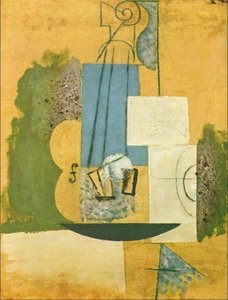
If Analytical Cubism was about the destruction of form, Synthetic Cubism was about its ingenious reconstruction. Around 1912, a new energy infused the movement, moving away from the dense, almost illegible fragmentation of the previous years toward a more additive process. Instead of breaking down an existing object, artists began to "synthesize" new forms by layering different materials and shapes. This era introduced the revolutionary concept of collage, where real-world elements—newspaper clippings, wallpaper, or sand—were integrated directly into the painted composition.
This period brought a newfound sense of materiality and playfulness to the movement. Picasso’s Guitar (1920) serves as a profound emblem of this shift. In his sculptural explorations, he utilized starker, more recognizable geometric shapes to build a sense of volume without relying on traditional shading. The focus shifted from the analytical dissection of light to the construction of meaning through texture and shape. This method challenged the very definition of art, blurring the boundary between the "real" world of physical objects and the "represented" world of the painted image, paving the way for much of the abstract art that would follow in the decades to come.
The Collaborative Vision: The Symbiotic Genius of Picasso and Braque
 Cubism's Revolution: 10 Masterpieces That Redefined Modern Art | ArtsDot
Introduction To gaze upon these ten masterpieces is to enter a realm where perception itself is fractured and reassembled, a world born from the audacious vision of Pablo Picasso and Georges Braque. The Cubist style wasn’t merely an artistic shift; i...
It is impossible to discuss the trajectory of Cubism without acknowledging the profound, almost telepathic collaboration between Pablo Picasso and Georges Braque. Their relationship was less a rivalry and more a shared intellectual crusade. While Picasso possessed a restless, volcanic energy that often pushed him toward radical new frontiers, Braque brought a disciplined, structural mastery rooted in his background as a decorator. This synergy allowed them to push the boundaries of experimentation further than either could have achieved alone.
For several years, their respective works were so closely aligned in style and philosophy that they were often indistinguishable to the untrained eye. They worked side-by-side in the Parisian avant-garde, sharing ideas on how to utilize the influence of Paul Cézanne—the "father" of modernism—to restructure the canvas. While Braque’s work often possessed a quiet, meditative quality that questioned the fundamental nature of perception, Picasso’s contributions were frequently more disruptive and iconoclastic. Together, they created a visual language that did not just represent a new style, but established an entirely new way of thinking about the relationship between the creator, the subject, and the viewer.
Beyond Paris: The Global Expansion and Legacy of the Cubist Movement
 Czech Cubism
Czech Cubism (referred to more generally as Cubo-Expressionism) was an avant-garde art movement of Czech proponents of Cubism, active mostly in Prague from 1912 to 1914. Prague was perhaps the most important center for Cubism outside Paris before the...
Though born in the studios of Montmartre and the Marais, Cubism was never a localized phenomenon. Its revolutionary DNA spread rapidly across the globe, influencing every facet of modern creativity, from the rhythmic structures of jazz and the fragmented narratives of literature to the sharp angles of modernist architecture. In Prague, a unique movement known as Czech Cubism emerged, where artists applied these geometric principles to sculpture and even urban design, creating a crystalline aesthetic that celebrated national identity through avant-garde form.
The legacy of Picasso and Braque remains etched into the very foundation of contemporary art. Every time an artist utilizes abstraction to convey emotion, or uses collage to bridge the gap between reality and imagination, they are speaking the language of Cubism. The movement taught us that truth is not found in a single, perfect image, but in the complex, multifaceted way we experience the world. For those who wish to bring this profound intellectual depth into their own environments, the enduring power of these masterpieces continues to offer a window—or rather, a fractured and beautiful prism—into the infinite possibilities of human perception.
At ArtsDot.com, we celebrate this enduring legacy by offering museum-quality reproductions of these transformative works. Whether you are an art student seeking to study the intricate brushstrokes of Analytical Cubism or a collector looking to anchor a modern space with the bold geometry of Synthetic Cubism, our master artists hand-paint each piece on 100% cotton canvas. We specialize in bringing the profound depth and texture of the Old Masters and the Modernists into your home through authentic, oil-on-canvas reproductions that capture the true soul of the original.