Early Life & Artistic Beginnings: A Canary Island Roots
Óscar M. Domínguez (aka Oscar Dominguez, Oscar Domínguez Palazón, Oscar Manuel Domínguez Palazón, O. Domínguez, Oscar Manuel Domínguez) (3 January 1906 – 31 December 1957) was a Spanish-born French surrealist painter, commercial artist, tapestry desi...
Óscar Domínguez, born on January 3, 1906, in San Cristóbal de La Laguna, Tenerife, was an artist inextricably linked to the volcanic landscapes and shadowed beauty of his native Canary Islands. His early life, however, was marked by fragility; a childhood illness left him with physical limitations that subtly shaped his artistic vision. Raised largely by his grandmother in Tacoronte, he found solace and expression through painting at a young age – an outlet not merely for creativity but as a means of confronting and transmuting personal hardship. This formative period instilled within him a sensitivity to form and texture, a preoccupation with the human figure, and a nascent exploration of inner worlds that would later define his surrealist aesthetic. The isolation and introspective nature of his youth fostered an intensely personal artistic language, far removed from the bustling art scenes of mainland Europe, yet possessing a unique power born from its singular origins.
Embracing Surrealism in Paris: Breton, Automatism & Key Influences
Surrealism is an art and cultural movement that developed in Europe in the aftermath of World War I in which artists aimed to allow the unconscious mind to express itself, often resulting in the depiction of illogical or dreamlike scenes and ideas. I...
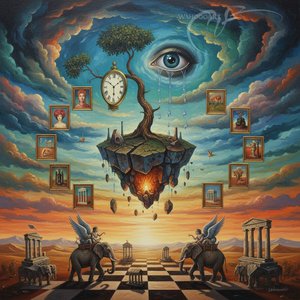
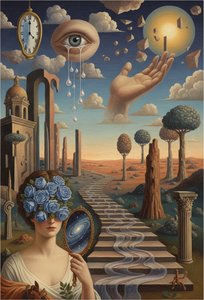
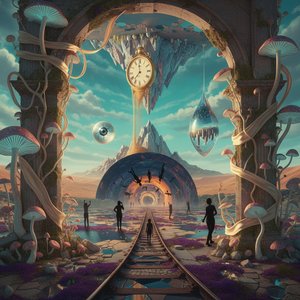
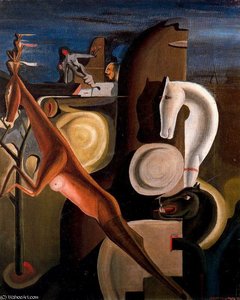
The year 1927 proved pivotal. At the age of twenty-one, Domínguez relocated to Paris, a city then thrumming with avant-garde energy. Initially supporting himself through work at Les Halles market, he immersed himself in the artistic milieu, frequenting museums and galleries, absorbing the currents of Cubism, Dada, and burgeoning Surrealism. His encounter with André Breton in 1933 marked his formal entry into the Surrealist movement, a brotherhood of artists united by their desire to unlock the unconscious mind and challenge conventional perceptions of reality. Domínguez quickly became a committed participant, embracing the principles of automatism – allowing spontaneous creation to bypass conscious control – as a means of accessing deeper psychological truths. The influence of figures like Yves Tanguy, with his ethereal landscapes, and Pablo Picasso, whose deconstruction of form resonated deeply with Domínguez’s own explorations, is palpable in his early Parisian works. However, he wasn't merely an imitator; he rapidly developed a distinctive style characterized by unsettling juxtapositions and dreamlike imagery.
Decalcomania: Domínguez’s Innovative Technique and its Impact
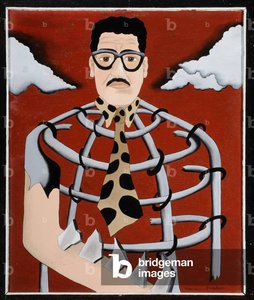 oscar dominguez
Explore Oscar Dominguez's surrealist art: haunting portraits & innovative decalcomania techniques. Discover the Spanish painter's dreamlike world at ArtsDot.
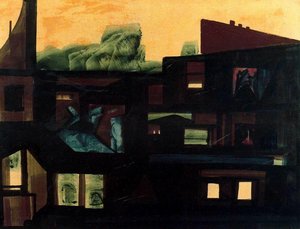
While deeply influenced by the Surrealist ethos, Oscar Domínguez distinguished himself through his groundbreaking technique of decalcomania. Inspired by earlier experiments in Russia, he perfected a method involving the application of thick gouache paint onto a surface – often glass or paper – then pressing it onto another canvas. This seemingly simple act yielded astonishing results: unpredictable textures, distorted forms, and a sense of organic chaos emerged, mirroring the fluidity of the subconscious. Domínguez wasn’t simply creating images; he was revealing hidden realities through chance encounters between materials. The technique allowed for an unprecedented level of spontaneity and automatism, bypassing conscious control and tapping into the realm of pure intuition. His mastery of decalcomania quickly garnered attention within the Surrealist circle, influencing artists like Max Ernst who adopted and adapted the method in their own work. It became a signature element of his style, lending his paintings a unique visual language that was both unsettling and captivating.
Recurring Themes & Symbolic Language: Distortion, the Body & Spanish Identity
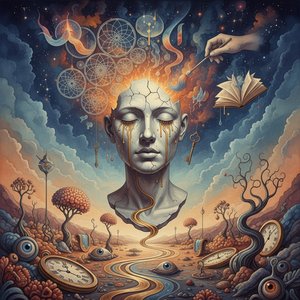
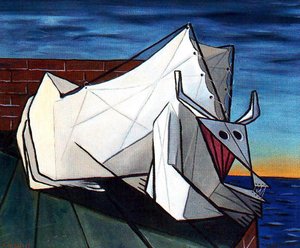
Domínguez’s canvases are populated by fragmented bodies, distorted faces, and unsettling juxtapositions. The human form, often rendered in a state of decay or metamorphosis, serves as a central motif – a reflection perhaps of his own physical struggles and anxieties. These aren't portraits in the traditional sense; they are explorations of psychological states, meditations on mortality, and visceral representations of inner turmoil. Recurring symbols—eyes, mouths, hands—appear throughout his oeuvre, imbued with layers of meaning related to perception, communication, and desire. Furthermore, a strong undercurrent of Spanish identity permeates his work. While fully embracing the Parisian avant-garde, Domínguez never entirely abandoned his roots. The dramatic chiaroscuro reminiscent of Spanish masters like Goya and El Greco, coupled with themes of bullfighting and religious iconography, subtly infuse his surrealist visions with a distinctly Iberian sensibility. This fusion of personal experience, psychological exploration, and cultural heritage creates a uniquely compelling artistic language.
Legacy & Influence: A Brief but Powerful Mark on 20th-Century Art
Despite a tragically short career – Domínguez took his own life in December 1957 at the age of fifty-one – he left an indelible mark on 20th-century art. His innovative use of decalcomania, coupled with his hauntingly evocative imagery, resonated deeply with fellow Surrealists and continues to captivate audiences today. Though often overshadowed by more prolific contemporaries, Domínguez’s work represents a crucial link between the early explorations of automatism and the later developments of abstract expressionism. His influence can be seen in the works of Remedios Varo and other artists who sought to explore the subconscious through unconventional techniques. The rediscovery of his paintings in recent decades has solidified his position as a significant figure within the Surrealist movement, prompting renewed appreciation for his unique vision and technical mastery.
Exploring Domínguez's Work Today: Collections & Rediscovering a Master
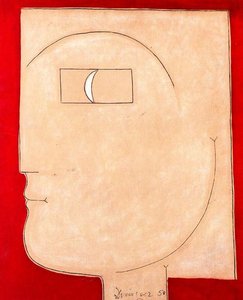
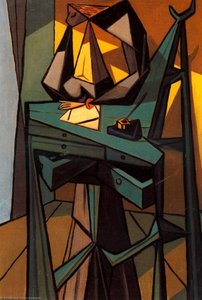
The works of Oscar Dominguez can be found in prominent collections worldwide, including the Museum of Modern Art (MoMA) in New York. His paintings offer a compelling glimpse into the anxieties and aspirations of a generation grappling with the aftermath of war and the complexities of the human psyche. ArtsDot.com provides high-quality reproductions of his most iconic pieces, allowing art enthusiasts to experience the power and beauty of his surrealist visions firsthand. From the unsettling intensity of “The Clown” to the haunting symbolism of “untitled (7776)” and the captivating portraits like “Head in Profile 1”, Domínguez’s work invites contemplation and challenges conventional perceptions. Rediscovering Oscar Dominguez is not merely an act of appreciating a historical artist; it's an invitation to delve into the depths of the subconscious and explore the poetics of decay, distortion, and the enduring power of the human imagination.