Early Life and Artistic Formation: A Rejection of Convention
 Wikipedia: Pierre Puvis de Chavannes
Pierre Puvis de Chavannes (French pronunciation: [pjɛʁ pyvi də ʃavan]; 14 December 1824 – 24 October 1898) was a French painter known for his mural painting, who came to be known as "the painter for France". He became the co-founder and president of ...
Pierre Puvis de Chavannes, born Pierre-Cécile Puvis in Lyon in 1824, was a figure who deliberately cultivated an air of detachment from the bustling artistic currents of his time. Though descended from an old Burgundian noble family – a lineage he consciously emphasized throughout his life, distancing himself from his Lyonnaise origins – his path to becoming “the painter for France” was far from predetermined. A serious illness interrupted formal studies intended to follow in his father’s footsteps as a mining engineer, leading instead to a period of convalescence and, crucially, a transformative journey to Italy in 1846. This Italian sojourn proved pivotal, awakening within him a nascent artistic sensibility that would ultimately reject the prevailing academic rigidity in favor of a more personal, contemplative approach.
His early training was fragmented, marked by brief apprenticeships with Eugène Delacroix (though Delacroix’s studio closed shortly after Puvis joined due to ill health), Henri Scheffer, and Thomas Couture. However, Puvis found himself increasingly drawn to independent study, preferring the solitude of his own exploration over the constraints of established methods. He immersed himself in anatomy classes at the Académie des Beaux-Arts, but it was a deliberate eschewal of classical norms – a quiet rebellion against the dominant aesthetic – that truly defined his formative years. This early resistance to convention foreshadowed the unique and profoundly influential style he would later develop.
The Rise of Mural Painting: Puvis de Chavannes as 'the Painter for France'
Puvis de Chavannes’s ascent was gradual, marked not by immediate acclaim but by a persistent dedication to his vision. His initial Salon debut in 1850 with works like *Dead Christ* and *Jeune noir à l'épée* garnered little attention. It wasn’t until the government of France recognized his talent – acquiring one of his paintings – that he began to gain wider recognition. However, it was his embrace of mural painting that truly cemented his reputation and earned him the moniker “the painter for France.”
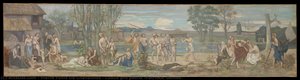
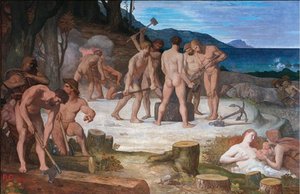
His first significant commission came from his brother for the château de Le Brouchy, a medieval-style structure in Saône-et-Loire. The decorations centered around the four seasons, providing an early opportunity to explore allegorical themes on a grand scale. The 1860s saw further public commissions at the Musée de Picardie in Amiens – *Concordia*, *Bellum*, *Le Travail*, and *Le Repos* – establishing his classicizing style and decorative aesthetic. Between 1883 and 1886, a major mural for the Museum of Fine Arts in Lyon further solidified his position. These early works weren’t merely decorations; they were statements—attempts to forge a new visual language that resonated with national ideals.
Symbolism in Practice: Themes, Techniques, and Aesthetic Principles
 Wikipedia: Symbolism (movement)
Symbolism was a late 19th-century art movement of French and Belgian origin in poetry and other arts seeking to represent absolute truths symbolically through language and metaphorical images, mainly as a reaction against naturalism and realism. In l...
While often categorized as a Symbolist, Puvis de Chavannes occupied a unique position within the movement. He wasn’t driven by the Decadent fascination with the macabre or the overtly mystical that characterized some of his contemporaries. Instead, his symbolism was rooted in a search for timeless truths and an idealized vision of humanity. His work emerged as a reaction against both Naturalism and Realism, seeking to represent absolute ideals through metaphorical imagery rather than direct observation.
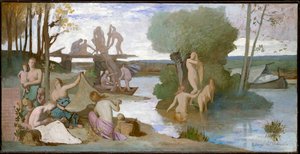
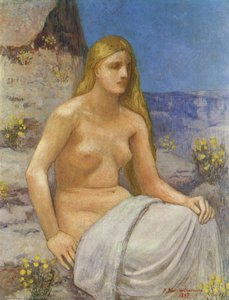
His technique was equally distinctive. Puvis deliberately flattened perspective, eschewing dramatic chiaroscuro in favor of broad swathes of color and rhythmic line. Figures often appear suspended in an ethereal space, their forms simplified and imbued with a sense of calm dignity. This deliberate reduction of detail wasn’t a lack of skill but rather a conscious effort to evoke mood and convey underlying meaning. Works like The Shepherd's Song, Marie-Madeleine, and Woman by the Sea exemplify this approach, showcasing his ability to create allegorical scenes that are both serene and profoundly evocative.
Key Works and Masterpieces: Exploring the Iconography of Hope and Tranquility
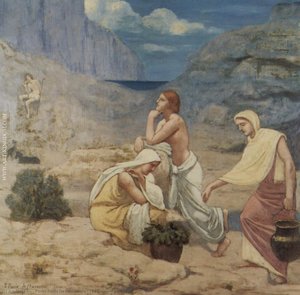 The Shepherd's Song
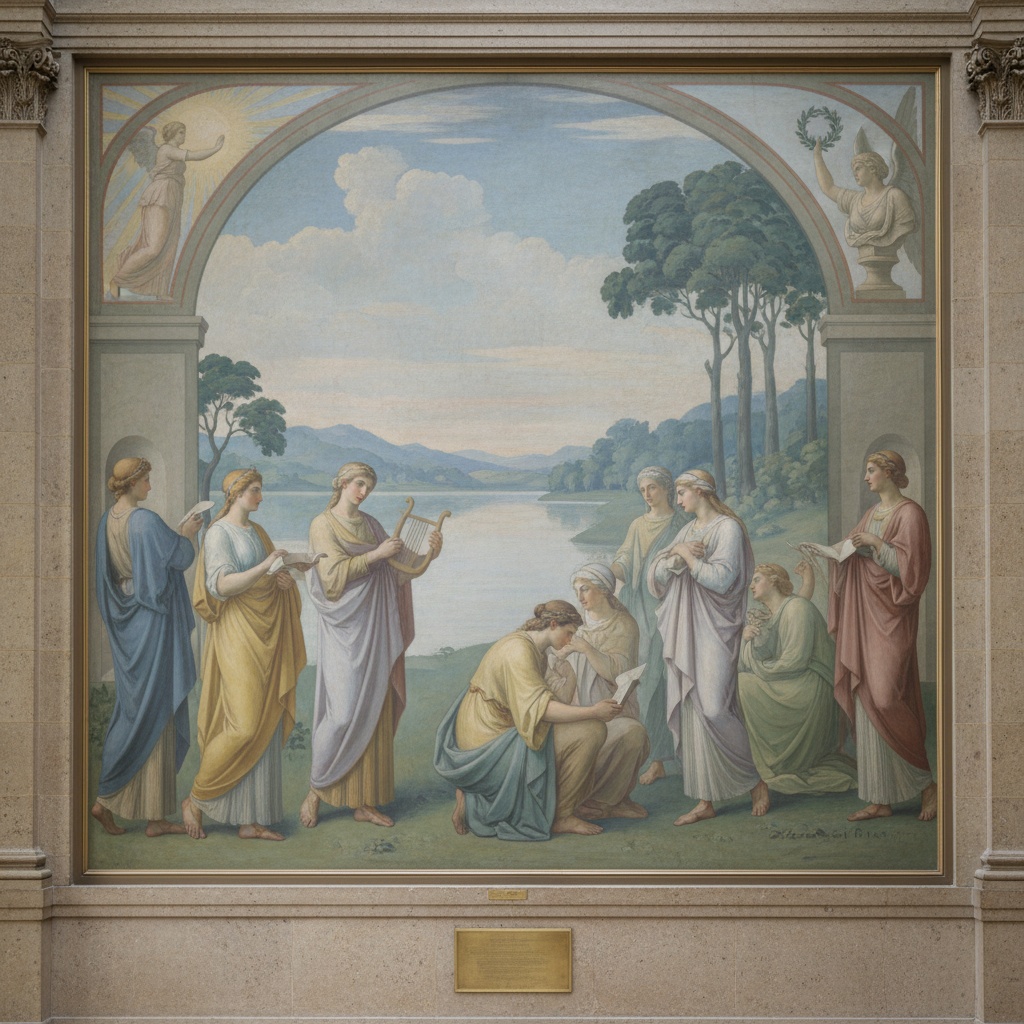
Puvis de Chavannes’s murals became synonymous with a particular vision of French identity – one rooted in order, family, and loyalty. The cycle at the Palais de Beaux-Arts in Lyon is perhaps his most celebrated achievement. Comprising *Antique Vision*, *The Wood Dear to the Arts and the Muses*, and *Christian Inspiration*, these works fill the main staircase with allegorical representations of France’s cultural heritage. Each panel is a testament to his mastery of composition, color, and symbolic imagery.
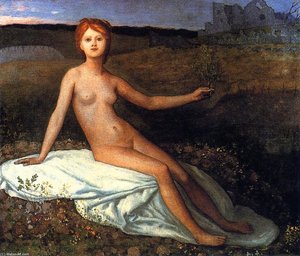
Hope, painted in 1872 in response to the turmoil of the Franco-Prussian War and the Paris Commune, stands as one of his most iconic creations. The painting depicts a group of figures gazing towards a radiant future, embodying a sense of resilience and optimism amidst devastation. The muted palette and simplified forms contribute to its dreamlike quality, offering a vision of solace and renewal. Similarly, his depictions of biblical scenes, such as *Marie-Madeleine*, are imbued with a quiet dignity and spiritual depth, moving beyond literal representation towards a more symbolic interpretation.
Legacy and Influence: Shaping Modern Art Through a Classical Lens
Puvis de Chavannes’s influence extended far beyond his own lifetime. Émile Zola famously described his work as “an art made of reason, passion, and will,” recognizing the intellectual rigor and emotional depth that underpinned his aesthetic vision. He became a mentor to a new generation of artists, including Georges de Feure, and aided medallists with designs and suggestions for their works. His impact can be seen in the works of numerous Modernist painters, from Toulouse-Lautrec and Van Gogh to Gauguin and Matisse.
His emphasis on simplified forms, flattened perspective, and symbolic imagery paved the way for abstraction and a renewed interest in decorative art. Artists admired his ability to create monumental compositions that were both visually striking and intellectually stimulating. Puvis de Chavannes’s legacy lies not only in the beauty of his individual works but also in his profound impact on the course of modern art, bridging the gap between academic tradition and the avant-garde.
Puvis de Chavannes and the Third Republic: Art as National Identity
The career of Puvis de Chavannes was inextricably linked to the complex debates surrounding French identity following the tumultuous events of the Franco-Prussian War and the Paris Commune. The Third Republic sought to redefine national values, and art played a crucial role in this process. Puvis’s work resonated with those who desired a return to order and stability, offering a vision of France rooted in its cultural heritage and idealized past.
His commissions from the government – murals for public buildings across the country – were not merely decorative; they were statements about what it meant to be French. Themes of family, loyalty, and civic virtue permeated his work, reinforcing a sense of national unity. While some criticized his escapist tendencies, others recognized him as a visionary artist who had captured the spirit of a nation striving to rebuild itself after years of conflict. Ultimately, Puvis de Chavannes became more than just a painter; he was a symbol of hope and renewal for France.
Discover the timeless beauty and profound symbolism of Pierre Puvis de Chavannes’s masterpieces at ArtsDot.com, where you can explore high-quality reproductions and delve deeper into the world of 19th-century French art.