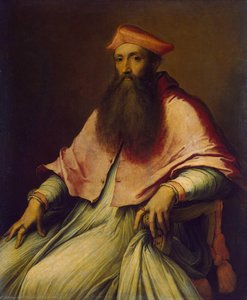
The Venetian Roots: Early Training & Artistic Foundations
The Venetian Renaissance had a distinct character compared to the general Italian Renaissance elsewhere. The Republic of Venice was topographically distinct from the rest of the city-states of Renaissance Italy as a result of their geographic locatio...
Sebastiano Luciani, as he was born, emerged from the vibrant artistic milieu of late 15th-century Venice – a city already steeped in a tradition of color and light that would profoundly shape his early development. Unlike many Renaissance artists who apprenticed within established family workshops, Sebastiano’s path began with musical training, hinting at an initial inclination towards harmony and expression beyond the purely visual realm. This sensitivity to nuance would later translate into his masterful handling of tone and atmosphere. His formal artistic education commenced under Giovanni Bellini, a pivotal figure in Venetian painting whose influence is discernible in Sebastiano's early works – a delicate precision of line and a growing understanding of composition. However, it was the burgeoning talent of Giorgione that truly captivated the young artist. Though their direct collaboration remains somewhat shrouded in historical ambiguity, the impact of Giorgione’s poetic realism and atmospheric perspective on Sebastiano is undeniable. He absorbed not merely technical skills but a philosophical approach to painting – an emphasis on mood, suggestion, and the evocative power of color itself. These formative years instilled within him a distinctly Venetian sensibility, one that prioritized sensual experience and emotional resonance over rigid adherence to classical form.
Del Piombo's Roman Ascent: Patronage, Style Shift & Raphael’s Influence
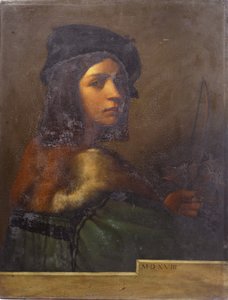 Sebastiano del Piombo
Sebastiano del Piombo (1485-1547) was a Venetian-Roman Renaissance painter known for his unique blend of Venetian colorism and Roman grandeur. His masterful works, including "Pietà" and "Raising of Lazarus," showcase Mannerist style and significant a...
The year 1511 marked a turning point in Sebastiano’s career. Summoned to Rome by the influential Agostino Chigi – a prominent banker and art patron – alongside Baldassare Peruzzi, he embarked on a commission for frescoes within the Villa Farnesina. This relocation was not merely a change of geography; it represented an immersion into a vastly different artistic ecosystem. While Venice fostered a spirit of independent innovation, Rome was dominated by the monumental grandeur of High Renaissance masters like Raphael and Michelangelo. Initially tasked with contributing to Chigi’s ambitious decorative scheme, Sebastiano found himself navigating a complex landscape of competing styles and expectations. He quickly recognized the power of Roman patronage and began adapting his Venetian techniques to suit the tastes of his new audience. The frescoes at Farnesina reveal this transitional phase – glimpses of Giorgione's lyricism interwoven with an increasing emphasis on sculptural form and dramatic narrative. Crucially, Sebastiano forged a close friendship with Michelangelo, who actively encouraged him to challenge Raphael’s dominance and embrace a more robust, classically-inspired aesthetic. This mentorship proved pivotal, pushing Sebastiano towards a synthesis of Venetian colorism and Roman monumentality – a unique artistic identity that would define his mature style.
Mastering the Portrait: A Synthesis of Color and Form – Key Works Analyzed
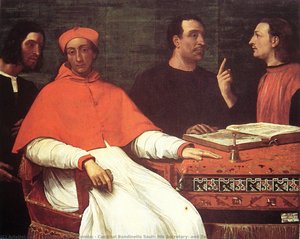 Cardinal Bandinello Sauli, His Secretary, and Two Geographers
Explore Sebastiano del Piombo’s masterpiece: ‘Cardinal Bandinello Sauli…’. Renaissance realism, Venetian color & Roman grandeur – a captivating portrait.
Sebastiano’s true genius blossomed in the realm of portraiture. He possessed an extraordinary ability to capture not merely physical likeness but also the psychological depth and social standing of his sitters. Cardinal Bandinello Sauli, His Secretary, and Two Geographers, exemplifies this mastery. The composition is meticulously arranged, conveying a sense of power and intellectual authority. The rich, luminous colors – hallmarks of his Venetian training – are deployed to create a palpable atmosphere of opulence and refinement. Equally compelling is the Portrait of Pope Clement VII, a starkly monochromatic study that reveals a profound understanding of human character. Stripped of elaborate ornamentation, the portrait focuses solely on the Pope’s face, conveying a sense of gravitas and inner turmoil. And then there's the Portrait of Cardinal Antonio Ciocchi del Monte, where vibrant reds and golds accentuate the cardinal’s noble bearing and the luxurious fabrics he wears. These portraits are not simply representations; they are carefully constructed statements about power, status, and personality – testaments to Sebastiano’s skill in blending technical virtuosity with insightful observation.
Beyond Likeness: Psychological Depth & Narrative in Del Piombo’s Portraits
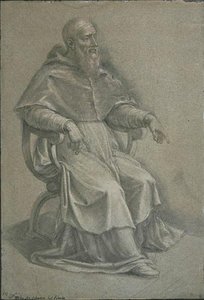 Portrait du Pape Clément VII
Explore Sebastiano del Piombo’s monochromatic study of Pope Clement VII – a masterful Renaissance portrait showcasing realism & classical elegance. Discover its details!
What sets Sebastiano's portraits apart is his ability to imbue them with a sense of narrative. He wasn’t content merely to depict outward appearances; he sought to reveal the inner lives of his subjects. The subtle gestures, the carefully chosen accessories, and the atmospheric lighting all contribute to a deeper understanding of their character and motivations. Consider the inclusion of objects within the portraits – books signifying intellectual pursuits, maps hinting at political ambitions, or religious symbols reflecting spiritual devotion. These details are not accidental; they are integral components of a larger narrative that speaks volumes about the sitter’s world and aspirations. Furthermore, Sebastiano's use of color is profoundly psychological. Warm tones evoke vitality and confidence, while cooler hues suggest introspection and melancholy. He understood that color could be used to manipulate perception and create an emotional response in the viewer – a technique he honed through years of study in Venice. This ability to convey complex emotions through subtle visual cues elevates his portraits beyond mere representations of individuals; they become windows into their souls.
The Papal Seal & Later Years: Artistic Productivity & Mannerist Tendencies
In 1531, Sebastiano’s life took another unexpected turn when he was appointed Keeper of the Papal Seal – a position of considerable responsibility and prestige. While this appointment brought him closer to the center of power, it also curtailed his artistic productivity. The demands of his office required constant attendance on the Pope, leaving him with limited time for painting. Moreover, he embraced holy orders, further restricting his freedom and influencing his subject matter. His later works reflect these changes – a shift towards more religious themes and a growing embrace of Mannerist tendencies. While he continued to produce portraits, they often lack the vibrancy and psychological depth of his earlier masterpieces. The influence of Michelangelo remained strong, but it was tempered by a sense of formality and restraint. Despite this decline in output, Sebastiano’s legacy as a pivotal figure in Renaissance art remained secure.
Legacy & Influence: Del Piombo's Place in Renaissance Art History
Sebastiano del Piombo occupies a unique position within the pantheon of Renaissance masters. He stands as a testament to the power of artistic synthesis – a rare ability to seamlessly blend the sensual colorism of Venice with the monumental forms of Rome. His influence, though perhaps less widely disseminated than that of Raphael or Michelangelo, was nonetheless profound. He introduced Giorgione’s poetic realism to Roman audiences and inspired a generation of artists to explore new possibilities in portraiture. While he may not have produced an extensive body of work, the quality and originality of his paintings ensure his enduring place in art history. Today, collectors prize his works for their exquisite beauty, psychological depth, and historical significance. ArtsDot offers meticulously crafted reproductions of Sebastiano del Piombo’s masterpieces, allowing you to experience the captivating artistry of this Renaissance master firsthand – bringing a touch of Venetian colorism and Roman grandeur into your own home.