

The Dawn of Oil: From Ancient Origins to Renaissance Innovation
Oil painting is a painting method involving the procedure of painting with pigments combined with a drying oil as the binder. It has been the most common technique for artistic painting on canvas, wood panel, or copper for several centuries. The adva...
The allure of oil painting, that luminous quality capable of capturing both the fleeting subtlety of light and the profound depth of human emotion, belies a history far more ancient than many realize. While often associated with the European masters of the Renaissance, its roots stretch back millennia, beginning not as a pursuit of artistic expression in the way we understand it today, but as a practical application of natural resources. Evidence suggests that Buddhist artists in 7th-century Afghanistan were among the first to utilize oil-based paints within the cave complexes of Bamiyan, employing walnut and poppy seed oils to bind pigments onto surfaces – a testament to early ingenuity and a sophisticated understanding of material properties. These weren’t isolated experiments; plant oils mixed with pigments served diverse purposes in ancient Mesopotamia and Egypt, from sealing boats to adorning tombs. However, these early uses differed significantly from the layered techniques that would come to define oil painting as we know it.
The true transformation began in Northern Europe during the 15th century, a period marked by an insatiable desire for realism and detail. Artists like Hubert and Jan van Eyck didn’t simply *adopt* oil paint; they revolutionized its application with what became known as the Flemish Technique. Dissatisfied with the limitations of egg tempera – its rapid drying time and tendency to crack – they sought a medium that offered greater flexibility, richer color saturation, and the ability to build up layers of translucent glaze. Their meticulous process involved preparing wooden panels with multiple layers of gesso, creating an exceptionally smooth surface upon which to work. A precise underdrawing was painstakingly transferred, followed by the application of imprimatura – a thin, tinted layer that established the overall tone of the painting and protected the delicate sketch beneath. The subsequent layering of transparent glazes, each subtly modulating color and light, resulted in works possessing an unparalleled luminosity and depth. This wasn’t merely about technical innovation; it was a philosophical shift—a desire to capture not just *what* they saw, but *how* they saw it.
Technique & Materials: The Science Behind Enduring Masterpieces
 The Enduring Legacy of Oil on Canvas: Technique, History & Contemporary Practice
Explore the rich history & enduring techniques of oil painting on canvas. Discover the science behind its longevity, conservation practices, and contemporary relevance. Expert insights for art enthusiasts.
The magic of oil paint isn't simply in the artist’s hand, but in the complex interplay of its components. At its core, oil painting involves suspending pigments – finely ground powders derived from minerals, plants, or even insects – within a drying oil binder, typically linseed, poppy seed, walnut, or safflower oil. Each oil imparts unique characteristics to the paint: linseed oil offers durability and gloss but yellows over time; poppy seed oil dries slowly and remains clearer; walnut oil provides a smoother consistency. The choice of solvent, traditionally turpentine, further influences viscosity and drying speed. But understanding these basic elements only scratches the surface.
The principle of ‘fat over lean’ is paramount – each successive layer must contain more oil than the one below to ensure proper adhesion and prevent cracking. This isn't a rigid rule but rather a guiding principle rooted in the physics of oxidation, the process by which oil paint dries and forms a durable film. Artists often incorporated resins like pine or frankincense into their mediums, adding texture and varnish-like protection. The brushes themselves were tools of precision – soft Minever hair for delicate details, hogs bristle for broader strokes. The very act of grinding pigments was an art form in itself, demanding skill and patience to achieve the desired consistency and color intensity. Furthermore, the support—canvas stretched taut over a wooden frame or a carefully prepared wood panel—played a crucial role in the longevity of the artwork. The quality of these materials, combined with meticulous application, explains why so many oil paintings from centuries ago continue to captivate us today.
Baroque Drama & Beyond: Exploring Stylistic Evolutions in Oil Painting
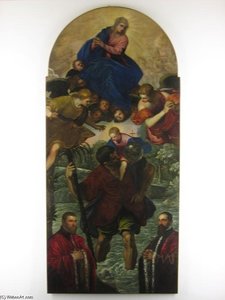 St. Christopher
Explore Tintoretto’s ‘St. Christopher,’ a dramatic Baroque masterpiece featuring Christ & angels. Discover rich colors, dynamic lines & spiritual depth in this Venetian icon.
The Renaissance emphasis on realism paved the way for the dramatic intensity of the Baroque period. Artists like Jacopo Tintoretto embraced the expressive potential of oil paint, utilizing rich colors, dynamic compositions, and bold chiaroscuro – the stark contrast between light and shadow – to evoke powerful emotions. His ‘St. Christopher,’ a masterpiece of Venetian painting, exemplifies this shift; the swirling figures and celestial light create a sense of movement and spiritual fervor rarely seen before. Simultaneously, in Spain, Francisco de Zurbarán employed oil paint with a different sensibility, focusing on austere religious scenes characterized by dramatic lighting and pyramidal compositions. ‘St. Bonaventure’ showcases his mastery of texture and detail, conveying a profound sense of contemplation and devotion.
As art evolved through the 18th and 19th centuries, oil painting continued to adapt and innovate. The Rococo period saw a shift towards lighter palettes and more decorative subjects, while Romanticism embraced emotional intensity and dramatic landscapes. Realism, spearheaded by artists like Gustave Courbet, sought to depict everyday life with unflinching honesty. The Impressionists, rejecting the academic conventions of their predecessors, experimented with broken color and fleeting moments of light, capturing the ephemeral beauty of the modern world. Each movement built upon – or reacted against – those that came before, pushing the boundaries of what oil paint could achieve.
Symbolism and Narrative: Deciphering the Stories Within the Paint
Beyond its technical prowess, oil painting has always been a powerful vehicle for storytelling and symbolic representation. Artists embedded layers of meaning within their works, often drawing upon religious iconography, mythology, or contemporary events. Johannes Vermeer’s ‘The Art of Painting,’ for example, is not merely a depiction of an artist at work; it's an allegorical masterpiece brimming with symbolism. The map on the wall, the carefully chosen objects, and even the model’s pose all contribute to a complex narrative about the nature of art itself.
Understanding these hidden layers requires careful observation and historical context. The choice of colors could convey specific emotions or social status; certain animals or plants held symbolic significance; even the composition of the painting – the arrangement of figures, the use of perspective – could communicate subtle messages. Art historians employ a range of methodologies to decipher these meanings, analyzing form, iconography, and the broader cultural context in which the artwork was created. The ability to ‘read’ a painting—to understand not just what is depicted but *why* it is depicted in a particular way—is essential to appreciating its full depth and richness.
Oil Painting Today: Contemporary Practices and Artistic Expression
Despite the emergence of new media, oil paint remains remarkably relevant in contemporary art. Artists continue to explore its unique properties, pushing boundaries and challenging traditional conventions. While some embrace classical techniques, others experiment with unconventional materials and approaches, incorporating collage, texture, and mixed media into their work. The versatility of oil paint allows for a wide range of expression, from hyperrealistic portraits to abstract explorations of color and form.
The enduring appeal of oil painting lies in its tactile quality – the visible brushstrokes, the subtle variations in texture, the luminosity that only oil can achieve. It’s a medium that demands patience, skill, and a deep understanding of materials, but it also offers unparalleled creative freedom. Contemporary artists are not simply replicating past masters; they are building upon centuries of tradition, forging new paths and redefining what oil painting can be.
Collecting Oil Paintings: Authenticity, Investment, and Lasting Value
 Navigating the Contemporary Landscape of Oil Painting Acquisition: A Guide for Collectors
A comprehensive guide for art collectors navigating the oil painting market. Learn to assess value, authenticate artworks, and build a lasting investment with expert insights.
For those drawn to the beauty and history of oil paintings, collecting presents a unique opportunity to own a piece of cultural heritage. However, navigating the art market requires careful consideration and expert guidance. Establishing authenticity is paramount – verifying provenance (the artwork’s documented history) and assessing the artist’s technique are crucial steps in ensuring a sound investment.
Understanding the factors that influence value—artist reputation, historical significance, condition, and rarity—is equally important. Working with reputable galleries or art advisors can provide valuable insights and protect against potential fraud. At ArtsDot.com, we specialize in delivering authentic, handmade oil paintings crafted by skilled artists. We offer a curated selection of masterpieces, custom reproduction services, and expert appraisal assistance to help you build a lasting collection. Investing in an oil painting is not merely acquiring an object; it’s investing in history, artistry, and the enduring power of human expression. Our commitment to quality ensures that each artwork is crafted with meticulous attention to detail, using gallery-quality materials designed to last for generations.