



Introduction: The Primacy of Observation
The act of seeing is, perhaps deceptively, the foundation upon which all artistic endeavor rests. Yet, to truly *see* – to move beyond mere visual registration and engage in a profound analysis of form, light, and composition – is a skill cultivated through rigorous training, innate sensitivity, and an unwavering commitment to detail. For the discerning collector, understanding this primacy of observation isn’t simply about appreciating aesthetic beauty; it's about recognizing the intellectual and emotional labor embedded within each brushstroke, each carefully considered hue. It is in these subtle nuances that value resides, a testament to the artist’s unique vision and mastery of their craft.
The Renaissance Eye: Van Eyck and Meticulous Detail
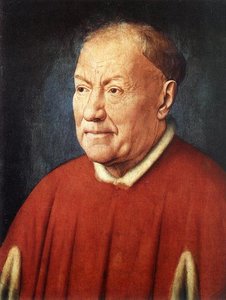 Portrait of Cardinal Niccolò Albergati
Jan van Eyck
No exploration of detailed observation would be complete without acknowledging Jan van Eyck. His work, particularly “Portrait of Cardinal Niccolò Albergati,” transcends portraiture; it’s a testament to the power of hyperrealism. Van Eyck didn't merely paint what he saw; he painstakingly recreated reality with an almost scientific precision. Examine the textures – the sheen of silk, the glint of metal, the individual hairs of the Cardinal’s beard. These aren’t approximations but meticulous renderings achieved through layered glazing techniques and a profound understanding of optics. The artist's ability to capture light itself—the way it falls across surfaces, defines form, and creates depth—was revolutionary. This wasn’t simply about technical skill; it was an attempt to understand the very essence of existence, reflected in the tangible world. The collector who appreciates Van Eyck understands they are acquiring not just a likeness, but a window into a different way of perceiving reality.
Impressionism's Fleeting Glimpses: Degas and the Analysis of Movement
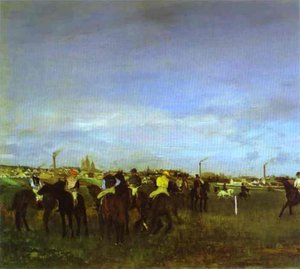 The Races. Before the Start
“Before the Race” by Edgar Degas is a captivating Impressionist depiction of equestrian life, capturing the tension before a race with innovative techniques and luminous color palettes. Explore this iconic artwork’s detailed analysis and discover mor...
Shifting forward several centuries, we encounter Edgar Degas, an artist whose approach to observation differed dramatically from Van Eyck’s. While Van Eyck sought permanence in detail, Degas captured the ephemeral – the fleeting moments of modern life. “The Races. Before the Start” exemplifies this perfectly. Instead of a static scene, Degas presents a dynamic composition brimming with tension and anticipation. His brushstrokes are loose, almost sketch-like, yet they convey an astonishing sense of movement and energy. The focus isn’t on precise anatomical accuracy but on capturing the *impression* of speed, light, and atmosphere. Degas wasn't simply recording what he saw; he was analyzing it – breaking down complex movements into their constituent parts and reconstructing them on canvas with remarkable intuition. This analytical approach, coupled with his innovative use of color and composition, redefined the possibilities of painting.
Bruegel’s Complex Narratives: Decoding Layers of Detail
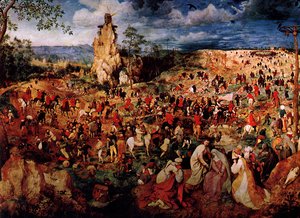 The Procession to Calvary
Pieter Bruegel’s "The Procession to Calvary" (1564): A chaotic Mannerist masterpiece! Explore this rich, detailed oil painting of religious fervor & political intrigue. #Bruegel #RenaissanceArt
Pieter Bruegel the Elder presents a unique challenge to the observer. “The Procession to Calvary” is not a scene of serene religious devotion but a chaotic panorama teeming with life, detail, and subtle social commentary. The painting is densely populated, filled with figures engaged in a multitude of activities, many seemingly unrelated to the central event. This apparent disorder, however, is deliberate. Bruegel’s meticulous attention to everyday details – the clothing, tools, and customs of 16th-century Flanders – provides a rich tapestry of social life. The collector must actively engage with the painting, deciphering its hidden meanings and unraveling its complex narrative layers. It's not enough to simply *look* at Bruegel; one must *interpret* him, recognizing the artist’s subtle critiques of human folly and societal hypocrisy. The sheer volume of detail demands repeated viewing, revealing new insights with each encounter.
Beyond Realism: The Psychological Depth of Observation
The pursuit of realism, in its strictest sense, is often a means to an end – a foundation upon which artists can explore deeper psychological and emotional truths. Consider how Van Eyck’s meticulous portraits convey not just physical likeness but also the sitter's character and status. Similarly, Degas’s fleeting impressions capture the anxieties and uncertainties of modern life. Bruegel’s detailed scenes reveal a profound understanding of human nature – its strengths, weaknesses, and contradictions. The most compelling artworks aren’t simply visually accurate; they offer insights into the human condition. The collector who understands this recognizes that detail isn't merely about technical skill but about conveying meaning, emotion, and intellectual depth.
Interactive Visual Analysis & the Modern Collector
Interactive Visual Analysis (IVA) is a set of techniques for combining the computational power of computers with the perceptive and cognitive capabilities of humans, in order to extract knowledge from large and complex datasets. The techniques rely h...
Today, technology offers new tools for engaging with art on a deeper level. Interactive Visual Analysis (IVA), combining computational power with human perception, allows us to dissect artworks in unprecedented detail – examining brushstrokes, color palettes, and compositional elements with scientific precision. While no tool can replace the subjective experience of viewing an artwork firsthand, IVA provides valuable insights for collectors seeking a more comprehensive understanding of their acquisitions. Furthermore, the ability to compare and contrast different works, identify stylistic influences, and assess authenticity is invaluable in today’s art market. At ArtsDot.com, we believe that informed collecting is empowered collecting. We offer not only museum-quality reproductions but also a wealth of resources – detailed analyses, artist biographies, and expert consultations – to help you cultivate your appreciation for the world's great masterpieces. Whether you’re seeking a timeless classic or commissioning a custom portrait, our commitment to quality and detail ensures that every artwork is a testament to the power of observation.