

The Architecture of Vision: Understanding Cubist Fragmentation
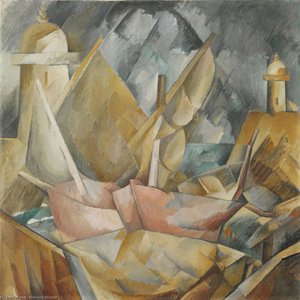
To gaze upon a Cubist masterpiece is to witness the deliberate shattering of a singular, comfortable reality. For centuries, the Western tradition was anchored by the Renaissance ideal of linear perspective—a window through which the viewer observed a static, unified world. However, at the dawn of the twentieth century, a seismic shift occurred. The advent of Cubism did not merely introduce a new style; it introduced a new way of perceiving time and space. Fragmentation, in this context, is not an act of destruction, but one of profound reconstruction. It is the analytical process of breaking down an object into its constituent geometric essences, allowing the artist to present a more complete, albeit complex, truth.
This architectural approach to vision demands an active participant rather than a passive observer. When we encounter the fractured planes and overlapping facets characteristic of this movement, our minds are invited to bridge the gaps left by the artist. We are no longer looking at a frozen moment in time, but rather at a synthesis of multiple viewpoints captured simultaneously. This technique challenges the very notion of what it means to "see," suggesting that true understanding requires us to acknowledge the multifaceted nature of existence, where every object possesses hidden dimensions waiting to be revealed through the interplay of light and form.
Deconstructing the Subject: From Picasso’s Portraits to Braque’s Geometry
The genesis of this revolution is inextricably linked to the genius of Pablo Picasso and Georges Braque. In the early works of Picasso, such as the evocative Boy with a Pipe, we see the seeds of a transformative era. While still retaining traces of vibrant color and recognizable form, the work begins to pulse with an embryonic fragmentation that hints at the radical departures to come. As the movement matured into Analytical Cubism, the subject matter underwent a rigorous interrogation. The human figure, once the pinnacle of anatomical accuracy, was subjected to a geometric dissection, where flesh and bone were reimagined as a series of interlocking shadows and light.
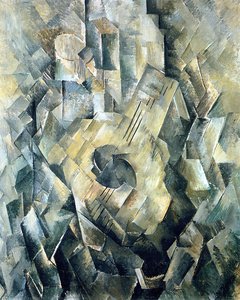
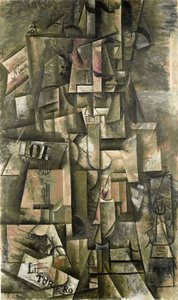
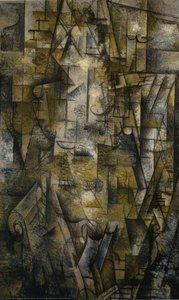
Braque, working in close intellectual symbiosis with Picasso, brought a rhythmic, structural discipline to this deconstruction. In works like The Man of the Guitar, the boundaries between the subject and the surrounding atmosphere begin to dissolve. The instrument, the musician, and the very air they inhabit are rendered through a shared language of planes and edges. This dissolution of the figure-ground relationship is perhaps the most radical achievement of the movement. By treating the void with the same structural weight as the solid, Cubism achieved a unified field of energy, where every brushstroke contributes to a larger, cohesive tapestry of geometric complexity.
The Multi-Dimensional Perspective: Breaking the Single Point of View
Traditional painting often relies on the illusion of depth to create a sense of realism, yet this depth is inherently deceptive, tethered to a single, fixed eye. Cubism sought to liberate the canvas from this limitation. By employing multiple perspectives, artists could depict the front, side, and top of an object all within the same pictorial plane. This technique mimics the way human memory and perception actually function—we do not experience objects as static snapshots, but as a collection of impressions gathered through movement and duration.
Beyond the Canvas: The Intellectual Legacy and Modern Resonance of Cubism
The ripples of the Cubist revolution extended far beyond the boundaries of the canvas, influencing everything from architecture and graphic design to literature and film. The movement’s emphasis on structure, rhythm, and the rejection of superficial imitation paved the way for the rise of pure abstraction. The intellectual rigor required to appreciate Cubism has left an indelible mark on the art collector's psyche, fostering a deep appreciation for works that demand intellectual engagement and reward careful study.
In our contemporary era, the spirit of fragmentation remains strikingly relevant. We live in a digital age characterized by fragmented information streams and multi-layered realities. The Cubist ability to synthesize disparate elements into a coherent whole provides a powerful framework for understanding our current landscape. When we collect works that echo these principles, we are not merely acquiring aesthetic objects; we are preserving a vital philosophical inquiry into the nature of perception itself—an inquiry that continues to challenge and inspire the modern collector.
Curating Complexity: Integrating Fragmented Masterpieces into Contemporary Interiors
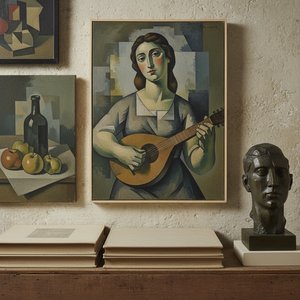
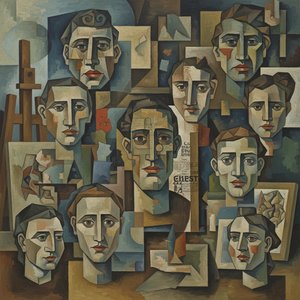
For the discerning collector, integrating Cubist-inspired works into a contemporary interior requires a sophisticated understanding of balance and tension. The inherent energy of fragmented forms can serve as a powerful focal point within a room, providing a dynamic counterpoint to the clean lines of modern architecture. A large-scale, multi-panel Cubist reproduction can transform a wide wall or a grand staircase into a site of profound visual interest, where the flow of color and geometry guides the eye through the space.
Successful curation involves playing with the interplay between the structured chaos of the artwork and the serenity of the surrounding environment. One might pair a heavily textured, impasto-style Cubist piece with minimalist furniture to allow the complexity of the brushwork to breathe. Alternatively, using professional digital mockups can assist in visualizing how the specific color palette of a fragmented masterpiece will interact with existing decor. Whether through a single iconic portrait or an expansive, multi-panel installation, the inclusion of Cubist elements brings a layer of intellectual depth and historical prestige to any curated collection.
At ArtsDot.com, we specialize in bringing these profound historical moments into the modern home. Our master artists, holding degrees from prestigious academies, meticulously hand-paint oil reproductions that capture the tactile soul and structural complexity of Cubist masterpieces. From custom "remixed" portraits to large-scale architectural murals, our mission is to make the transformative power of fine art accessible to collectors worldwide.