Introduction
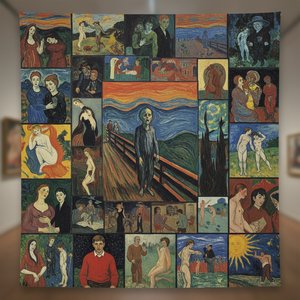
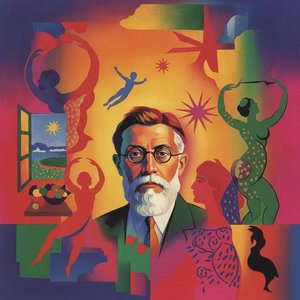
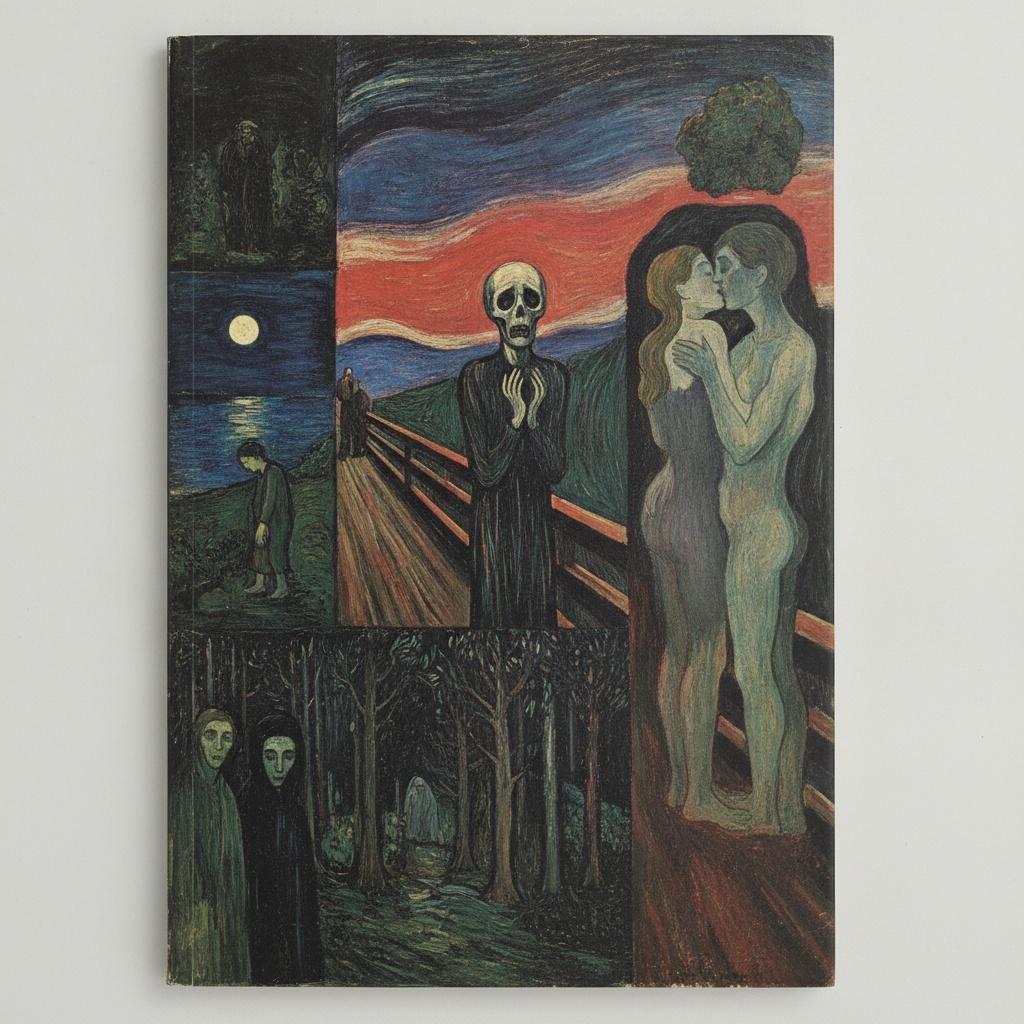
To step into the world of Edvard Munch is to walk through a gallery of the human soul, where the boundaries between the external landscape and internal heartache begin to dissolve. There is a profound, haunting intimacy in his work—a sense that we are not merely looking at paint on canvas, but peering directly into the quiet, often turbulent, corridors of memory and emotion. As we prepare to journey through these twenty-five seminal works, imagine the air growing heavy with the scent of salt spray and the weight of unspoken grief, much like the atmosphere that permeated Munch’s own life in Norway.
Born amidst the stark, beautiful shadows of the North, Munch’s early years were etched with the tragedy of loss, a theme that would become the heartbeat of his creative existence. While he emerged from the formal traditions of his training, he found his true voice by looking inward, moving beyond the mere depiction of light and form to pioneer what he called "soul painting." Influenced by the bold, expressive spirits of the Post-Impressionists, Munch transformed the raw textures of life—fear, anxiety, longing, and even ecstasy—into a visual language that remains as visceral today as it was at the turn of the century.
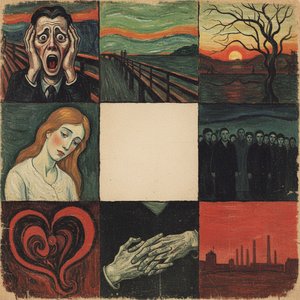
These masterpieces remain deeply meaningful in our modern age because they speak to the universal truths of the human condition. In an era of constant noise, Munch’s ability to capture the silent scream, the lonely silhouette, and the undulating rhythm of existential dread resonates with anyone who has ever felt the weight of the world. His colors do not just sit upon the canvas; they pulse with a psychological intensity that demands we acknowledge our own vulnerabilities.
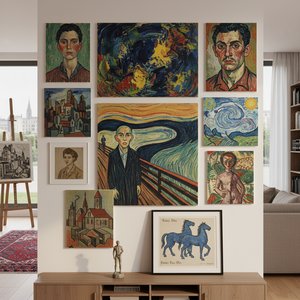
In the pages that follow, we invite you to linger before each piece, to feel the movement of his expressive brushstrokes and the depth of his tonal shadows. From his most iconic, world-renowned symbols of anxiety to the more tender, fleeting moments of light and life, this collection serves as a guided tour through the profound emotional landscape of one of history's most evocative masters.
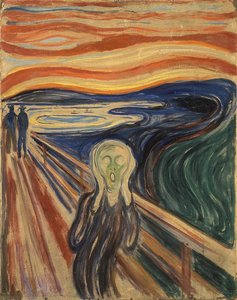
The Scream - Edvard Munch
 The Scream - Edvard Munch
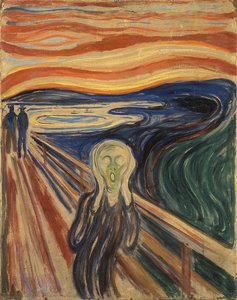
To stand before The Scream is to witness the very moment the human psyche fractures. Created in 1893, this is not merely a painting; it is a visceral, sonic experience captured in oil. Munch invites us into a world where the boundaries between the internal soul and the external landscape dissolve into a single, agonizing vibration. The composition pulls you along the sharp, receding diagonal of the bridge, thrusting you toward that iconic, skull-like figure clutching its face in silent terror.
The palette is a tempest of emotion—fiery, blood-orange skies clash violently with the deep, melancholic blues of the fjord, mirroring the artist's own turbulent spirit. Every thick, expressive brushstroke vibrates with existential dread, turning the swirling atmosphere into a visual echo of an internal cry. For the collector, bringing this masterpiece into your home is an act of profound transformation; it is about surrounding yourself with the raw, beautiful truth of human vulnerability. It turns a quiet corner of your room into a powerful gallery of the soul, where the shadows of anxiety meet the light of artistic genius.
Melancholy - Edvard Munch
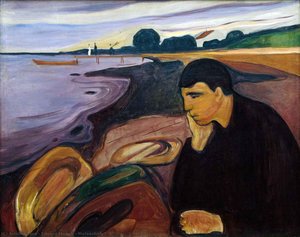 Melancholy - Edvard Munch
In Melancholy by Edvard Munch, a profound, heavy indigo permeates the canvas, casting a somber veil over the shoreline that immediately evokes a sense of quiet introspection. This mastery of a muted, cool palette—rich with deep purples, bruised blues, and earthy browns—is precisely why this work stands as one of the top 25 artworks of Edvard Munch . He does not merely paint a landscape; he uses color to externalize the weight of a solitary soul, where even the distant, flickering yellows in the sky feel burdened by the surrounding gloom.
For the discerning collector, integrating such an emotionally resonant piece into a modern home offers a unique opportunity to curate atmosphere. The painting’s twilight tones and diffused, atmospheric lighting can anchor a dining room or study, providing a sophisticated focal point that encourages stillness. When paired with soft, ambient lighting, the visible, energetic brushstrokes and the deep, melancholic hues create a sanctuary of contemplative elegance, bringing the raw, expressive power of Expressionism into your personal living space.
Madonna - Edvard Munch
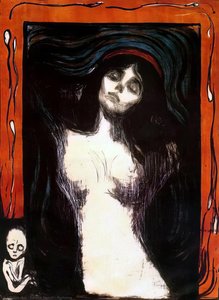 Madonna - Edvard Munch
In the hauntingly beautiful Madonna , Edvard Munch invites us into a realm where the sacred and the visceral collide. This masterpiece stands as a cornerstone of his most profound works, transcending traditional religious iconography to explore the raw, often agonizing, complexities of human existence. Rather than an idealized icon, we encounter a woman caught in a vortex of emotion, her pale features framed by swirling, chaotic lines that evoke both a celestial halo and an overwhelming psychological storm.
The painting’s visual language—characterized by deep blacks, fiery oranges, and a sense of profound vulnerability—resonates deeply within modern interiors that seek to tell a story of depth and introspection. As we navigate the themes of mortality and maternal anxiety present in this 1894 creation, we see how Munch’s Expressionist roots continue to influence contemporary aesthetics of emotional honesty. For the discerning collector, Madonna is more than an artwork; it is a profound cultural touchstone that brings a sense of dramatic, soulful intensity to any curated space.
Christmas in the Brothel - Edvard Munch
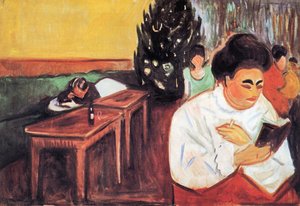 Christmas in the Brothel - Edvard Munch
In Christmas in the Brothel , Edvard Munch invites us into a world that is as visually arresting as it is psychologically complex. This 1905 masterpiece stands as a profound pillar among the top 25 artworks of Edvard Munch , capturing a moment of startling intimacy amidst a chaotic, modern setting. The painting vibrates with a saturated palette of deep reds, warm oranges, and earthy browns, creating an atmosphere that feels simultaneously energetic and unsettling.
Munch utilizes bold, gestural brushstrokes and flattened perspectives to draw the eye toward a central figure—a woman lost in a book, her quiet contemplation acting as a poignant anchor against the swirling, fragmented crowd around her. This tension between solitude and social density offers a timeless reflection on the human condition. For the modern collector or interior designer, this piece brings an unparalleled emotional resonance to a space; its expressive textures and dramatic, artificial lighting provide a sophisticated focal point that transcends mere decoration, offering instead a window into the very soul of Expressionism.
The Dance of Life - Edvard Munch
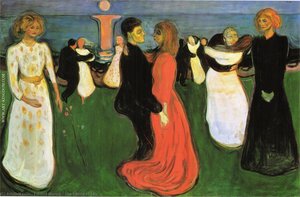 The Dance of Life - Edvard Munch
In The Dance of Life , Edvard Munch does not merely paint a scene; he composes a visual sonata of the human soul. As you stand before this 1899 masterpiece from his celebrated Frieze of Life series, you feel the rhythm of existence itself. The light here is a language of its own—not a mere reflection, but an emotional pulse that illuminates the tension between joy and dread.
The composition draws the eye through a swirling, almost hypnotic movement, where the striking red of a woman’s dress acts as a heartbeat against more muted, somber tones. Munch uses color to weave a symbolic narrative: the white of innocence, the red of passion, and the black of inevitable decline. His expressive, impasto-like brushwork creates a tactile depth, making the undulating lines of the figures feel as though they are breathing. It is a profound exploration of connection and loss, inviting you to witness the transient beauty of our shared journey. To possess such a work is to bring a portal of deep, psychological reflection into your own sanctuary.
Ashes - Edvard Munch
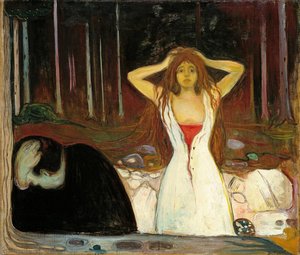 Ashes - Edvard Munch
In Ashes , we encounter one of Edvard Munch’s most hauntingly beautiful explorations of the human psyche. This 1894 masterpiece serves as a window into the artist's profound preoccupation with mortality and grief. The composition is anchored by a woman with striking, fiery red hair, her face etched with a visible, clutching anguish that seems to vibrate against the dark, vertical shadows of the forest. Beneath her, a shrouded, prone figure lies partially obscured, suggesting the heavy presence of loss and the fragility of life.
Munch utilizes a somber, earthy palette of deep greens, blacks, and browns, allowing the stark white of the woman’s dress and the vibrant crimson of her hair to emerge like flickers of memory in a dream. The loose, expressive brushwork creates a tactile energy, transforming the canvas into a gallery of the soul . For the discerning collector, this piece is more than an artwork; it is an emotional transformation, bringing the raw, symbolic intensity of Expressionism into the sanctuary of the home.
Separation - Edvard Munch
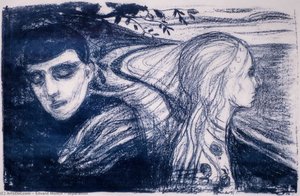 Separation - Edvard Munch
To stand before Separation by Edvard Munch is to witness the very moment a soul begins to fracture. In this hauntingly beautiful 1896 lithograph, Munch captures the visceral ache of departure, moving far beyond mere portraiture into the realm of pure, psychological experience. As one of the most profound entries in our collection of the top 25 artworks of Edvard Munch , this piece serves as a masterclass in the Expressionist language of grief.
The composition is a symphony of sorrow, split by flowing lines that mirror a widening emotional rift. Munch utilizes a somber palette of melancholic blues and deep blacks, yet he illuminates the scene with subtle, golden threads in the woman’s hair—a flicker of Art Nouveau elegance amidst the darkness. We see a man clutching his heart, a wound both spiritual and physical, while the woman drifts toward the sea, her hair acting as a symbolic, fading tether to the past. This work remains timeless because it does not just depict a parting; it invites us to feel the weight of every lost connection, transforming any space with its profound, quiet intensity.
Meeting in Space - Edvard Munch
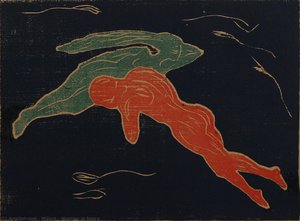 Meeting in Space - Edvard Munch
In Meeting in Space , the eye is immediately drawn to the visceral, grainy texture of Munch’s lithographic mastery, where the ink seems to pulse with a life of its own. As you trace the sweeping, blurred contours of the elongated figures, you feel the tension between the vibrant, unsettling green and the passionate, warning red against that infinite, abyssal black. This is not merely a print; it is a rhythmic dance of shadow and light that captures the very essence of Expressionism—the moment where psychological dread becomes visible through raw, simplified forms.
Munch’s ability to use color as an emotional vessel, rather than a descriptive tool, places this work at the heart of his most profound explorations of isolation. At ArtsDot.com, we strive to honor this tactile depth. Our handmade oil reproductions are meticulously crafted to preserve that essential three-dimensional quality—the weight of the pigment and the soul of the brushstroke—ensuring that the haunting, dreamlike atmosphere of Munch’s vision resides in your home with all its original, breathtaking intensity.
Self-Portrait - Edvard Munch
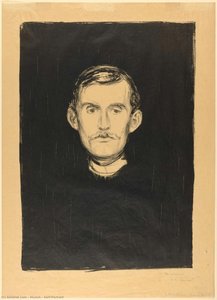 Self-Portrait - Edvard Munch
To encounter Self-Portrait (1895) is to stand face-to-face with the very soul of Edvard Munch. This isn't merely a study of a man’s features; it is a visceral window into the shadows of human vulnerability. In this haunting lithograph, Munch moves beyond simple representation, using agitated, fragmented lines to etch a landscape of psychological unrest onto the paper. The palette, a somber dance of deep blacks, earthy browns, and warm, aged beiges, creates an atmosphere of profound introspection.
As you gaze into his intense, melancholic eyes, you feel the weight of his personal history—the echoes of loss and the pervasive dread of mortality that defined his life. The composition is strikingly intimate, pulling you into a private moment where the boundaries between the artist and the observer dissolve. For those seeking to transform a quiet corner of their home into a sanctuary for contemplation, this piece offers a sophisticated, raw emotional depth. It is more than an artwork; it is a profound invitation to embrace the beautiful, turbulent complexity of the human spirit.
The Military Band on Karl Johan Street - Edvard Munch
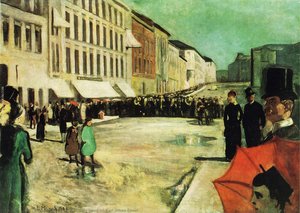 The Military Band on Karl Johan Street - Edvard Munch
To stand before The Military Band on Karl Johan Street is to feel the rhythmic pulse of 1889 Oslo through Munch’s restless, expressive brushwork. One cannot help but be drawn to the tactile energy where thick, deliberate strokes of yellow and deep blue collide, capturing not just a street performance, but the very vibration of sound and urban movement. This piece is essential among the top 25 artworks of Edvard Munch because it captures that pivotal transition from observation to raw, Symbolist emotion; the paint itself seems to breathe with the anxiety and excitement of the crowd.
At ArtsDot.com, we believe such profound textures deserve to be felt, not just seen. Our handmade oil reproductions are meticulously crafted on 100% cotton canvas, ensuring that the heavy impasto and the emotional weight of Munch’s palette are preserved with three-dimensional depth. We bring the soul of the museum into your private sanctuary, recreating every visible stroke so that the haunting, luminous atmosphere of Munch’s masterpiece remains a living, breathing presence in your home.
Winter Night - Edvard Munch
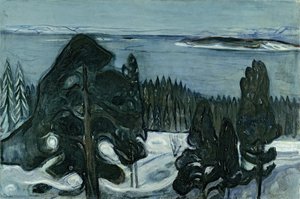 Winter Night - Edvard Munch
Before the world recognized him as a pioneer of Expressionism, Edvard Munch was a man navigating a private blizzard of grief, haunted by the shadows of loss that defined his youth. In 1900, this internal frost crystallized in Winter Night , a work that transcends mere landscape to become a visceral map of the human soul. Rather than capturing the crisp clarity of a Norwegian winter, Munch utilized heavy, angular brushstrokes and a somber palette of icy blues, stark whites, and deep, melancholic greys to evoke a sense of profound psychological solitude.
The technical brilliance of this piece lies in its ability to use simplified, almost distorted forms to create an atmosphere of stillness so heavy it feels tangible. The jagged silhouettes of the foreground trees act as dark sentinels, guarding a frozen expanse that mirrors the artist's own emotional numbness. For those seeking to curate a space of deep reflection, Winter Night offers more than just aesthetic beauty; its quiet prestige and contemplative depth make it an extraordinary centerpiece for a modern study or home office, inspiring a focused, sophisticated atmosphere of introspection and intellectual calm.
Man and Woman I - Edvard Munch
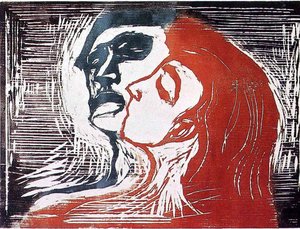 Man and Woman I - Edvard Munch
To encounter Man and Woman I by Edvard Munch is to stand before a raw, visceral window into the human soul, an experience as profound as discovering a hidden gem in a private collection. As one of the most significant works among the top 25 artworks of Edvard Munch , this 1905 masterpiece transcends mere portraiture; it is a psychological landscape where intimacy and anxiety collide. The composition draws the viewer into an unsettlingly beautiful embrace, with two figures pressed together against a striking, arterial red background that pulses with emotional life.
Munch’s mastery of Expressionist technique is evident in the bold, simplified forms and the way light seems to emerge from the very shadows of the wood panel. For the discerning collector, this piece offers more than just historical importance; it brings a sense of profound emotional intelligence and dramatic tension to a refined interior. Its ability to evoke deep contemplation makes it a timeless cornerstone for any gallery, embodying a legacy of beauty found in the most turbulent of human connections.
Kiss - Edvard Munch
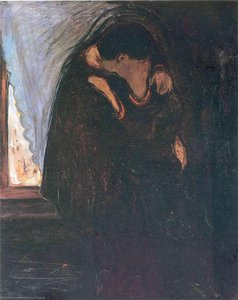 Kiss - Edvard Munch
In Kiss , Edvard Munch invites us into a sanctuary of profound introspection, where the boundaries between the physical world and the internal psyche begin to dissolve. This 1897 masterpiece is far more than a depiction of a solitary figure; it is a visceral exploration of the heavy, beautiful melancholy that defines much of Munch’s soul painting. As we stand before this work, we are enveloped by a somber, atmospheric palette where thick, gestural brushstrokes create an almost tactile sense of emotional turbulence.
The central figure, draped in a dark, flowing cloak, appears lost in a state of deep contemplation or perhaps grief. Munch utilizes a dramatic chiaroscuro effect, allowing a soft, directional light to spill from the side, illuminating the texture of the paint while leaving much of the subject in shadow. This interplay of light and darkness serves as a poignant symbol of hope flickering amidst the shadows of despair. To possess such a piece is to bring a fragment of this raw, expressive genius into your own home, transforming a mere wall into a gallery of the human spirit.
Girl on a Bridge - Edvard Munch
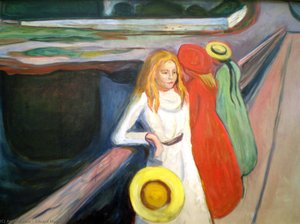 Girl on a Bridge - Edvard Munch
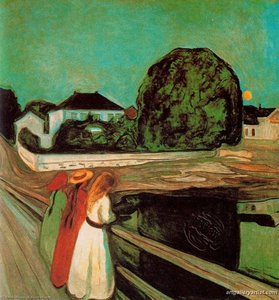
While many associate Edvard Munch solely with the visceral terror of The Scream , there are moments in his oeuvre where the shadows hold a much softer, more intimate weight. In 'Girl on a Bridge' , we step away from pure agony into a delicate realm of Symbolism and quiet companionship. The painting captures two figures poised upon a threshold, their umbrellas shielding them from an unseen elements, creating a sense of shared sanctuary amidst the vastness of the landscape.
Munch’s technical genius lies in his ability to use the bridge as a metaphorical transition between the external world and the internal soul. Through rhythmic brushstrokes and a melancholic palette, he transforms a simple stroll into a profound exploration of human connection and isolation. This mastery of atmosphere—balancing light and shadow to evoke deep introspection—makes it a cornerstone among the top 25 artworks of Edvard Munch . Hanging such a contemplative piece in a modern study or home office invites a sophisticated sense of focus, encouraging a workspace that is not merely productive, but deeply soulful and emotionally resonant.
Mother and Daughter - Edvard Munch
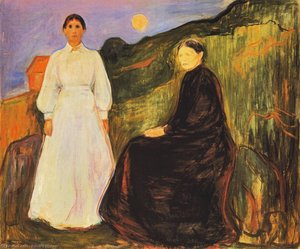 Mother and Daughter - Edvard Munch
In the quiet, heavy air of Edvard Munch’s Mother and Daughter , one can almost feel the pulse of a shared, unspoken sorrow. At ArtsDot.com, we believe that the profound beauty of such masterpieces should not be confined to distant museums, but accessible to those who feel their emotional resonance deeply. This work earns its place among the top 25 artworks of Edvard Munch through its haunting ability to bridge the gap between intimate connection and existential dread.
The painting captures a delicate dialogue of fear and tenderness; while the figures share a moment of closeness, the presence of the clock on the wall serves as a somber reminder of mortality's relentless march. Through loose, agitated brushstrokes and a muted, melancholic palette, Munch transcends mere portraiture to externalize the very soul of human anxiety. It is this raw, psychological depth that makes the piece an irreplaceable pillar of Expressionism. Today, you can bring this transformative presence into your own home or personal gallery through our high-fidelity, hand-painted oil reproductions, allowing Munch's evocative light and profound emotional weight to breathe life into your modern sanctuary.
Portrait of Hanni Esche - Edvard Munch
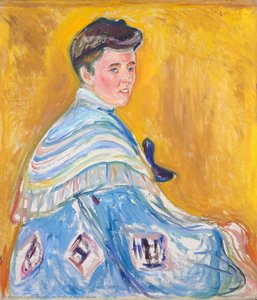 Portrait of Hanni Esche - Edvard Munch
To gaze upon Portrait of Hanni Esche by Edvard Munch is to encounter a soul caught between the elegance of high society and the raw, burgeoning energy of the modern age. Painted in 1905, this work transcends mere likeness, offering us a window into a pivotal era of German social transformation. The subject, Hanni Esche, emerges from a vibrant, sun-drenched yellow background, her presence anchored by the deep, patterned blues of her dress. Munch’s brushwork here is nothing short of elemental; it possesses a certain Kraft —a force and power—that breathes life into the canvas through visible, energetic strokes.
While Hanni embodies the progressive spirit of her time, Munch captures something much more intimate: a thoughtful, subtly melancholic gaze that invites quiet contemplation. The striking color contrast and the textured, almost tactile application of oil paint create a sense of immediacy that is rare in traditional portraiture. As one of the top 25 artworks of Edvard Munch, this piece serves as a profound reminder of how art can capture the fleeting intersection of personal identity and historical change, bringing a timeless, emotive depth to any space it inhabits.
untitled (6059) - Edvard Munch
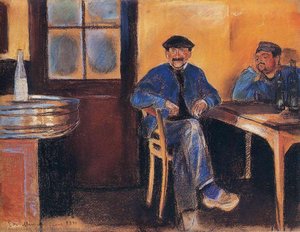 untitled (6059) - Edvard Munch
Step into the quiet, shadowed corner of a late-night tavern, where the air feels heavy with unspoken words. In Untitled (6059) , Edvard Munch invites us to witness a moment that appears deceptively still, yet vibrates with a profound, restless energy. Two figures sit anchored at a weathered wooden table, surrounded by the silent company of glass bottles, their presence captured in a stark, monochrome intensity that strips away all distraction.
Munch utilizes a masterful, almost Expressionistic technique here, using deep tonal contrasts to evoke the psychological weight of the fin de siècle era. The absence of color forces our eyes to trace the textures of the wood and the somber silhouettes of the men, mirroring the internal landscapes of isolation and contemplation. This piece stands out among the top artworks of Edvard Munch because it captures the very essence of existential reflection. In a modern home, such a work serves as a powerful focal point for deep thought, bringing a sophisticated, cinematic gravity to a study or library, and inviting a space for quiet, soulful introspection.
Anxiety - Edvard Munch
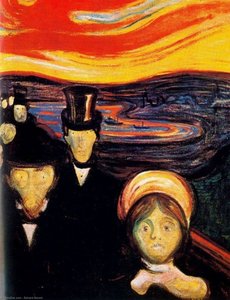 Anxiety - Edvard Munch
In Anxiety , Edvard Munch does not merely paint a landscape; he performs an excavation of the human psyche. There is a gaze in this masterpiece that follows you—not with judgment, but with a profound, haunting understanding . As you stand before these swirling, turbulent waters, you realize this isn't just a depiction of a crowd by a jetty; it is a mirror reflecting our most private, unspoken terrors.
The palette is visceral and bruised, utilizing deep blues and sickly yellows to externalize a state of internal unrest. The figures, though gathered, remain isolated in their anonymity, embodying the universal weight of existential dread. Within this essential piece of the top 25 artworks of Edvard Munch , the boundaries between the observer and the observed dissolve into the rhythmic, expressive brushstrokes. Now, imagine that gaze in your own space. It does not watch you; instead, it serves as a quiet, powerful reminder : you are seen, your complexities are recognized, and you are an inseparable part of this enduring human story.
Jealousy - Edvard Munch
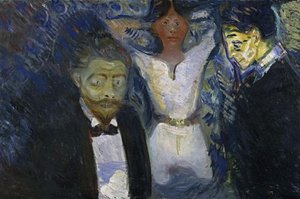 Jealousy - Edvard Munch
To stand before Jealousy by Edvard Munch is to step into a room where the air itself feels heavy with unspoken resentment. Painted in 1913, this masterpiece does not merely depict three figures; it captures the very vibration of psychological tension. Through a muted palette of deep, somber blues and greens, Munch externalizes the stinging ache of suspicion, using his signature "soul painting" technique to turn shadows into emotion.
This work earns its place among the top 25 artworks of Edvard Munch by redefining the boundaries of Expressionism, moving beyond mere portraiture to map the turbulent landscapes of the human psyche. The agitated brushstrokes and skeletal forms serve as a visceral reminder of our shared vulnerability. At ArtsDot.com, we believe such profound emotional depth belongs in your personal sanctuary. Bringing a hand-painted reproduction of Jealousy into your home transforms a simple wall into a window onto the human condition, making the raw, haunting beauty of Munch’s vision a living, breathing part of your daily atmosphere.
Girl with Doll. Erdmute Esche with Polar Bear and Doll - Edvard Munch
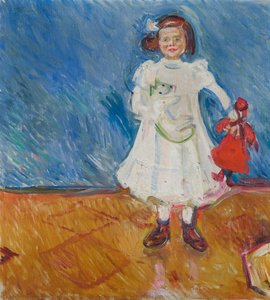 Girl with Doll. Erdmute Esche with Polar Bear and Doll - Edvard Munch
In the quiet, flickering shadows of 1905, Girl with Doll: Erdmute Esche with Polar Bear and Doll by Edvard Munch emerges as a hauntingly beautiful fragment of a dream, where childhood innocence meets the profound weight of the subconscious. This masterpiece earns its place among the top 25 artworks of Edvard Munch through its masterful ability to balance the sweetness of youth with an underlying, restless tension that defines the very soul of Expressionism.
The canvas breathes with a visceral energy; thick, expressive impasto brushstrokes create a textured landscape where vibrant blues collide with earthy browns and sudden, piercing accents of red. The girl’s pale presence acts as a luminous anchor amidst swirling, abstract forms, her gaze slightly averted as if lost in an internal world. For the modern collector, this piece offers more than mere decoration; it brings a sophisticated, psychological depth to a room, inviting a sense of introspective calm and a deep appreciation for the raw, emotive power of light and color captured in eternal motion.
Death of Marat I - Edvard Munch
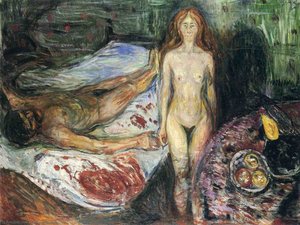 Death of Marat I - Edvard Munch
What story does the swirling, bruised atmosphere of Death of Marat I by Edvard Munch tell us about the fragility of life? In this 1907 masterpiece, Munch moves beyond historical documentation to offer a visceral plunge into the human psyche. Emerging from a period of profound personal mourning and mental instability, this work stands as a cornerstone in our collection of the top 25 artworks of Edvard Munch because it transforms a political assassination into a haunting allegory of mortality.
The canvas is alive with unsettling textures; sickly greens and deep, wounded purples collide through agitated, rhythmic brushstrokes that seem to vibrate with grief. As you observe the pale, vulnerable figure amidst the scattered vessels and the stark presence of the knife, you feel the heavy stillness of a life interrupted. Bringing such a profound piece into your home offers more than mere decoration; it provides a window into the depths of Expressionism, inviting a sense of historical weight and emotional resonance that turns any modern space into a curated sanctuary of reflection and quiet prestige.
Despair - Edvard Munch
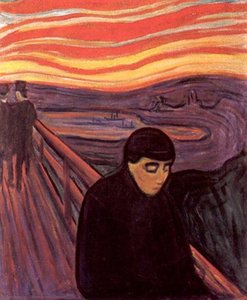 Despair - Edvard Munch
In the quiet, heavy shadows of Despair by Edvard Munch, one finds a profound silence that speaks louder than any cry. This 1892 masterpiece remains an essential pillar among the top 25 artworks of Edvard Munch because it captures the very essence of the human psyche—the moment where isolation becomes visible. The painting presents a solitary figure at a piano, enveloped in a palette of somber, muted tones that seem to swallow the light, leaving only the weight of existence behind.
As you gaze upon the thick, expressive brushstrokes, you can almost feel the textured ache of the artist's soul. The dark, vertical lines of the composition create a sense of confinement, while the distant, detached figures remind us of the world's indifference to individual suffering. For the modern collector, bringing such a powerful piece into a home offers more than mere decoration; it provides a window into the depths of emotional truth. It is a work that demands reflection, inviting a sophisticated, contemplative atmosphere into any curated space, much like the hauntingly beautiful landscapes of the Impressionists.
To mennesker. De ensomme (Reinhardt-frisen) Two Human Beings. The Lonely Ones (The Reinhardt Frieze) - Edvard Munch
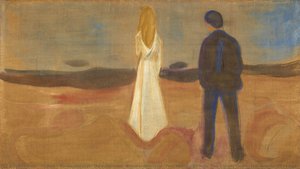 To mennesker. De ensomme (Reinhardt-frisen) Two Human Beings. The Lonely Ones (The Reinhardt Frieze) - Edvard Munch
In To mennesker. De ensomme (The Reinhardt Frieze) , Edvard Munch masterfully manipulates a diffuse, shadowless light to evoke a profound sense of psychological stillness. There is no dramatic chiaroscuro here; instead, a muted, even illumination washes over the figures, stripping away the comfort of depth and leaving only the raw, exposed ache of human disconnection. This soft, somber glow illuminates a palette of earthy ochres and bruised blues, casting the two souls into a state of eternal, quiet melancholy.
The artist’s command over this atmospheric light is precisely what secures its place among the top 25 artworks of Edvard Munch . By eschewing traditional brilliance for a heavy, melancholic haze, he captures the very essence of Expressionism—the externalization of an internal void. When brought into a contemporary home, a faithful oil reproduction of this piece introduces a layer of quiet prestige and contemplative depth. The visible, textured brushstrokes and the subtle interplay of muted tones create a sophisticated focal point, inviting a sense of soulful introspection and timeless elegance to any curated wall.
House in Moonlight - Edvard Munch
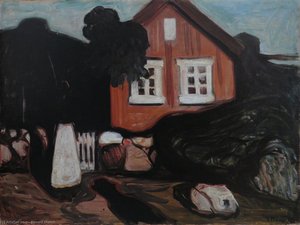 House in Moonlight - Edvard Munch
In the quiet, silvered stillness of House in Moonlight , Edvard Munch invites us to step into a world where the boundary between the external landscape and the internal soul begins to dissolve. This 1895 masterpiece stands as an essential pillar in our collection of Munch’s top 25 artworks, not merely for its haunting beauty, but for its profound role in pioneering the language of Expressionism. Through a striking use of impasto and a deliberate, symbolic palette—where the fiery red of the dwelling clashes against the oppressive, nocturnal shadows—Munch captures a visceral sense of solitude and psychological vulnerability.
The painting transcends simple depiction; it is a rhythmic dance of light and dread, mirroring the era's fascination with the subconscious. Its inclusion in this selection celebrates how Munch transformed personal grief into universal visual poetry. Today, this evocative atmosphere offers a transformative presence for the discerning collector. By bringing a high-fidelity, hand-painted reproduction of this work into your home or private gallery, you invite a piece of art history that breathes life, depth, and a profound emotional resonance into your personal sanctuary.
Women at the beach Sun - Edvard Munch
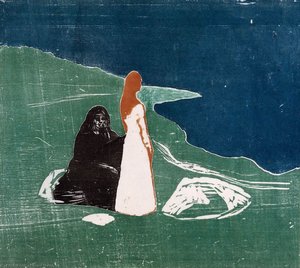 Women at the beach Sun - Edvard Munch
In Women at the Beach Sun , Edvard Munch invites us into a delicate, sun-drenched moment that belies the profound psychological depth characteristic of his most celebrated works. As one of the top 25 artworks of Edvard Munch , this piece serves as a breathtaking bridge between the serene beauty of the landscape and the turbulent inner landscapes of the human soul. The way the golden afternoon light washes over the figures in black and white creates a luminous dialogue, capturing a sense of intimacy shadowed by an unmistakable, quiet melancholy.
Munch’s mastery of tonal gradations—achieved through his meticulous approach to oil and aquatint techniques—allows the viewer to feel the warmth of the sun and the cool salt air simultaneously. This painting transcends mere seaside scenery; it is a meditation on vulnerability and the unspoken connections between us. For the discerning collector, bringing such a piece into a modern home offers more than decor; it introduces a timeless conversation about light, shadow, and the enduring beauty found within our most private reflections.
Conclusion
As the light fades and we prepare to leave the quiet corridors of Munch’s psyche, we realize that these canvases are far more than mere relics of a turbulent era. They do not belong solely to the museums or the annals of art history; instead, they exist as living, breathing echoes of our own shared humanity. To stand before his work is to recognize that the shadows he painted—the tremors of anxiety, the depths of grief, and the piercing light of longing—are the very same textures found within our own souls. His brushstrokes do not just depict a moment in time; they pulse with a rhythmic, emotional vitality that continues to breathe life into our modern spaces.
Bringing a piece of this profound legacy into your home is an act of connection, a way to invite that timeless, expressive energy to reside alongside you. Whether it is the haunting silhouette of a figure or the swirling, emotive sky of a landscape, these works serve as windows into the eternal, reminding us that even in our most vulnerable moments, there is a profound beauty to be found in being truly seen. We invite you to continue this intimate journey and find the piece that speaks to your own story within our full collection . May these masterpieces forever serve as a gentle reminder that art, much like life itself, is an enduring dance of light and shadow, waiting to move us anew each time we look upon it.