Introduction
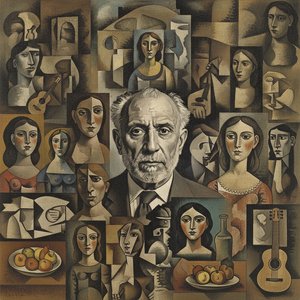
To step into the world of Pablo Picasso is to witness the very heartbeat of modern creativity. It is not merely an encounter with paint on canvas, but a journey through a restless, brilliant mind that refused to accept the world as it was given. Imagine walking through a gallery where the light shifts from the somber, melancholic blues of a lonely street in Barcelona to the warm, sun-drenched pinks of a circus troupe, before suddenly shattering into the fractured, revolutionary geometries of Cubism. Picasso did not just paint; he reimagined the very fabric of perception.
Born in Málaga, Spain, with a pencil already in hand, Picasso’s life was a continuous metamorphosis. He moved through history like a force of nature, navigating the profound grief of his Blue Period and the tender, rhythmic joy of his Rose Period, eventually tearing down the traditional boundaries of perspective that had held art captive for centuries. His work became a mirror to the turbulence of the 20 erat twentieth century—capturing the fragility of human existence, the weight of political struggle, and the unyielding spirit of innovation.
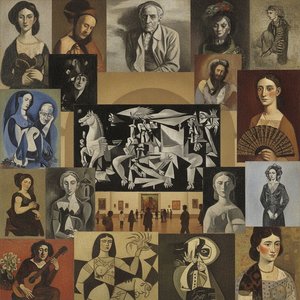
These twenty-five masterpieces remain deeply meaningful today because they speak a universal language of emotion. Whether through the haunting gaze of a beggar or the jagged, powerful lines of a protest against war, Picasso’s canvases resonate with our own capacity for change and resilience. They remind us that beauty can be found in fragmentation and that truth often lies beneath the surface of what we see.
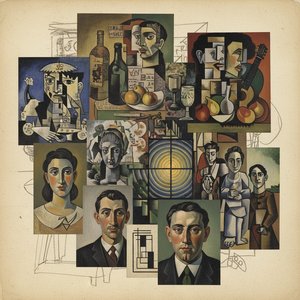
As we begin this curated exploration, prepare to lose yourself in a collection that defines an era. We will guide you through these iconic works, tracing the evolution of a master who taught us that to truly see, one must be willing to look at the world from a thousand different angles.
Guernica - Pablo Picasso
 Guernica - Pablo Picasso
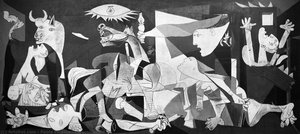
To stand before Guernica by Pablo Picasso is to witness a silent, monochromatic scream that echoes through the corridors of history. Created in 1937, this monumental masterpiece transcends mere canvas; it is a visceral, jagged response to the devastation of the Spanish Civil War. As you gaze upon its immense, fragmented forms, the absence of color—a stark palette of only blacks, whites, and greys—strips away all comfort, leaving only the raw, journalistic truth of suffering.
Picasso utilizes the fractured language of Cubism to deconstruct chaos, where a wounded horse and a grieving mother emerge from a whirlwind of angular shadows and sharp, piercing lines. There is no soft light here, only the harsh, flattened perspective that evokes a sense of inescapable claustrophobia. This work earns its place among the top 25 artworks of Pablo Picasso not merely for its technical brilliance, but because it transforms a specific moment of tragedy into a universal symbol of peace. It remains a profound emotional anchor, reminding us how art can capture the very soul of human resilience.
Three Musicians - Pablo Picasso
 Three Musicians - Pablo Picasso
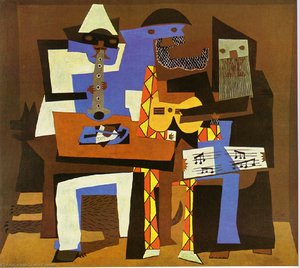
In Three Musicians , Pablo Picasso invites us into a rhythmic dance of geometry and soul, marking a breathtaking peak in his Synthetic Cubist period. This masterpiece stands among the top 25 artworks of Pablo Picasso because it transcends mere fragmentation; it reassembles the world into a vibrant, decorative tapestry of color and form. The composition breathes with the spirit of the Commedia dell'arte , featuring the whimsical Harlequin and the melancholic Pierrot, their figures woven from flat planes of ochre, blue, and deep earth tones.
As you gaze upon these interlocking shapes, you feel a sense of structured harmony that resonates deeply with modern interior aesthetics. The painting’s balance of angular precision and soft, layered textures offers a sophisticated focal point for contemporary spaces, bringing an air of intellectual prestige and quiet movement to any room. It is not just a depiction of a musical ensemble; it is a sensory exploration of how light, shape, and memory converge to create a lasting emotional resonance that continues to captivate collectors worldwide.
The Young Ladies of Avignon - Pablo Picasso
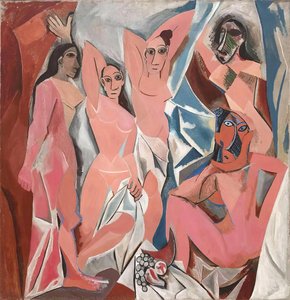 The Young Ladies of Avignon - Pablo Picasso
To stand before Les Demoiselles d'Avignon is to witness the very moment the foundations of traditional beauty were shattered. This 1907 masterpiece acts as a seismic detonation in art history, marking the birth of Cubism and a radical departure from the soft, representational grace we often seek in classical works. Picasso does not offer us a window into a serene world; instead, he presents a fractured, confrontational reality where five female figures are deconstructed into sharp, angular planes and geometric shards.
The painting’s visual language—a haunting blend of muted pinks, greys, and flesh tones interrupted by the mask-like intensity of African-inspired features—challenges the viewer to find meaning within chaos. It is a profound exploration of perspective, where depth is sacrificed for a raw, multi-dimensional truth. Even today, its fragmented composition resonates in our modern, digital age of fractured imagery, making it an essential cornerstone among the top 25 artworks of Pablo Picasso . It remains a powerful, unsettling dialogue between the primitive and the avant-garde, forever altering how we perceive form and emotion on canvas.
Portrait of Ambroise Vollard - Pablo Picasso
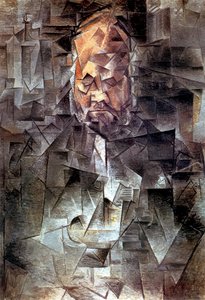 Portrait of Ambroise Vollard - Pablo Picasso
What if I told you that Portrait of Ambroise Vollard by Pablo Picasso was born from a moment of profound rebellion—a stroke of defiance against the very idea of what a face should be? This is not merely a portrait; it is a manifesto of Analytical Cubism . In this 1910 masterpiece, Picasso deconstructs the influential art dealer into a mesmerizing dance of geometric planes, muted ochres, and somber grays, challenging us to reconstruct his identity through a fractured lens.
Its inclusion in our Top 25 is essential because it represents the moment art ceased to mirror reality and began to interpret its complex, multi-dimensional truth. The painting breathes with an intellectual energy, where light and shadow intersect in sharp, angular rhythms. At ArtsDot.com, we believe such transformative works belong in your personal sanctuary, not just behind museum glass. Imagine this radical deconstruction hanging in your study—a sophisticated reminder that beauty lies in the complexity of perspective. It turns a quiet corner of your home into a profound conversation with history.
A boy with pipe - Pablo Picasso
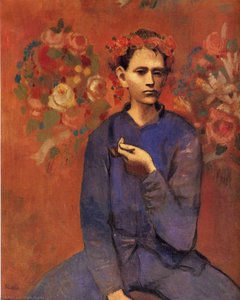 A boy with pipe - Pablo Picasso
In the quiet, sun-drenched transition of Picasso’s Rose Period , A boy with pipe emerges as a tender meditation on the threshold between childhood and maturity. To gaze upon this portrait is to witness a moment of profound stillness; the young subject, crowned with a vibrant garland of orange flowers, sits enveloped in an atmospheric wash of warm, terracotta hues. The pipe he holds serves as a poignant symbol of burgeoning contemplation, grounding the ethereal beauty of the floral wreath with a touch of worldly gravity.
As one of the top 25 artworks of Pablo Picasso , this piece captivates through its tactile impasto textures and the expressive, gestural brushstrokes that echo the emotive spirit of Post-Impressionism. In today’s curated interiors, such a work resonates deeply, offering a soulful counterpoint to modern minimalism. Its blend of melancholic introspection and radiant warmth makes it more than a mere portrait; it is a timeless exploration of fleeting innocence, inviting us to find beauty in the soft, ephemeral shadows of memory.
Two women running on the beach (The race) - Pablo Picasso
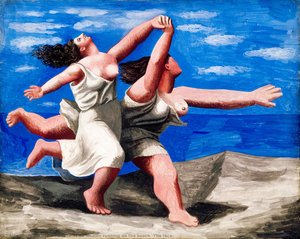 Two women running on the beach (The race) - Pablo Picasso
What if I told you that Two Women Running on the Beach (The Race) by Pablo Picasso was born from a moment of pure, unbridled vitality—a stroke of defiance against the stillness of tradition? In this 1922 masterpiece, Picasso captures more than just a coastal sprint; he captures the very pulse of life. As one of the most essential works in our collection of the top 25 artworks of Pablo Picasso , this piece stands out for its rhythmic, almost musical movement. The diagonal energy of the figures, set against a vibrant blue sky and sun-drenched sand, creates a sense of liberation that is impossible to ignore.
The painting’s inclusion in this prestigious selection is earned through its ability to transform modernist distortion into pure joy. At ArtsDot, we believe art should be a living, breathing part of your sanctuary. Imagine this dynamic composition gracing your walls, where the bold, gestural lines and expressive textures turn a quiet corner of your home into a celebration of freedom. It is not merely decor; it is an invitation to embrace movement and light every single day.
Sabartes - Pablo Picasso
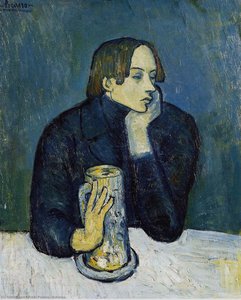 Sabartes - Pablo Picasso
To possess Sabartes by Pablo Picasso is to hold a fragment of an unfolding legend, making it a profound investment in both artistic legacy and refined taste for the discerning collector. Created in 1901, this evocative work captures the young master at a pivotal threshold, where the somber, melancholic whispers of his Blue Period begin to coalesce with Post-Impressionist depth. The painting presents a solitary figure lost in thought, cradling a glass of absinthe amidst a sea of deep, nocturnal blues and verdant greens. Through thick, textured brushstrokes and a deliberate flattening of perspective, Picasso transforms a quiet moment of introspection into a powerful study of solitude.
As one of the top 25 artworks of Pablo Picasso, Sabartes carries an immense historical weight, signaling the transition from naturalism to the emotive abstraction that would later redefine modern art. Its moody, atmospheric palette and soulful composition offer an unparalleled aesthetic authority, making a high-quality oil reproduction a breathtaking centerpiece for modern luxury interiors, bringing the quiet dignity of a museum gallery into the heart of a sophisticated home.
Women of Algiers (Version O) - Pablo Picasso
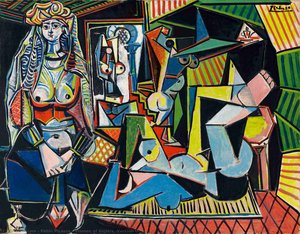 Women of Algiers (Version O) - Pablo Picasso
To encounter Women of Algiers (Version O) is to witness a profound dialogue between the past and the radical present. In this 1955 masterpiece, Picasso does not merely paint; he deconstructs, engaging in a vibrant, rhythmic conversation with Delacroix’s Romantic tradition. This particular iteration stands as a breathtaking pinnacle of his late-career Synthetic Cubism, where the boundaries of form dissolve into a kaleidoscope of sensation.
The canvas breathes with a dynamic energy, utilizing fragmented geometric planes to present multiple perspectives at once. One moment, you are drawn to the cool, architectural blues and whites; the next, you are ignited by sudden bursts of fiery orange and sun-drenched yellow. The figures emerge from an ambiguous, layered space, their identities secondary to the sheer movement of color and line. Owning a piece of this legacy is not simply about decoration; it is an inheritance of taste . It brings the revolutionary spirit of Picasso’s most daring explorations directly into your private sanctuary, turning a wall into a window onto the very evolution of modern art.
Guitar player - Pablo Picasso
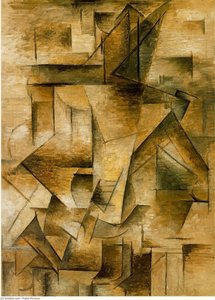 Guitar player - Pablo Picasso
In the 1910 masterpiece Guitar Player , one can almost feel the rhythmic tension within the fractured planes of Picasso’s brushwork. To gaze closely at this work is to encounter a landscape of earthy ochres and muted browns, where the texture of the oil paint creates a tactile map of Analytical Cubism. The artist deconstructs the musician into a symphony of sharp angles, overlapping triangles, and translucent layers, stripping away traditional perspective to reveal the raw, geometric soul of the subject. This piece stands firmly among the top 25 artworks of Pablo Picasso because it captures that pivotal moment when art ceased to mirror reality and began to reinvent it through structure and light.
At ArtsDot.com, we believe such profound innovation deserves more than a flat print; it requires a tribute to its physical essence. Our hand-painted oil reproductions are meticulously crafted to honor this Guitar Player , using thick, visible brushstrokes and layered pigments on cotton canvas to recreate the three-dimensional depth and soulful materiality that define Picasso’s revolutionary genius for your own collection.
Mother and child (Marie-Therese and Maya) - Pablo Picasso
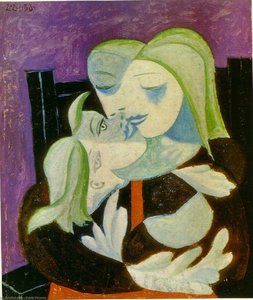 Mother and child (Marie-Therese and Maya) - Pablo Picasso
To gaze upon Mother and Child (Marie-Thérèse and Maya) is to step into a sanctuary of profound tenderness. In this 1938 masterpiece, Picasso moves away from the fractured tensions of Cubism to embrace a lyrical, almost dreamlike intimacy. The painting captures the soft, rhythmic bond between his muse, Marie-Thérèse Walter, and their daughter, Maya, through fluid lines and a soothing palette of ethereal blues, greens, and purples.
Its inclusion in our collection of the top 25 artworks of Pablo Picasso is essential; it represents a rare moment where the revolutionary's hand sought to celebrate life, protection, and maternal warmth. The way the simplified, stylized forms melt into one another creates a sense of harmony that transcends time. At ArtsDot.com, we believe such emotional depth should be a living part of your home. Bringing this reproduction into your personal sanctuary transforms a mere wall into an evocative window of peace, offering a sophisticated statement of love and artistic brilliance for the most refined interiors.
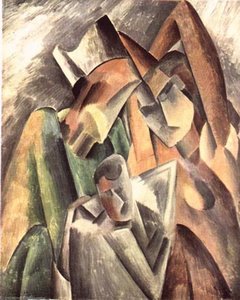
Harlequin and his family - Pablo Picasso
Before the world recognized him as the architect of Cubism, a young Picasso was already deeply enamored with the theatricality of the circus, finding a mirror for his own soul in the colorful, often tragic figures of the traveling troupe. In Harlequin and his family , painted in 1908, we witness a breathtaking moment of transition where the warmth of his Rose Period begins to fracture into something much more radical. This piece is a cornerstone among the top 25 artworks of Pablo Picasso because it captures the precise second when traditional perspective began to dissolve.
The canvas breathes with an earthy, muted palette of browns, mossy greens, and somber grays, using sharp, angular planes to deconstruct the human form. You can almost feel the textured, layered brushstrokes that lend a tactile weight to the fragmented figures. It is a masterful dance of geometry and emotion, where the stability of a family unit is reimagined through overlapping shapes and shifting viewpoints. To hang such a work in a modern study is to invite a spirit of profound intellectual inquiry and structured creativity into your workspace, fostering an atmosphere of focused, visionary ambition.
La Vie (Life) - Pablo Picasso
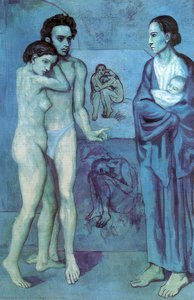 La Vie (Life) - Pablo Picasso
There is a gaze in La Vie by Pablo Picasso that follows you—not with judgment, but with a profound, quiet understanding . As one of the most significant entries in our collection of the top 25 artworks of Pablo Picasso, this masterpiece from his Blue Period acts less like a portrait and more like a mirror for the soul. Bathed in a somber, monochromatic palette of melancholic blues and deep shadows, the painting captures a dreamlike, almost surreal moment of human vulnerability.
The composition, featuring figures entwined in a delicate, triangular embrace, speaks to themes of intimacy, loss, and the cyclical nature of existence. You can almost feel the cool, heavy atmosphere of the canvas as the fluid, undulating lines guide your eyes through a landscape of shared sorrow and protection. To invite La Vie into your home is to welcome a piece of history that reminds you: even in our most isolated moments, we are seen. It is a powerful, emotive presence that makes the invisible weight of human emotion visible.
Saltimbanques (The Family of Saltimbanques) - Pablo Picasso
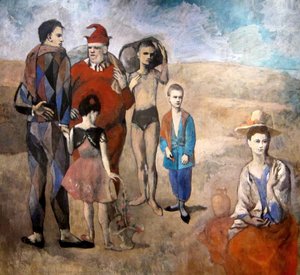 Saltimbanques (The Family of Saltimbanques) - Pablo Picasso
In the transition from the somber, melancholic shadows of his Blue Period to the luminous warmth of his Rose Period, Picasso gifted us Saltimbanques (The Family of Saltimbanques). This masterpiece is a breathtaking window into a more hopeful era, where the palette softens into tender pinks, warm ochres, and sun-drenched oranges. As you stand before this work, you are not merely observing a group of circus performers; you are witnessing a profound exploration of human connection amidst isolation.
The composition gathers these itinerant artists—figures Picasso saw as kindred spirits living on the fringes of society—within a vast, dreamlike landscape. There is a delicate tension here between the fragmented, proto-Cubist geometry and a soft, organic tenderness. The figures, clustered with an intimate yet asymmetrical grace, evoke a sense of theatrical drama and quiet introspection. To possess a reproduction of such a piece is to invite a transformative energy into your home, turning a simple wall into a gallery of the soul where the light of Picasso’s genius can forever dance.
Celestina - Pablo Picasso
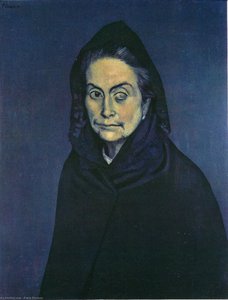 Celestina - Pablo Picasso
In the quiet, melancholic depths of Picasso’s Blue Period , there exists a moment of profound stillness found in Celestina . As you stand before this portrait from 1904, you do not merely see an elderly woman; you feel the weight of her history. The light here does not simply illuminate her features—it breathes through the somber blues and deep purples, composing a visual sonata of solitude and grace.
Picasso captures a gaze that is both direct and introspective, pulling you into an intimate connection with a subject draped in shadows. The heavy, dark cloak seems to wrap around the viewer as much as the woman, symbolizing a protective layer of mystery and resilience. Through soft, expressive brushstrokes and a palette of muted ochre and indigo, the artist transforms a simple portrait into a portal of emotion. To bring Celestina into your home is to invite a sense of timeless dignity and serene contemplation, allowing the soulful shadows of Picasso's early mastery to transform your walls into a sanctuary of reflection.
Woman standing in a garden - Pablo Picasso
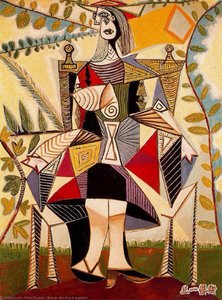 Woman standing in a garden - Pablo Picasso
In Woman standing in a garden , the lines of Picasso’s genius are not merely drawn; they are choreographed . This is not a simple depiction of a figure amidst foliage, but rather a dance frozen in time . As you gaze upon this masterpiece, you witness the very essence of Cubism—where the boundaries between the human form and the natural world dissolve into a mosaic of geometric grace.
The composition breathes with a rhythmic vitality, utilizing fragmented planes and sharp, angular shapes to reconstruct reality. A vibrant palette of primary reds, blues, and yellows intermingles with earthy greens, creating a sensory experience that feels both structured and wildly organic. The central figure, rendered with elongated, stylized elegance, emerges from a sea of overlapping triangles and trapezoids, inviting the viewer to perceive multiple viewpoints simultaneously. It is a profound exploration of identity and movement. Imagine your own sanctuary holding this same exquisite balance; where your walls do not just decorate, but breathe rhythm through the transformative power of Picasso’s most iconic, deconstructed visions.
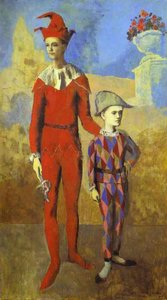
Acrobat and young harlequin - Pablo Picasso
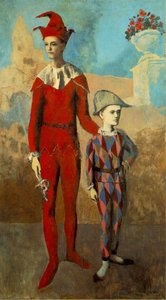 Acrobat and young harlequin - Pablo Picasso
To gaze upon Acrobat and Young Harlequin is to witness a tender, fleeting moment of transition in the soul of Pablo Picasso. As he moved from the somber, melancholic depths of his Blue Period into the warmer, sun-drenched hues of his Rose Period, this 1905 masterpiece captured the very heartbeat of that change. The painting presents a poignant duality: a tall, imposing figure in striking reds paired with a smaller, vulnerable boy in a patchwork suit, set against a dreamlike, ethereal cityscape.
This work earns its place among the top 25 artworks of Pablo Picasso through its profound emotional resonance and its ability to use the theatricality of the circus to explore the masks of human existence. The loose, expressive brushstrokes and the soft, diffused light create a sense of mystery that remains as captivating today as it was in Montmartre. At ArtsDot.com, we strive to preserve this delicate magic. Our hand-painted oil reproductions are meticulously crafted to honor every visible stroke and textured layer, allowing you to invite the profound, transformative beauty of Picasso’s legendary Rose Period into your own cherished space.
Femme assise aux bras croises - Pablo Picasso
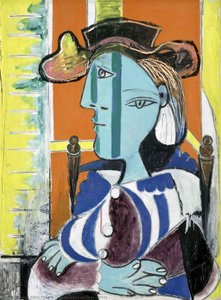 Femme assise aux bras croises - Pablo Picasso
In the profound journey through Picasso’s evolution, Femme assise aux bras croisés stands as a breathtaking testament to the moment where form begins to fracture and dance. To behold this work is to witness the very birth of a new way of seeing. The composition pulls you into a rhythmic, geometric embrace, where the seated figure is no longer a mere subject, but a collection of vibrant, angular planes that challenge our traditional understanding of depth and identity.
The palette is a striking dialogue between warmth and shadow; brilliant oranges and sun-drenched yellows collide with deep, soulful blues, creating a visual tension that feels both energetic and introspective. Through thick, expressive impasto brushstrokes, Picasso breathes a tactile life into the canvas, making the fragmented features of the woman feel as though they are vibrating with modern complexity. This is not merely a portrait; it is an invitation to experience the deconstruction of reality itself. Bringing such a masterpiece into your home does more than decorate a wall—it transforms your space into a sanctuary of intellectual curiosity and raw, emotional depth.
Seated Woman (after Cranach) - Pablo Picasso
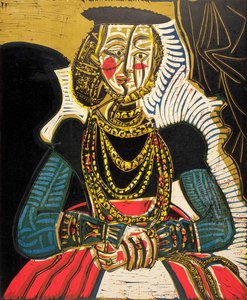 Seated Woman (after Cranach) - Pablo Picasso
To gaze upon Seated Woman (after Cranach) by Pablo Picasso is to witness a profound, whispered dialogue between the Renaissance and the modern age. In this remarkable piece, Picasso does not merely imitate the past; he deconstructs it, taking the elegant, idealized grace of Lucas Cranach the Elder and refracting it through the revolutionary, fractured lens of Cubism. It stands as one of the top 25 artworks of Pablo Picasso because it captures the very moment tradition meets transformation.
The canvas vibrates with a dynamic interplay of geometric planes and bold, rhythmic lines. Picasso replaces smooth, classical surfaces with sharp angles and overlapping shapes, inviting us to reconstruct the subject's form through our own perception. A muted palette of ochre, deep blue, and earthy brown is punctuated by striking red accents around the eyes, imbuing the sitter with a haunting, modern intensity. This masterful manipulation of perspective—showing multiple viewpoints at once—creates a sensory experience that remains as intellectually stimulating today as it was at its inception, proving how a single masterpiece can forever alter the emotional landscape of a room.
Woman with cockerel - Pablo Picasso
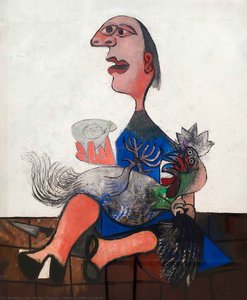 Woman with cockerel - Pablo Picasso
What if I told you that Woman with Cockerel by Pablo Picasso was born from a moment of profound tension—a delicate dance between the simplicity of Naive Art and the fractured reality of a world in upheaval? Created in 1938, amidst the shadows of the Spanish Civil War, this masterpiece captures a striking duality. On one hand, we see the charming, almost primitive directness of the woman’s features; on the other, the sharp, geometric echoes of Cubism that refuse to let the viewer remain comfortable.
Its inclusion in our Top 25 is essential because it embodies Picasso's ability to find strength in fragility. The vibrant contrast of her blue dress against the stark background, paired with the spirited presence of the cockerel, creates a visual narrative of resilience. At ArtsDot, we believe such powerful imagery should not be confined to museum walls. Imagine this piece as a living part of your sanctuary, where its bold colors and historical depth transform a quiet corner of your home into a sophisticated conversation about strength and enduring beauty.
Estudios - Pablo Picasso
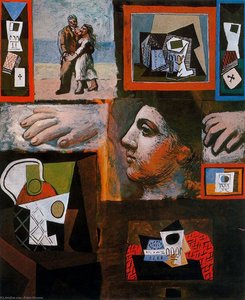 Estudios - Pablo Picasso
To encounter Estudios is to step into the very heartbeat of Picasso’s restless mind. This work does not present a single, finished window into reality; instead, it offers a vibrant, fragmented collage that acts as a visual echo chamber of his creative evolution. Within this assembly of studies, we witness the profound dialogue between his earlier, soulful Blue Period and the revolutionary, fractured planes of Cubism.
There is a certain magic in these sketches—they are not merely preparatory exercises but concentrated distillations of pure genius. As you move your eyes across the bold strokes and thick impasto, you feel the energy of an artist dismantling established forms to find a deeper truth. The way the light catches the textured layers reminds us that Picasso was never content with the surface; he sought to interpret the very essence of existence. Bringing such a piece into your home is like inviting a whirlwind of history and transformation onto your walls, reminding you that beauty often lies in the beautiful, unfinished process of becoming.
Musical instruments on a table - Pablo Picasso
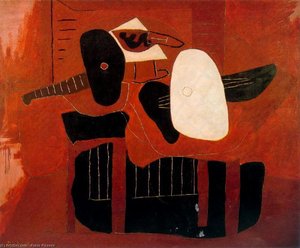 Musical instruments on a table - Pablo Picasso
In Musical Instruments on a Table by Pablo Picasso, a muted, earthy palette of ochre and soft shadows establishes a contemplative, almost hushed atmosphere, much like the quiet moment before a symphony begins. This mastery of tone is precisely why this work earns its place among the top 25 artworks of Pablo Picasso ; he does not merely paint objects, but captures the very vibration of sound through fragmented planes and interlocking shapes. The way the light catches the geometric edges of the central guitar creates a visual rhythm that feels both structured and spontaneous.
For the discerning collector, integrating such a piece into a modern interior offers a sophisticated way to anchor a room's emotional lighting. The painting’s subdued color scheme works beautifully in a dining room or study, providing a focal point that stimulates intellectual curiosity without overwhelming the senses. By pairing this Cubist masterpiece with warm, ambient textures, you can curate a space that feels as layered and profound as Picasso’s own revolutionary vision.
Great Profile - Pablo Picasso
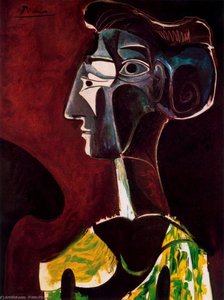 Great Profile - Pablo Picasso
In Great Profile by Pablo Picasso, we encounter a breathtaking masterclass in geometric fragmentation that secures its place among the top 25 artworks of Pablo Picasso . The composition is a rhythmic dance of intersecting planes; Picasso deconstructs the feminine visage into a sophisticated arrangement of sharp angles and soft curves, creating a structural harmony that feels both chaotic and perfectly balanced. This deliberate interplay of lines guides the eye through a kaleidoscope of fiery reds, deep blues, and verdant greens, where each shard of color contributes to a sense of timeless perfection.
Beyond its Cubist complexity, there is an inherent, quiet equilibrium within the work that mirrors the principles of modern minimalist design. The way Picasso balances heavy, textured impasto against starker, angular voids allows the piece to ground a contemporary aesthetic with ease. It is more than a portrait; it is a soulful exploration of identity, where the fractured geometry serves as a window into a deeply emotional landscape, making it an enduring icon for any serious collection.
Musician Faun N.3 - Pablo Picasso
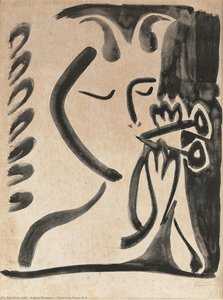 Musician Faun N.3 - Pablo Picasso
In the quiet, contemplative corners of Picasso’s vast legacy, Musician Faun N.3 (1948) emerges as a profound meditation on rhythm and fragmentation. As you wander through this selection of the top 25 artworks of Pablo Picasso, this piece invites you to slow your breath. Moving away from the vibrant colors of his earlier periods, Picasso utilizes a striking, almost monochromatic palette of greys and blacks to strip the subject down to its very essence.
The faun—a mythological creature of nature and revelry—is captured here in a moment of soulful isolation. Through the lens of Cubist influence, the musician's form is subtly fractured; his tilted head and the suggestion of a flute held to his lips create a visual melody of lines and shadows. This work is not merely a depiction of a mythic figure, but a window into the artist's post-war reflections on vulnerability and the human condition. To possess such a piece is to invite a sense of timeless, intellectual depth into your own sanctuary, transforming a simple wall into a gallery of the soul.
Proyecto para el telón de ''Parade'' - Pablo Picasso
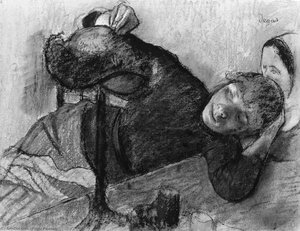 Proyecto para el telón de ''Parade'' - Pablo Picasso
What if I told you that Proyecto para el telón de ''Parade'' by Pablo Picasso was born from a moment of pure, theatrical rebellion? This charcoal drawing is far more than a mere stage design; it is a whispered fragment of the avant-garde spirit that sought to shatter the boundaries between life and performance. In this piece, we see Picasso stepping away from the rigid geometries of Cubism toward something more gestural and intimate. The soft, textured layers of charcoal create a palpable sense of volume, capturing two figures in a moment of quiet repose that feels both modern and timeless.
Its inclusion in our Top 25 is essential because it represents the intersection of visual art, music, and dance—a manifesto of collaboration. To possess a reproduction of such a pivotal work is to invite that same revolutionary energy into your own sanctuary. At ArtsDot.com, we believe great art should be a living presence; imagine this evocative sketch gracing your study or salon, transforming a simple wall into a profound statement of cultural depth and artistic defiance.
Still life on a piano - Pablo Picasso
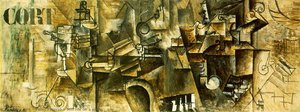 Still life on a piano - Pablo Picasso
In the quiet, fractured rhythm of Still Life on a Piano , Pablo Picasso captures a moment where time itself seems to splinter into beautiful, geometric echoes. This masterpiece holds its place among the top 25 artworks of Pablo Picasso because it represents the very heartbeat of Analytical Cubism, inviting us to look beyond the surface of reality. There is a profound, intellectual intimacy in how the artist deconstructs a simple arrangement—a vase, a book, and a pipe—into a dance of overlapping planes and earthy, muted tones.
The painting breathes with a sophisticated complexity; the soft ochres and deep shadows create a tactile depth that feels almost sculptural. As you gaze upon the fragmented forms, you feel the tension between the recognizable objects and their new, abstract existence. In a modern home, such a piece serves as a profound anchor of intellectual elegance, offering a window into the revolutionary spirit that redefined the 20th century. It is not merely a depiction of objects on a piano, but a sensory exploration of how we perceive the world through layers of light and structure.
Conclusion
As the light fades and we step away from these canvases, we carry with us more than just images of blue shadows or fractured perspectives; we carry the enduring pulse of a man who dared to see the world in pieces so that we might understand its wholeness. To wander through Picasso’s evolution is to witness the very heartbeat of human experience—the profound ache of solitude, the warmth of a circus performer's smile, and the revolutionary courage to shatter tradition. These masterpieces are not merely relics of a bygone era, frozen behind museum glass, but living, breathing forces that continue to whisper to us in the quiet corners of our modern lives.
They possess a remarkable alchemy, capable of transforming a simple room into a space of profound reflection and intellectual vitality. Whether it is the somber empathy of his Blue Period or the vibrant, structural dance of his Cubist explorations, Picasso’s work remains a sanctuary for the curious soul. We invite you to keep this dialogue alive within your own home, finding a piece of this eternal revolution to grace your walls. You may explore the depth and breadth of his transformative genius by visiting our full collection .
As the sun sets on our journey through these twenty-five wonders, let us remember that art, much like Picasso himself, is never truly finished; it continues to reshape our vision, one brushstroke at a time.