Early Life and Artistic Awakening: From Pharmacy to Painter
 Wikipedia: Tivadar Csontváry Kosztka
Tivadar Csontváry Kosztka born Mihály Tivadar Kosztka (Hungarian pronunciation: [ˈtivɒdɒr ˈt͡ʃontvaːri ˈkostkɒ]; 5 July 1853 – 20 June 1919) was a Hungarian painter who was part of the avant-garde movement of the early twentieth century. Working most...
The story of Tivadar Csontváry Kosztka is one of profound transformation, a late blossoming of artistic genius that defied convention and ultimately reshaped the landscape of Hungarian painting. Born Mihály Tivadar Kosztka in 1853 in Kisszeben, Hungary (modern-day Slovakia), his early life seemed destined for a path far removed from the world of art. Following in his father’s footsteps, he trained as a pharmacist, a profession he diligently pursued well into his twenties. This period, however, was not without its undercurrent of restless yearning. A deep sensitivity to beauty and an innate desire for creative expression simmered beneath the surface, waiting for the catalyst that would ignite a lifelong passion.
That pivotal moment arrived on October 13th, 1880. While working in his pharmacy, Csontváry experienced what he described as a mystical vision – a voice declaring him “the greatest painter of the world, greater than Raphael.” This extraordinary claim, whether interpreted literally or as an intensely felt calling, irrevocably altered the course of his life. He embarked on a journey fueled by unwavering conviction, determined to realize this seemingly impossible destiny. He initially attempted formal training but found himself stifled by academic constraints, choosing instead to forge his own path, driven by an internal compass and a relentless pursuit of artistic truth.
The 'Sunway' Style: A Unique Vision in Landscape and Light
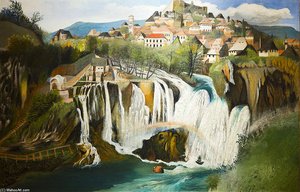 Waterfall At Jajce
Explore Tivadar Csontváry Kosztka’s "Waterfall At Jajce," a stunning 19th-century Romantic landscape painting. Discover its dramatic composition, impasto texture & serene beauty.
Csontváry’s art is immediately recognizable for its distinctive style, often referred to as the ‘sunway’ (napút) – a term he coined himself. This wasn’t merely a technical approach but a philosophical one, reflecting his fascination with the transformative power of light and its ability to reveal the underlying essence of nature. He sought to capture not just the visual appearance of landscapes but their very soul, imbuing his canvases with an almost spiritual intensity. While influenced by Post-Impressionism’s bold colors and expressive brushwork, Csontváry developed a uniquely Hungarian sensibility.
His technique involved layering vibrant hues – often applied with thick impasto – to create a luminous quality that seems to emanate from within the painting itself. He wasn't interested in meticulous detail but rather in conveying atmosphere and emotion through broad strokes and dynamic compositions. This approach is beautifully exemplified in works like “Waterfall at Jajce,” where the cascading water and surrounding foliage are rendered with a dramatic energy, capturing both the raw power of nature and its serene beauty. The ‘sunway’ wasn't simply about depicting light; it was about finding a pathway to express his inner vision through the medium of color and form.
Middle Eastern Journeys and Spiritual Symbolism
Modernism was an early 20th-century movement in literature, visual arts, performing arts, and music that emphasized experimentation, abstraction, and subjective experience. Philosophy, politics, architecture, and social issues were all aspects of thi...
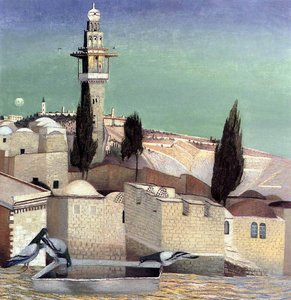
To fully understand Csontváry’s artistic development, one must consider the profound impact of his travels. He embarked on extensive journeys throughout Europe and beyond, but it was his experiences in the Middle East – to Lebanon, Palestine, Egypt, and Syria – that proved particularly transformative. These landscapes, steeped in history and religious significance, resonated deeply with his spiritual inclinations.
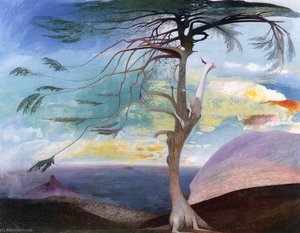
Paintings like “Pilgrimage to the Cedars in Lebanon” and “The Lonely Cedar” are not simply depictions of exotic locales; they are imbued with a profound sense of symbolism. The ancient cedar trees, majestic and enduring, became metaphors for resilience, faith, and the passage of time. “The Lonely Cedar,” perhaps his most iconic work, is often interpreted as a self-portrait, representing Csontváry’s own solitary journey and unwavering dedication to his art. The vibrant colors and dreamlike atmosphere further enhance the painting's mystical quality, inviting viewers to contemplate deeper meanings beyond the surface representation.
Themes of Isolation, Faith, and the Human Condition
Beneath the breathtaking landscapes and spiritual symbolism lies a recurring exploration of profound human themes: isolation, faith, and the search for meaning. Csontváry’s life was marked by periods of intense solitude, and this sense of alienation is often reflected in his work. His paintings frequently feature solitary figures or vast, empty landscapes, evoking a feeling of introspection and existential questioning.
However, this isolation wasn't necessarily negative; it allowed him to connect with something larger than himself – a divine presence that permeated the natural world. His art is filled with subtle religious undertones, not in the form of overt depictions of biblical scenes but rather through symbolic representations and an overall sense of reverence for creation. Even paintings like “Maria’s Will in Nazareth,” while depicting a specific religious narrative, transcend literal interpretation, becoming meditations on faith, sacrifice, and the enduring power of the human spirit.
Critical Reception and Lasting Legacy: Hungary’s Rediscovered Master
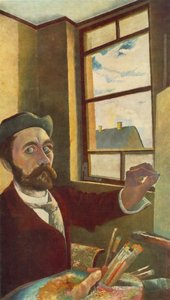 Tivadar Csontváry Kosztka
Explore the visionary art of Tivadar Csontváry Kosztka (1853-1919), a Hungarian painter bridging Post-Impressionism & Expressionism. Known for large landscapes, Middle Eastern scenes, and his unique 'sunway' style.
Despite his unwavering conviction and unique artistic vision, Csontváry received little recognition during his lifetime. He was often dismissed as an eccentric crank, his unconventional style failing to resonate with contemporary tastes. He refused to sign his paintings, believing that their inherent quality should speak for themselves, but this only added to the perception of him as an outsider.
Ironically, it wasn’t until a decade after his death in 1919 that his work began to gain widespread acclaim. A young architect named Gedeon Gerlóczy stumbled upon a collection of Csontváry's rolled-up canvases, saving them from potential destruction and ultimately bringing his art to the attention of the public. Today, Tivadar Csontváry Kosztka is widely considered Hungary’s greatest painter, celebrated for his bold originality, spiritual depth, and enduring legacy. His paintings are held in prestigious collections like the Hungarian National Gallery in Budapest, offering a testament to the power of artistic vision and the importance of recognizing genius that transcends conventional boundaries.
At ArtsDot, we offer stunning reproductions of Csontváry’s masterpieces, allowing you to experience the beauty and emotional resonance of his work firsthand. Explore our collection today and discover the captivating world of this Hungarian visionary.