The Semiotics of Subversion: Deconstructing the Linguistic Trap
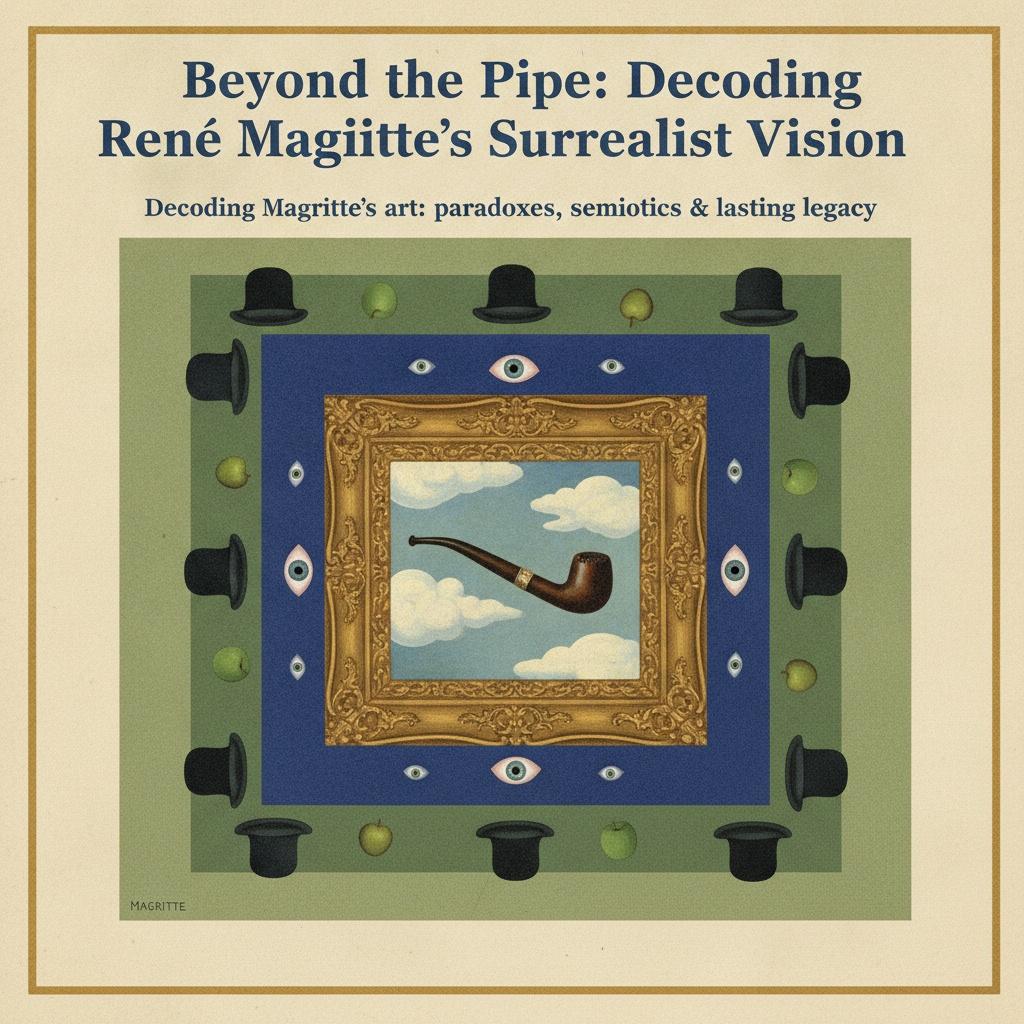
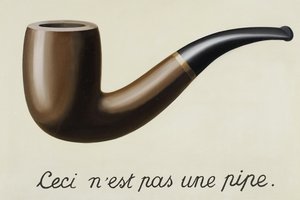
To encounter René Magritte’s The Treachery of Images is to enter a profound state of cognitive dissonance. At first glance, the viewer is presented with a deceptively simple subject: a meticulously rendered pipe, suspended in a void of neutral clarity. Yet, beneath this veneer of academic precision lies a radical linguistic assault. The inclusion of the cursive script, Ceci n'est pas une pipe—"This is not a pipe"—serves as a devastating rupture in the contract between image and language. It is an invitation to recognize the fundamental betrayal inherent in all representation.
Magritte does not merely present a painting; he presents a philosophical crisis. By asserting that the image is not the object itself, he forces the observer to confront the gap between the physical reality of a wooden pipe and the mere pigment on canvas that mimics its form. This subversion of semiotics challenges the very foundation of how we derive meaning from symbols. For the discerning collector, this work represents more than a Surrealist milestone; it is a masterclass in the instability of truth, reminding us that every visual signifier is but a shadow, a ghost of the tangible world.
Beyond the Canvas: Magritte’s Philosophical Inquiry into Reality and Perception
The Belgian master did not seek to escape reality through the dreamscapes of Dalí; rather, he sought to interrogate the very fabric of our waking existence. His work operates within a realm where the familiar becomes uncanny, a technique that demands an intellectual engagement far beyond mere aesthetic appreciation. Magritte’s inquiry is deeply rooted in the tension between what we see and what we know. He utilizes a style that is almost clinical—a smooth, academic finish that avoids the expressive distortions of other Surrealists—to lend an air of undeniable authority to his impossible propositions.
In works such as The Triumphant March or the hauntingly obscured faces in The Lovers, Magritte manipulates perception to suggest that reality is a construct of habit and convention. He invites us to question the reliability of our senses, suggesting that our perception is often a veil that obscures more than it reveals. This philosophical depth transforms his canvases into intellectual puzzles, where the act of looking becomes an act of discovery. To possess or study Magritte is to engage in a continuous dialogue with the enigma of existence, making his vision as much a part of the intellect as it is of the eye.
The Poetics of the Everyday: Symbolism and the Surrealist Mundane
There is a quiet, haunting beauty in Magritte’s ability to elevate the mundane to the monumental. He selects objects from the lexicon of the everyday—bowler hats, green apples, clouds, and stones—and recontextualizes them within landscapes of profound strangeness. This is not the Surrealism of monsters or nightmares, but a poetics of the ordinary. By stripping these objects of their utilitarian context, he reveals their latent symbolic power, turning a simple piece of fruit into an instrument of mystery.
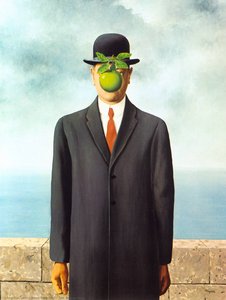
This mastery of the mundane allows Magritte to create a sense of "disrupted reality" that feels intimately connected to our own lives. When we see a stone floating in the sky or a man whose face is replaced by an apple, as seen in The Son of Man, the shock comes from the intrusion of the impossible into the recognizable. He utilizes the textures of the real—the weight of a stone, the softness of a cloud—to anchor his surrealist visions, ensuring that the viewer cannot simply dismiss them as fantasy. It is this precise balance of the familiar and the fantastic that gives his work its enduring, magnetic pull.
Visual Paradoxes: Analyzing Iconic Works from 'The Son of Man' to 'The Lovers'
The breadth of Magritte’s oeuvre is a testament to his ability to sustain a singular, subversive logic across diverse compositions. In The Son of Man, the tension is found in the occlusion; the apple hides the face, creating a conflict between the visible and the concealed. This theme of concealment is echoed with even greater psychological intensity in The Lovers, where the shroud over the faces transforms an intimate embrace into a scene of profound isolation and frustration. The viewer is denied the emotional climax of the kiss, much as Magritte denies us the truth of the image.
Furthermore, his explorations of scale and gravity—seen in works like Golconda, where men descend from the sky like raindrops—challenge our fundamental understanding of physics and space. Each painting functions as a closed loop of logic, a self-contained paradox that rewards repeated viewing. For those who curate spaces of intellectual depth, these works offer a sophisticated layer of narrative complexity, providing much more than decoration; they provide a window into the mechanics of thought itself.
Legacy of the Uncanny: The Enduring Influence of Magritte on Modern Visual Culture
The ripples of Magritte’s vision extend far beyond the borders of the Surrealist movement, permeating contemporary advertising, cinema, and digital media. His ability to manipulate symbols has become a cornerstone of modern visual communication, teaching us how to use irony and juxtaposition to command attention. The "Magrittean" aesthetic—the clean lines, the unexpected placement, the philosophical wink—is a recognizable language in our globalized, image-saturated culture.
For the modern connoisseur, Magritte remains a vital presence. His work continues to challenge the boundaries of what art can achieve, proving that the most profound revolutions often occur not through loud proclamations, but through the quiet, persistent questioning of the images we take for granted. As we navigate an era of deepfakes and digital illusions, his warnings about the treachery of the image have never been more prescient or more essential to our understanding of the world.
About ArtsDot.com
ArtsDot.com is a global leader in the curation and reproduction of fine art. Since 2004, we have dedicated ourselves to making the world's most profound masterpieces accessible to discerning collectors, interior designers, and institutions worldwide. Our atelier specializes in museum-quality, hand-painted oil reproductions on 100% cotton canvas, executed by artists holding degrees from prestigious Fine Arts academies. Whether you seek a bespoke commission, such as transforming a personal photograph into a Renaissance-style portrait, or require large-scale architectural murals for luxury hospitality projects, ArtsDot provides an unparalleled service defined by authenticity, craftsmanship, and a 100% satisfaction guarantee. Explore our vast library of over 465,000 works and experience the intersection of historical heritage and modern excellence.