The Impressionist Legacy: A Foundation for Change
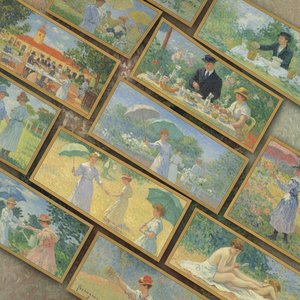
To understand the seismic shift of the Post-Impressionist movement, one must first appreciate the ephemeral beauty of the Impressionists who preceded them. In the late 19th century, artists like Claude Monet and Pierre-Auguste Renoir sought to capture the fleeting essence of light, atmosphere, and a single moment in time. Their canvases were triumphs of perception, utilizing broken brushstrokes and a luminous palette to replicate the sensory experience of a sun-drenched garden or a misty morning on the Seine. While this revolution broke the shackles of rigid academic realism, it remained tethered to the external world—a pursuit of optical truth that, while breathtaking, often lacked a deeper, more permanent structural or emotional weight.
The Impressionist era was a period of unprecedented light, yet for a new generation of visionaries, this focus on the transient felt incomplete. They looked at the shimmering surfaces of their predecessors and yearned for something more substantial. They did not wish to merely record how light hit an object; they sought to explore what that object meant, how its form could be distilled into a geometric essence, and how color could serve as a direct conduit to the human psyche. This tension between the fleeting moment and the enduring form became the catalyst for a movement that would forever alter the trajectory of Western art.
Breaking the Surface: The Structural Innovations of Paul Cézanne
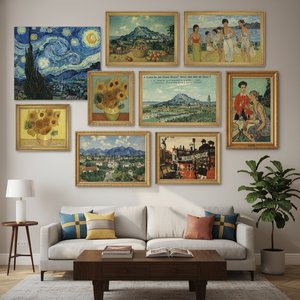
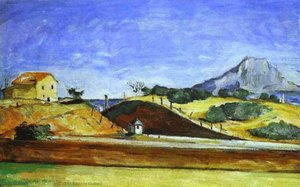
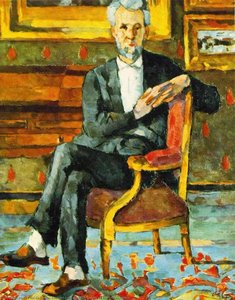
Emerging from the shadows of Impressionism, Paul Cézanne acted as the bridge between the ephemeral and the eternal. Often described as the father of modern art, Cézanne found the Impressionist technique too disorganized, lacking the architectural permanence found in the Old Masters. His mission was to "make of Impressionism something solid and durable, like the art of the museums." In works such as 'Mont Sainte-Victoire', we witness a profound departure from mere observation. Instead of dissolving the mountain into light and mist, Céziente utilized simplified forms and deliberate, rhythmic brushstrokes to construct a sense of monumental stability.
Cézanne’s genius lay in his ability to perceive the underlying geometry of nature. He famously suggested that everything in nature could be reduced to the cylinder, the sphere, and the cone. In his still lifes, such as 'Pot of Flowers', he did not simply paint a bouquet; he orchestrated a complex arrangement of color planes and volumes. By using subtle shifts in hue to create depth rather than traditional perspective, he challenged the viewer’s perception of space. This structural rigor provided the blueprint for Cubism, proving that art could be a construction of the mind as much as a reflection of the eye.
Color as Emotion: The Expressive Power of Post-Impressionism
While Cézanne sought structure, other Post-Impressionists turned their gaze toward the internal landscape of emotion. For these artists, color was no longer a tool for mimicry but a language of feeling. They liberated pigment from its descriptive duties, allowing it to vibrate with symbolic intensity. This era saw the birth of a more subjective reality, where the sky might burn with an unnatural crimson or a face might glow with an unsettling green, all to convey a specific psychological state or spiritual truth.
This movement embraced the idea that color could possess its own autonomy. The palette became bolder, more saturated, and increasingly arbitrary. By decoupling color from its naturalistic origins, artists could tap into a primal, visceral connection with the viewer. This shift transformed the canvas from a window looking out onto a landscape into a mirror reflecting the artist's soul. It was a revolution of the spirit, where the vibrancy of the paint matched the intensity of the human experience, laying the groundwork for the expressive movements of the 20th century.
From Form to Fauvism: The Bold Evolution Toward Modernity
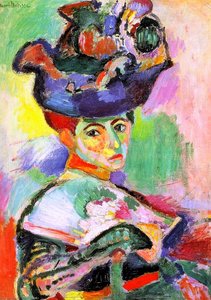
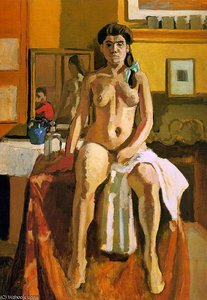
The seeds of Post-Impressionist experimentation found their most explosive expression in the early 20th century through the movement known as Fauvism. If Cézanne provided the bones and the other Post-Impressionists provided the heart, the Fauves—led by the incomparable Henri Matisse—provided the unbridated fire. Matisse and his contemporaries utilized "wild" colors that shocked the traditionalist eye, employing flat planes of intense pigment and fluid, decorative lines to create works of immense vitality.
In masterpieces like 'The Joy of Life', we see the culmination of this evolutionary line. The influence of Matisse’s bold use of color and simplified forms can be traced directly back to the structural experiments of Cézanne and the expressive freedom of his predecessors. The Fauves pushed the boundaries of abstraction, prioritizing the decorative harmony of the canvas over any semblance of photographic reality. This era of "wild beasts" proved that art could exist as a pure arrangement of color and line, an idea that would eventually pave the way for the total abstraction of the modern age.
The Lasting Impact: How Post-Impressionism Redefined the Artistic Lens
The legacy of the Post-Impressionist revolution is visible in nearly every corner of contemporary art. By breaking the singular focus on optical realism, these artists expanded the definition of what a painting could be. They taught us that an artist’s duty is not merely to document the world, but to interpret, deconstruct, and reimagine it. The movement introduced a dualism—the tension between structure and emotion, between the seen and the felt—that remains the heartbeat of artistic creation today.
Today, we continue to find profound inspiration in their courage to deviate from tradition. Whether through the geometric precision of a landscape or the emotive power of a portrait, the spirit of Post-Impressionism lives on in our appreciation for texture, color, and the subjective truth. It was a period that taught the world that art is not just a reflection of life, but a vibrant, transformative force capable of reshaping our very perception of reality.
Preserving the Masterpiece: The ArtsDot Legacy
At ArtsDot.com, we share this profound passion for the masters who redefined art history. Since 2004, our mission has been to bring the breathtaking beauty of these revolutionary eras into the homes of collectors worldwide. We specialize in creating high-quality, hand-painted oil reproductions that capture the very essence of Post-Impressionist brilliance—from the tactile, impasto brushstrokes of a Cézanne landscape to the vibrant, emotive palettes of Matisse.
Our dedication to excellence ensures that every piece is a tribute to academic mastery. Whether you are seeking a museum-grade Giclée print or a bespoke, multi-layered oil painting commissioned from a personal photograph, our artists utilize premium pigments and heavy-duty canvases to ensure longevity. We invite you to explore our vast library of 465,000 paintings and discover how the vibrant revolution of Post-Impressionism can become a living part of your own architectural space.