The Shattered Lens: Understanding the Cubist Revolution
To understand the birth of Cubism is to witness the moment the single, fixed viewpoint of the Renaissance was irrevocably shattered. For centuries, Western art had been a window—a transparent pane through which a viewer observed a carefully constructed illusion of depth, light, and shadow. However, at the dawn of the 20th century, a profound restlessness began to stir within the studios of Paris. The world was accelerating; the invention of photography had relieved painters of the burden of mere mimesis, while new scientific understandings of time and space suggested that reality was far more complex than what meets the eye.
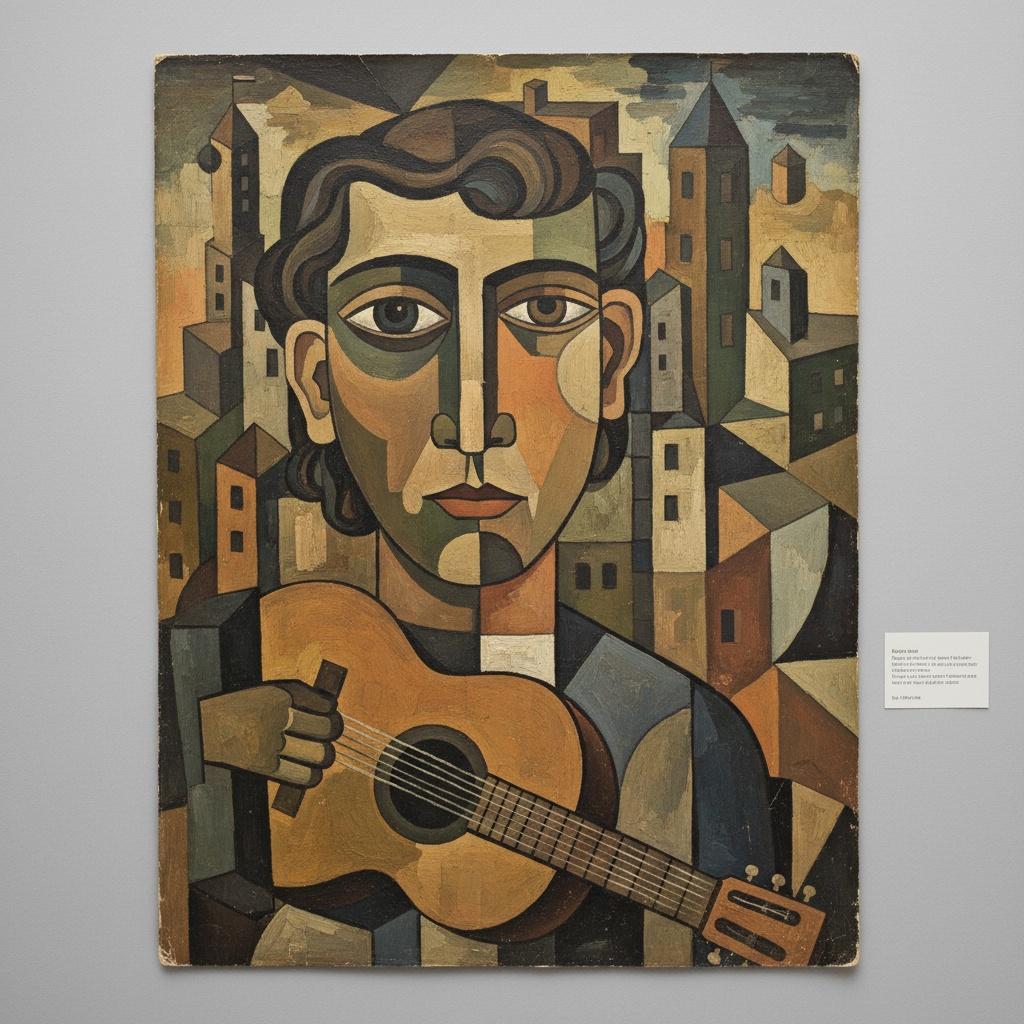
Cubism emerged not merely as a new style, and certainly not as a mere trend, but as a radical reconfiguration of visual language. It sought to represent the subject not as it appears from one static moment, but as it is known by the mind through multiple perspectives. This was an intellectualized approach to painting, where the artist abandoned the comfort of traditional perspective to embrace a fragmented, multi-dimensional reality. By breaking objects into geometric components, the Cubists invited the viewer to participate in a reconstruction of form, turning the act of looking into an active, cognitive process.
This revolution demanded a new way of seeing—one that embraced the flat surface of the canvas rather than trying to hide it. It was a courageous departure from the romanticized landscapes and classical portraits of the past, signaling the arrival of a modern consciousness that found beauty in the fractured, the geometric, and the abstract.
Analytical Cubism: Deconstructing Form and Light
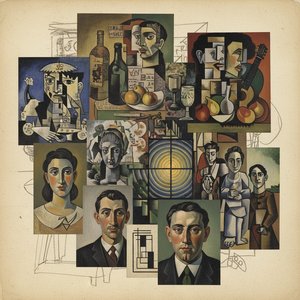
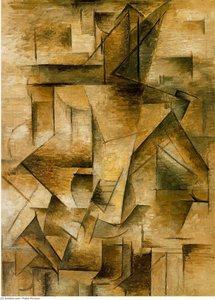
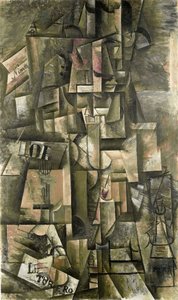
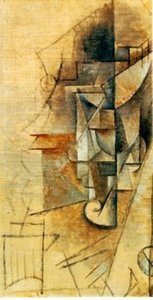
The first profound phase of this movement, known as Analytical Cubism, represents one of the most rigorous periods in art history. During this era, artists like Pablo Picasso and Georges Braque worked with a shared intensity to dissect their subjects into fundamental components. The goal was not to destroy the subject, but to analyze it—to peel back the layers of appearance to reveal the underlying structure. In these works, the familiar contours of a violin, a carafe, or a human face are dissolved into a complex web of overlapping planes and intersecting lines.
Visually, this period is characterized by a deliberate restraint in color. To prevent the emotional pull of vibrant hues from distracting the viewer from the structural investigation, the palette was often reduced to monochromatic earth tones: ochres, greys, browns, and muted blacks. This austerity forced the eye to focus entirely on the interplay of light and shadow across the fractured facets. The light does not fall upon a solid object in a traditional sense; instead, it seems to emanary from within the very intersections of the planes, creating a rhythmic, almost musical cadence of light and dark.
The complexity of Analytical Cubism can be overwhelming to the uninitiated, yet there is a profound logic to its chaos. Each shard of color and each sharp edge serves as a clue in a visual puzzle. By presenting various angles of an object simultaneously, the artist provides a more complete, albeit fragmented, truth than a single-point perspective ever could. It is a dance of geometry where the boundaries between object and atmosphere begin to blur, creating a unified, crystalline composition.
Synthetic Cubism: The Art of Collage and Composition
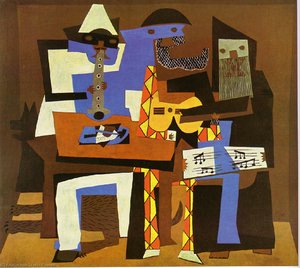
As the movement evolved, it transitioned from the analytical deconstruction of forms into the more additive, playful era of Synthetic Cubism. If the first phase was about taking things apart, this second phase was about putting them back together in entirely new, unexpected ways. This period saw a significant shift in technique and materiality, moving away from the monochromatic dissection of reality toward a richer, more textured exploration of composition.
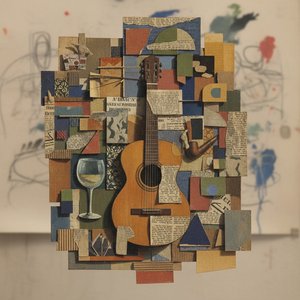
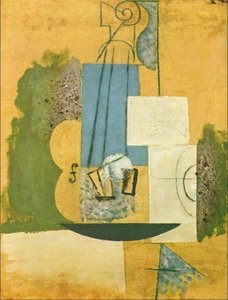
The most revolutionary contribution of Synthetic Cubism was the introduction of collage. Artists began to incorporate non-art materials directly onto the canvas—scraps of newspaper, wallpaper, cloth, and even sand. This act of "synthesizing" disparate elements brought a new sense of tactile reality to the work. The painting was no longer just a representation of an object; it became an object itself, a physical assemblage of textures and meanings. This technique bridged the gap between high art and the everyday world, inviting the mundane textures of urban life into the sacred space of the masterpiece.
Color returned with renewed vigor during this stage. The compositions became flatter, bolder, and more decorative, utilizing larger shapes and brighter pigments to create a sense of layered depth. Works like Picasso’s Guitar (1920) exemplify this evolution, where geometric forms and earthy tones coalesce into a dynamic composition that celebrates the essence of the instrument through simplified, symbolic shapes. Synthetic Cubism taught us that art could be constructed from the fragments of reality, creating a new, vibrant whole that was both abstract and deeply connected to the physical world.
The Architects of Abstraction: Picasso, Braque, and the Avant-Garde
While many artists contributed to the expansion of modernism, the symbiotic relationship between Pablo Picasso and Georges Braque remains the heartbeat of the Cubist movement. Their collaboration was so intense and their visions so aligned that they often described themselves as being like "two mountaineers roped together." Together, they navigated the treacherous terrain of radical abstraction, pushing the boundaries of what a painting could be until the very concept of a "subject" was transformed.
- Pablo Picasso: The Spanish master whose restless energy and ability to reinvent himself allowed him to lead the charge. From the primal intensity of Les Demoiselles d'Avignon to the intricate layers of his later works, Picasso provided the raw, transformative power that fueled Cubism.
- Georges Braque: The more methodical and contemplative of the duo, Braque brought a profound sense of structure and poetic rhythm to the movement. His mastery of texture and space helped ground the radical experiments of Cubism in a sophisticated aesthetic language.
- The Avant-Garde Spirit: Beyond these two giants, a wider circle of artists embraced the Cubist logic, applying its principles to sculpture, ceramics, and even design, ensuring that the movement's influence permeated every corner of 20th-century culture.
The legacy of these architects lies in their courage to abandon the familiar. They did not merely change the way we paint; they changed the way we perceive the very fabric of reality. Through their experimentation, they paved the way for nearly every major movement that followed, from Futurism and Constructivism to the total abstraction of the mid-century masters.
Cubism's Legacy: From Canvas to Modern Architectural Design
The ripples of the Cubist revolution extend far beyond the edges of a canvas or the frames of a museum gallery. The movement’s fundamental principles—the fragmentation of form, the emphasis on geometric clarity, and the rejection of superficial ornament—became the foundational pillars of modern design and architecture. The Cubist eye, which sought the essential structure beneath the surface, found its ultimate expression in the clean lines and functionalist beauty of the International Style.
In the realm of architecture, the influence is unmistakable. The works of Le Corbusier and the Bauhaus school echo the Cubist fascination with intersecting planes and the interplay of volume and void. Modern skyscrapers, with their rhythmic glass facades and geometric precision, are essentially large-scale, three-dimensional manifestations of Cubist logic. The movement taught architects to view a building not as a static monument, but as a dynamic composition of light, shadow, and structural transparency.
Even in our contemporary digital age, the spirit of Cubism persists. The way we navigate fragmented information on screens, the layered interfaces of modern software, and the deconstructed aesthetics of graphic design all owe a debt to those early 20th-century experiments. Cubism taught us that truth is rarely found in a single, unadorned view; rather, it is discovered in the beautiful, complex, and multifaceted assembly of many different perspectives.
At ArtsDot.com, we celebrate this enduring legacy of human creativity. Whether you are drawn to the profound depth of a handmade oil reproduction or the modern precision of a museum-quality Giclée print, our mission is to bring the transformative power of art history into your personal space. From custom commissions that reimagine your own memories in the style of the masters to large-scale architectural murals that redefine your environment, we provide the bridge between the masterpieces of the past and the homes of the future.