The Architect of Modernity: Understanding Cézanne’s Post-Impressionist Revolution
To step into the world of Paul Cézanne is to witness the precise moment when the ephemeral light of Impressionism began to coalesce into something far more permanent and structural. While his contemporaries, the Impressionists, sought to capture the fleeting dance of sunlight upon water or the hazy atmosphere of a Parisian afternoon, Cézanne felt a profound calling toward the enduring. He did not merely wish to record a moment; he sought to reconstruct the very essence of reality through a lens of disciplined observation. This pursuit marked the dawn of Post-Impressionism, a movement that moved beyond mere sensory perception to explore the underlying architecture of the visible world.
Cézanne’s revolution was not one of sudden, violent change, but rather a meticulous, almost scientific re-evaluation of how we perceive form. He looked at the landscape of Provence and saw more than just rolling hills and olive groves; he saw a rhythmic arrangement of masses and volumes. By moving away from the soft, blurred edges of his predecessors, he introduced a sense of weight and permanence that had been absent from much of late 19th-century art. His work serves as a profound meditation on the tension between what the eye sees in a passing glance and what the mind knows to be true about the structure of existence.
This intellectual rigor transformed the canvas into a site of deep inquiry. Through his dedicated study of nature, Cézanne taught us that art could be both a sensory experience and an analytical one. His legacy is not found merely in the beauty of his palettes, but in the way he fundamentally altered the DNA of Western painting, providing the necessary foundation for the radical abstractions that would follow in the twentieth century.
Geometry in Nature: The Structural Essence of the Cylinder, Sphere, and Cone
One of the most enduring legacies of Cézanne is his famous directive to treat nature by means of the cylinder, the sphere, and the cone. This was not a call to reduce the living world to cold, lifeless shapes, but rather an invitation to recognize the inherent geometry that governs all organic life. When observing one of his profound still lifes, such as his explorations of Apples, Pears and Grapes, one begins to see how the soft curves of fruit are underpinned by a rigorous geometric logic. Each piece of fruit becomes a vessel for volume, held in place by a careful arrangement of color and shadow.
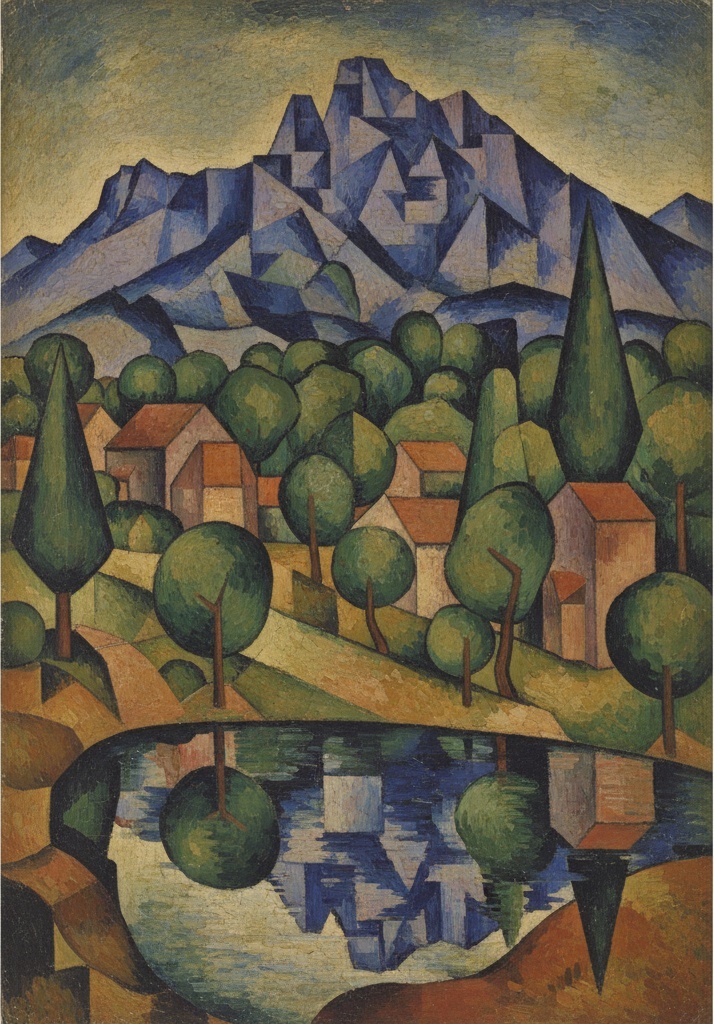
This approach allowed Cézanne to achieve a sense of monumental stability within his compositions. By identifying these fundamental shapes, he could build a composition that felt as sturdy and timeless as the mountains of Mont Sainte-Victoire. He utilized geometric forms not to flatten the world, but to deepen it, creating a tactile reality where objects possess a palpable presence. The viewer does not merely look at a pear; they feel its weight and its roundness through the deliberate application of color patches that define its curvature.
This structural methodology creates a fascinating dialogue between the organic and the mathematical. In his hands, a simple arrangement of fruit or a rugged landscape becomes a complex puzzle of interlocking planes. This mastery of form ensures that even his most quiet subjects possess an underlying energy, a structural tension that keeps the eye moving across the canvas, searching for the equilibrium that Cézanne so masterfully maintains.
A Bridge Between Eras: How Cézanne’s Vision Prefigured Cubism
History often remembers Paul Cézanne as the pivotal figure standing at the crossroads of two great epochs. He was the bridge that allowed the fluid, light-drenched world of Impressionism to cross over into the fragmented, multi-perspective realm of Cubism. Without his radical experimentation with perspective and form, the works of Picasso and Braque might never have found their footing. Cézanness's revolutionary technique involved breaking down objects into distinct facets, a method that directly inspired the Cubist obsession with fragmentation and the simultaneous viewing of multiple angles.
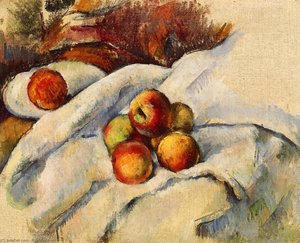
In masterpieces such as Still Life with Apples and Oranges, we see the early tremors of this shift. Here, the traditional single-point perspective begins to dissolve. The edges of objects are not strictly contained; instead, they bleed into one another, creating a sense of overlapping planes that challenge our traditional understanding of depth. This fragmentation does not destroy the subject but rather reconstructates it in a way that acknowledges the complexity of human vision—a vision that is always moving, always shifting.
By treating the canvas as a flat surface upon which depth must be reconstructed through color and shape, Cézanne liberated art from the requirement of literal imitation. He proved that an artist could manipulate space to convey a deeper, more conceptual truth. This liberation was the essential precursor to the modern era, paving the way for artists to explore the purely formal qualities of paint, line, and shape, ultimately leading to the birth of total abstraction.
The Chromatic Language: Color, Light, and Depth in Still Life Masterpieces
While his structural innovations provided the bones of his work, it was Cézanne’s use of color that provided its soul. He developed a sophisticated vibrant color palette that functioned as much more than mere decoration; color was his primary tool for constructing depth and atmosphere. Eschewing the traditional use of heavy black shadows, he utilized shifts in temperature—moving from warm ochres to cool blues—to create a sense of recession and protrusion within the painting.
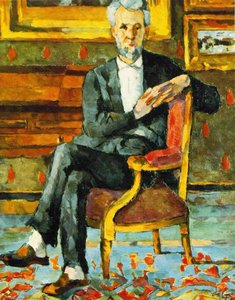
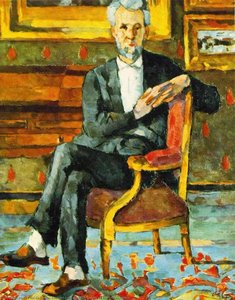
In works like The Peasant, we observe how color can embody both character and light. The interplay of warm tones against cooler, shadowed areas creates a rhythmic pulse across the canvas, guiding the viewer's gaze through the composition. His use of color was never purely descriptive; it was emotive and structural. He understood that a certain shade of green could suggest the density of foliage, while a touch of bright orange could pull an object forward toward the viewer, creating a shallow but intensely active pictorial space.
This chromatic language allows his still lifes to breathe with a life of their own. The fruit appears ripe and heavy, not because of fine detail, but because of the way the colors vibrate against one another. This technique creates a sensory experience that is both intellectually stimulating and viscerally satisfying, inviting the collector to appreciate the profound harmony found in the careful balance of light and pigment.
Curating the Legacy: Integrating Cézanne-Inspired Art into the Modern Interior
For the contemporary art enthusiast, bringing the spirit of Cézanne into a home is an exercise in timeless elegance. His work, characterized by its geometric forms and rich textures, possesses a unique ability to anchor a room, providing a sense of historical depth and intellectual sophistication. Whether through a large-scale reproduction of a landscape or a more intimate still life, the presence of Cézanne-inspired art introduces a rhythmic stability to modern architectural spaces.
Integrating such works requires an appreciation for balance. In a minimalist setting, a painting with heavy, visible brushstrokes and deep tonal ranges can serve as a powerful focal point, adding much-needed warmth and texture to clean lines. Conversely, in more traditional interiors, his structured compositions can provide a sophisticated link between classical decor and modern sensibilities. The key lies in recognizing the structural harmony he brings to any environment.
When selecting pieces that honor this Post-Impressionist vision, one should look for the tactile quality of the paint—the way light catches the ridges of an impasto stroke. This connection to the physical act of painting ensures that the artwork remains a living part of the home, a constant reminder of the beauty found in the intersection of nature’s organic chaos and the human mind's quest for order. To curate with Cézanne is to invite a legacy of profound observation and enduring grace into one's personal sanctuary.
At ArtsDot.com, we celebrate this enduring legacy by offering exquisite, hand-painted reproductions that capture the very essence of the masters. Our artists, trained in the finest academic traditions, meticulously recreate the textures, brushstrokes, and vibrant palettes of Cézanne, ensuring that every piece is not merely a copy, but a profound tribute to the structural soul of Post-Impressionism.