
The Dawn of Grace: Sandro Botticelli and the Florentine Renaissance
To step into the world of the Quattrocento is to enter a period where the shadows of the Middle Ages began to dissolve under the luminous dawn of humanism. At the heart of this cultural awakening stood Florence, a city vibrating with intellectual fervor, mercantile wealth, and an insatiable thirst for beauty. It was within this fertile Florentine soil that Sandro Botticelli emerged, not merely as a painter, but as a poet of the brush. His era was defined by a profound shift in perspective, where the divine and the earthly were no longer viewed as disparate realms, but as interconnected threads in a grand, cosmic tapestry.
Botticelli’s arrival coincided with the rise of the Medici family, whose patronage provided the essential sanctuary for artistic experimentation. Unlike the rigorous anatomical realism that would later define the High Renaissance, Botticelli cultivated an aesthetic rooted in linea—the graceful, undulating line. This stylistic choice allowed him to transcend the physical weight of his subjects, imbuendo them with a weightless, ethereal quality. His work serves as a bridge between the structured devotion of the early Italian primitives and the breathtaking complexity of the classical revival, capturing a moment in history when the rediscovered wisdom of antiquity began to dance alongside Christian piety.
Poetry in Motion: Decoding the Mythological Symbolism of 'The Birth of Venus'
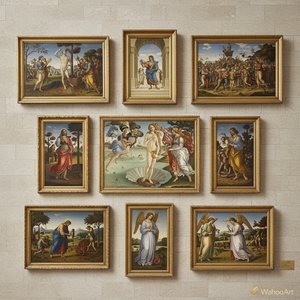
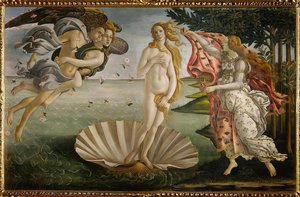
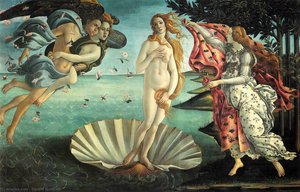
Perhaps no image captures the collective imagination of the Western world quite like The Birth of Venus. In this masterpiece, we witness more than a mere mythological scene; we observe a profound Neoplatonic allegory. As the goddess emerges from the sea foam, her arrival is not merely a physical event but a spiritual manifestation of beauty entering the human consciousness. The gentle breeze of the Zephyrs and the floral abundance surrounding her are laden with meaning, representing the breath of life and the blossoming of the soul through the contemplation of divine aesthetics.
The symbolism within this work invites the viewer into a meditative state. Every element, from the delicate arrangement of the roses to the rhythmic movement of the drapery, serves to elevate the subject matter above the mundane. Botticelli utilizes mythological motifs to explore complex philosophical ideas regarding love, purity, and the ascent of the spirit. To gaze upon Venus is to engage in a silent dialogue with the classical past, where the beauty of the human form becomes a vessel for higher, transcendental truths. It is a visual symphony where melody and meaning are indistinguishable.
Divine Elegance: The Sacred Narratives and Devotional Depth of His Religious Works
While his mythological allegories often command the spotlight, Botticelli’s profound religious compositions reveal a different facet of his genius: a deep, soulful devotion. In works such as the Adoration of the Magi, the artist demonstrates an unparalleled ability to infuse sacred narratives with human emotion and rhythmic grace. Here, the divine presence is not depicted through overwhelming power, but through a delicate, luminous sanctity that invites intimacy rather than awe-struck distance.
In these religious canvases, Botticelli employs a rich palette and intricate detail to guide the faithful through the mysteries of the Christian faith. The figures are often arranged in compositions that emphasize movement and interconnectedness, mirroring the spiritual unity of the holy event. There is a rhythmic cadence to his religious figures—a way in which their gazes and gestures create a circular flow of devotion. Through this, he transformed the altarpiece from a mere instructional tool into a window through which the viewer might glimpse the celestial realm, rendered with a tenderness that remains profoundly moving centuries later.
Luminous Linearity: The Technical Mastery of Botticelli’s Aesthetic Style
The technical brilliance of Botticelli lies in his mastery of the contour. While contemporaries like Antonello da Messina were pioneering the use of oil to achieve deep, realistic textures, Botticelli remained a master of the tempera medium, utilizing its capacity for fine, precise detail. His technique relies heavily on the rhythmic repetition of lines to define form and movement. This creates a sense of "luminous linearity," where light does not merely strike a surface but seems to emanate from the very edges of his subjects.
His ability to balance delicate translucency with structural clarity is nothing shortient of miraculous. He often applied layers of pigment with such precision that the transitions between shadow and light appear almost seamless, yet they retain a crispness that prevents the composition from becoming muddy. This emphasis on the edge—the boundary where one form meets another—allows his figures to appear as if they are floating within a dreamscape, unburdened by gravity. It is this specific technical approach that gives his work its signature "ethereal" quality, making the painted surface feel like a shimmering veil between worlds.
A Lasting Legacy: The Enduring Influence of Western Art History
The influence of Sandro Botticelli extends far beyond the borders of 15th-century Florence. His aesthetic language—characterized by grace, symbolic depth, and linear elegance—has echoed through the centuries, inspiring countless generations of artists, from the Pre-Raphaelites to the modern masters of decorative design. He taught the art world that beauty could be a vehicle for profound intellectual inquiry, and that the line itself possesses a musicality capable of stirring the human heart.
Today, we continue to find resonance in his work because it speaks to a universal human longing: the desire to find the divine within the beautiful. His ability to synthesize the classical and the Christian, the mythological and the emotional, ensures that his masterpieces remain living entities in our cultural consciousness. As we study his legacy, we do not merely look back at a closed chapter of history; rather, we participate in an ongoing celebration of the enduring power of human creativity and the eternal pursuit of grace.
At ArtsDot.com, we are dedicated to preserving this profound legacy. Our mission is to make the timeless beauty of the Old Masters accessible to modern collectors through exquisite, hand-painted oil reproductions and museum-quality Giclée prints. Whether you seek a bespoke commission that reimagines history or a textured masterpiece for your private collection, our artists strive to capture the very soul of Botticelli’s elegance for your home.