Introduction
To step into the world of Paul Klee is to abandon the safety of the recognizable and enter a realm where color breathes, lines dance, and geometry finds its soul. His work does not merely ask us to look; it invites us to listen with our eyes. As we prepare to journey through his top twenty-five masterpieces, we are not simply viewing paintings, but witnessing a profound visual symphony—a rhythmic arrangement of form and pigment that mirrors the very heartbeat of human emotion.
Born in the quietude of Switzerland, Klee’s artistic consciousness was shaped by a unique duality: the structured discipline of his father’s musicality and the vibrant, wandering spirit of an explorer. His journey through the early 20's century saw him navigating the avant-garde currents of Expressionism, Cubism, and Surrealism , yet he remained fiercely singular. From the sun-drenched, transformative light of his travels in Tunisia to his influential tenure at the Bauhaus, Klee mastered the art of the "inner eye," translating the intangible—music, dreams, and movement—into a delicate language of abstract symbols.
These selected works remain profoundly meaningful today because they speak to the universal experience of discovery. In an era of digital saturation, Klee’s meticulous interplay of texture and tone offers a sanctuary of contemplation. His ability to find cosmic significance in a single dot or a wandering line resonates with our modern search for meaning within complexity. Each piece serves as a bridge between the seen and the unseen, reminding us that art is not a mirror held up to nature, but a window into the spirit.
In the following curation, we will explore twenty-five pivotal works that define his legacy. We shall traverse his most iconic landscapes of color, his rhythmic geometric compositions, and those hauntingly beautiful abstractions that continue to challenge our perceptions of reality. Prepare to lose yourself in the poetic architecture of a true master.
Twittering machine 1 - Paul Klee
 Twittering machine 1 - Paul Klee
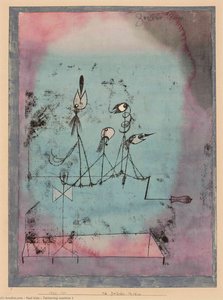
In Twittering Machine 1 , Paul Klee invites us into a delicate, rhythmic world where the boundaries between the organic and the industrial dissolve. This masterpiece, a cornerstone of his most celebrated works, functions as a visual symphony; it does not merely depict a scene, but orchestrates a feeling. Through a masterful use of fine, fragmented lines and a soft, ethereal palette of pale blues and muted pinks, Klee captures the fragile pulse of modernity.
The composition presents a whimsical, mechanical bestiary—a collection of insectoid forms and birdcage-like structures that seem to vibrate with an automated song. There is a profound, quiet intelligence in these shapes, suggesting a world where technology attempts to mimic the soul of nature. To possess a reproduction of this work is to bring a sense of intellectual curiosity and dreamlike serenity into your home. It acts as a subtle reminder of the beauty found in complexity, making it an exquisite focal point for a sophisticated study or a contemporary living space.
To Parnassus - Paul Klee
 To Parnassus - Paul Klee
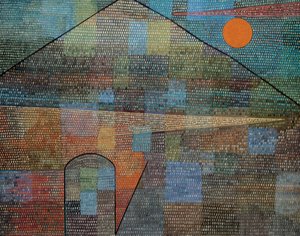
In To Parnassus , Paul Klee invites us to transcend the mundane and ascend toward a higher plane of consciousness. This masterpiece, a cornerstone in our collection of the top 25 artworks of Paul Klee , functions less like a landscape and more like a spiritual gateway. The composition is anchored by a luminous, sun-like orb that radiates warmth against a meticulously textured, mosaic-style terrain. As your eyes traverse the fragmented, geometric planes—reminiscent of both ancient tilework and modern digital pixels—you encounter an arched portal that beckons you into a realm of profound mystery.
There is a rhythmic pulse in this work, a visual melody where bold black outlines meet a sophisticated palette of deep purples, fiery oranges, and cool blues. It does not merely depict a mountain or a celestial event; it captures the very essence of abstract expressionism and Bauhaus innovation . To possess such a piece is to bring a sense of eternal transition into your home—a constant, beautiful reminder that every moment is a passage toward enlightenment.
Legend of the Nile - Paul Klee
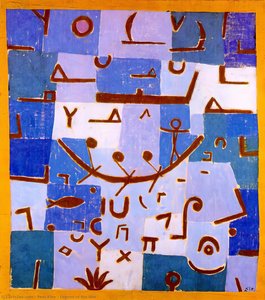 Legend of the Nile - Paul Klee
What ancient secrets lie beneath the rhythmic, fragmented surface of Legend of the Nile by Paul Klee? Created in 1937, this masterpiece serves as a profound visual tapestry, weaving together the mythic essence of the Nile with the avant-garde spirit of the Bauhaus era. As Klee masterfully synthesizes elements of Cubism and Surrealism, he invites us into a world where hieroglyphic-like symbols, celestial crescents, and stylized aquatic forms dance across a vibrant palette of deep blues, purples, and warm ochre.
This work stands as a cornerstone in the top 25 artworks of Paul Klee because it transcends mere abstraction; it is a spiritual journey through color and form. For the discerning collector or interior designer, such a piece offers more than decoration—it provides a curated escape into a timeless, mythic landscape. The energetic brushstrokes and layered textures create a sense of movement that breathes life into modern spaces, making it an exquisite focal point for those seeking to infuse their homes with historical depth, cultural mystery, and the sophisticated soul of 20th-century modernism.
Rose Garden - Paul Klee
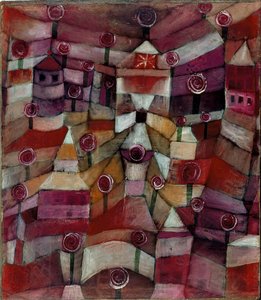 Rose Garden - Paul Klee
To encounter Paul Klee’s “Rose Garden” (1920) is to witness a masterclass in the architecture of emotion, a piece that demands a place among the world's most significant twentieth-century masterpieces. Created during his transformative tenure at the Bauhaus, this work transcends mere landscape painting, offering instead a rhythmic, geometric symphony where organic life meets structural precision. Klee utilizes a vibrant, sun-drenched palette of warm reds, oranges, and soft pinks, interweaving them with cooler purples to create a breathing, tactile depth that feels both intimate and expansive.
The brilliance of this composition lies in its ability to balance the rigid with the fluid; sharp triangles and rectangles provide a structural skeleton, while delicate circular motifs suggest the ephemeral beauty of blooming roses. For the discerning collector or interior designer, “Rose Garden” offers an unparalleled aesthetic versatility. Its sophisticated interplay of color and form provides a focal point of profound intellectual depth, making it a timeless addition to any refined modern interior seeking to harmonize avant-garde innovation with a sense of serene, botanical grace.
Botanical Theater - Paul Klee
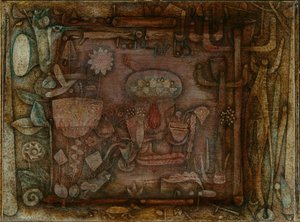 Botanical Theater - Paul Klee
In Botanical Theater , the delicate interplay of watercolor washes and rhythmic gouache strokes reveals the true soul of Paul Klee’s mastery. To observe this 1934 masterpiece is to witness a tactile symphony; one can almost feel the precision of his fine hatching and the soft, translucent layers that breathe life into each abstract petal. Klee does not merely paint flora; he orchestrates a dreamlike performance where earthy ochres and sudden bursts of vibrant pink dance across a structured, stage-like composition.
This piece stands firmly within the top 25 artworks of Paul Klee because it captures his revolutionary ability to blend Cubist geometry with organic, biomorphic movement. At ArtsDot.com, we believe such profound textures deserve more than a flat digital reproduction. Our artisans specialize in capturing this very materiality, using hand-painted oil techniques on fine cotton canvas to recreate the visible brushwork and depth of Klee’s original vision. We bring the three-dimensional essence of this botanical dreamscape into your private collection, ensuring the whimsical spirit of the Bauhaus master remains a vibrant, tactile centerpiece in your home.
May Picture - Paul Klee
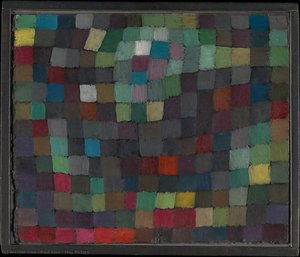 May Picture - Paul Klee
In May Picture , Paul Klee orchestrates a mesmerizing mosaic of geometry, where the boundaries between shape and emotion dissolve into a rhythmic dance of color. This 1925 masterpiece presents a structural harmony composed of interlocking squares and rectangles, meticulously layered to achieve a luminous, jewel-like depth. As you observe the vibrant reds, serene blues, and sun-drenched yellows, you witness Klee’s profound ability to translate the pulse of music into a visual arrangement of light and form.
The composition functions like a delicate architectural blueprint for the soul; its balanced fragmentation offers a sense of timeless perfection that secures its place among the top 25 artworks of Paul Klee . There is an undeniable resonance with modern minimalist design found within these fractured planes, making the piece an ideal anchor for contemporary interiors seeking a sophisticated, clean aesthetic. By distilling complex visual information into fundamental geometric elements, Klee creates a work that feels both ancient and avant-garde, inviting the viewer to find unity within the beautifully disparate pieces of its colorful, rhythmic whole.
Arctic Dew - Paul Klee
 Arctic Dew - Paul Klee
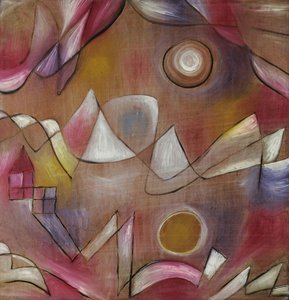
In the ethereal realm of Paul Klee’s “Arctic Dew,” the boundaries between reality and imagination dissolve into a luminous dance of color and rhythm. Created in 1920, this mesmerizing work serves as an invitation to a dreamscape where the frozen stillness of the North Pole meets the vibrant energy of the aurora borealis. Klee does not merely depict a landscape; he orchestrates a visual symphony, using rhythmic, undulating lines to create a dynamic equilibrium between a celestial upper world and a tranquil, reflective lower expanse.
The brilliance of this masterpiece lies in its masterful manipulation of light; while the subject suggests an arctic vista, Klee employs a palette rich with ochre, sun-drenched yellows, soft pinks, and deep reds . This unexpected warmth, balanced by whispers of blue and purple, creates a sense of depth that mimics the glowing layers of the Northern Lights. As one of the top 25 artworks of Paul Klee , this piece remains a profound cultural talking point in contemporary curated spaces, offering an emotional anchor through its symbolic use of duality and reflection. It is a timeless exploration of nature's organic fluidity, perfect for those seeking to evoke wonder within a sophisticated interior.
Woman Knitting - Paul Klee
 Woman Knitting - Paul Klee
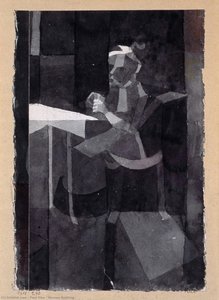
In Woman Knitting , Paul Klee achieves a profound structural harmony that exemplifies his mastery of the geometric language. The composition is a delicate dance of angularity; sharp triangles and rhythmic rectangles coalesce to form the seated figure, creating a visual puzzle where every line serves a purpose. Through a restrained palette of charcoal blacks, soft grays, and luminous whites, Klee strips away the distractions of realism to reveal a skeletal beauty. This deliberate flattening of space and use of overlapping shapes create a sense of timeless perfection, securing its place among the top 25 artworks of Paul Klee .
There is an undeniable resonance between this 1915 masterpiece and the principles of modern minimalist design. The artwork’s internal balance—its ability to convey depth through mere shape and tone—offers a sophisticated blueprint for contemporary aesthetics. For the discerning collector, this piece provides a grounding element in a clean, modern interior, where its quiet, monochromatic intensity acts as a soulful anchor amidst much simpler surroundings.
Comedians' Handbill - Paul Klee
 Comedians' Handbill - Paul Klee
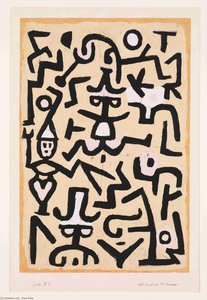
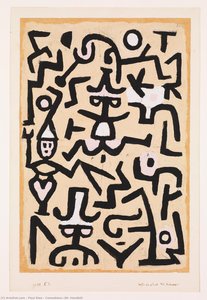
In Comedians' Handbill , Paul Klee captures a fleeting moment of theatrical whimsy, freezing the joyous chaos of the stage in a dance of abstract geometry. This masterpiece earns its place among the top 25 artworks of Paul Klee through its profound ability to translate human emotion into a rhythmic language of form and line. Created in 1938, the gouache composition vibrates with a playful energy; bold, black outlines delineate organic shapes that suggest performers caught in mid-motion, while a warm, cream-toned background provides a stage for these spectral figures.
The palette is a sophisticated dialogue of earthy browns and deep blacks, punctuated by delicate pink accents that breathe life into the abstract anatomy. There is a rhythmic, musical quality to the linework—a visual symphony that mirrors Klee’s own deep connection to auditory harmony. For the discerning collector or interior designer, this piece offers more than mere decoration; its balanced composition and intellectual depth bring a sense of curated sophistication and avant-garde spirit to any modern space, inviting a continuous exploration of movement and light.
Fire at Full Moon - Paul Klee
 Fire at Full Moon - Paul Klee
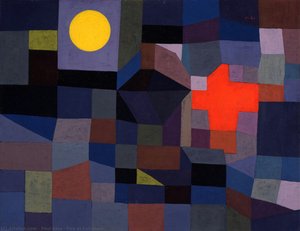
To encounter Fire at Full Moon is to step into a private nocturnal dream, an evocative masterpiece that secures its prestigious place among the top 25 artworks of Paul Klee. Created in 1933, this work transcends mere abstraction, offering a profound visual dialogue between light and shadow. The composition is a rhythmic dance of geometric fragments—rectangles and trapezoids that interlock like a sophisticated celestial puzzle. A luminous yellow orb, representing the full moon, anchors the piece with a sense of intuitive clarity, while a sudden, visceral burst of fiery red in the lower quadrant introduces a tension of passion and primal energy.
For the discerning collector or interior designer, this painting offers an unparalleled atmospheric depth. Its palette of melancholic blues, purples, and greys provides a sophisticated foundation for modern luxury interiors, where it acts as a focal point of intellectual and emotional resonance. Klee’s ability to harmonize the cool stillness of night with the warmth of a spreading flame creates a timeless aesthetic that speaks to both the avant-garde spirit and the refined, quiet elegance of a curated home.
Women - Paul Klee
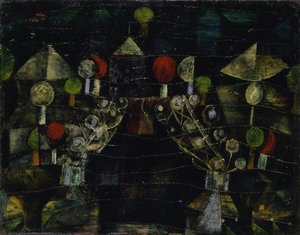 Women - Paul Klee
To encounter a work from the early 1920s is to step into the very crucible of modern abstraction, where the boundaries between reality and the subconscious begin to dissolve. In Women by Paul Klee, we witness a masterclass in the architecture of mystery. This piece earns its place among the top 25 artworks of Paul Klee through its profound ability to evoke a dreamscape using a remarkably disciplined palette of charcoal, deep greens, and somber grays, punctuated by sudden, rhythmic flashes of red and yellow.
Klee does not merely paint figures; he composes them. The silhouettes of women, stripped of individual identity, emerge as geometric echoes—part architectural plan, part musical score. One can almost feel the tension between the sharp, decisive ink lines and the soft, bleeding watercolor washes that create a sense of layered depth. It is a work of beautiful instability, where flattened perspectives and fragmented shapes invite the viewer to find their own emotional resonance within the shadows. Today, such a piece remains a transformative presence in any collection, offering a window into a timeless, enigmatic world that continues to haunt and inspire the modern eye.
Strong Dream - Paul Klee
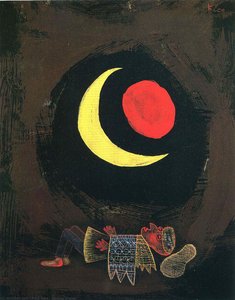 Strong Dream - Paul Klee
In the vast landscape of 20th-century abstraction, Strong Dream by Paul Klee stands as a profound psychological threshold, inviting viewers to traverse the delicate boundary between wakefulness and the subconscious. As one of the most evocative entries in our collection of the top 25 artworks of Paul Klee , this 1929 masterpiece utilizes a rhythmic, symbolic language to map the terrain of the human psyche. The composition is anchored by a striking celestial duality: a vibrant yellow crescent moon, pierced by a central red orb, which looms over a fragmented, reclining figure rendered in somber reds and blacks.
Klee’s mastery lies in his ability to use geometric deconstruction to express emotional intensity. The tension between the luminous lunar elements and the angular, dark forms below creates a sense of cosmic equilibrium—a balance of light and shadow, consciousness and instinct. In contemporary interior curation, such works serve as powerful focal points, offering a sophisticated, meditative depth that resonates with modern desires for introspection and soulful, meaningful decor.
Like a Window Pane - Paul Klee
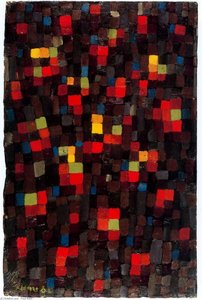 Like a Window Pane - Paul Klee
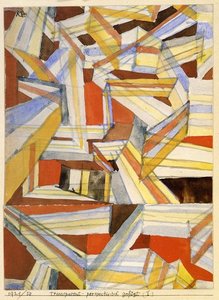
In the quiet, rhythmic dance of Paul Klee’s “Like a Window Pane,” we encounter more than just a collection of shapes; we enter a sanctuary of pure visual emotion. This masterpiece earns its place among the top 25 artworks of Paul Klee by demonstrating his unparalleled ability to distill the chaos of existence into a harmonious, geometric language. Through a delicate patchwork of interlocking squares and translucent watercolor washes, Klee creates a luminous mosaic that feels as though it is breathing with the soft glow of morning light.
To possess such a work is to invite a meditative stillness into your environment. At ArtsDot.com, we believe art should be a living presence; this piece serves as a profound architectural element for any refined interior, offering a sense of structural order and cosmic harmony. Whether gracing a private study or a sophisticated lounge, the interplay of vibrant hues and ethereal depth ensures that your space is not merely decorated, but transformed into a soulful statement of elegance and intellectual depth.
Black prince - Paul Klee
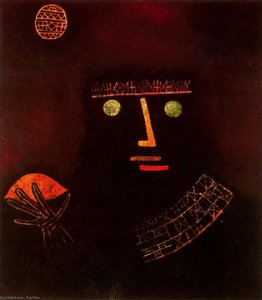 Black prince - Paul Klee
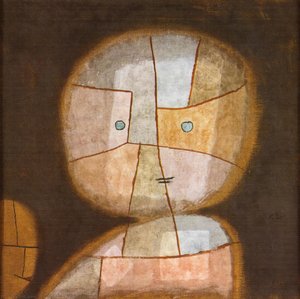
In the haunting depths of Black Prince by Paul Klee, the viewer is not merely observing a portrait but witnessing a psychological rupture defined by a masterful command of chiaroscuro. The face emerges from an abyssal, void-like black background, creating a stark, dramatic contrast that draws the eye into a state of metamorphosis. This interplay between the encroaching shadows and the fractured, illuminated planes of the visage captures the raw essence of human anxiety, securing its place among the top 25 artworks of Paul Klee .
Klee’s technical use of encaustic—a rich medium of beeswax and resin—imbues the work with a sculptural, tactile warmth. When reproduced as a hand-painted oil, this depth is amplified; the way light catches the raised textures and subtle highlights mimics the original's emotional tension. For the discerning collector or interior designer, integrating such a profound study of light and shadow into a contemporary space adds an incomparable layer of intellectual luxury and atmospheric mystery to any curated wall.
Head of a Famous Robber - Paul Klee
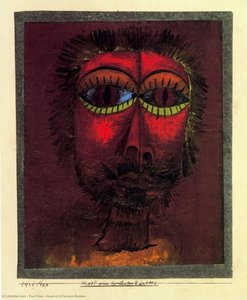 Head of a Famous Robber - Paul Klee
In the hauntingly vibrant masterpiece "Head of a Famous Robber," Paul Klee invites us into a psychological landscape where color and form collide to evoke profound human emotion. The central figure, a stylized face rendered in striking crimson hues, commands immediate attention with its intense, primal energy. As one of the most captivating entries in our collection of the top 25 artworks of Paul Klee , this piece serves as a visceral encounter with Expressionism , stripping away objective reality to reveal the raw, subjective truths of the soul.
Klee utilizes thick, textured applications of paint and rhythmic hatching lines that create an underlying sense of movement and internal tension. The fiery red of the face vibrates against a luminous backdrop of warm oranges and yellows, creating a hypnotic contrast. For the discerning collector or interior designer, integrating such a powerful emotional resonance into a home can transform a personal sanctuary into a space for profound reflection. This work is not merely a portrait; it is an intellectual anchor that brings drama, warmth, and a sense of historical depth to any curated environment.
Part of G - Paul Klee
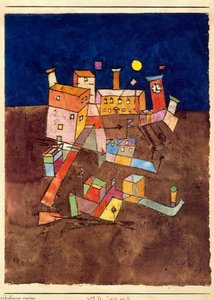 Part of G - Paul Klee
What if I told you that “Part of G” by Paul Klee was born from a moment of profound introspection—a nocturnal dreamscape where the boundaries between urban reality and surrealist fantasy dissolve? This masterpiece does not merely depict a moonlit cityscape; it captures the very pulse of the Weimar Republic’s uncertainty, translating the anxieties of a shifting era into a rhythmic dance of geometric forms and ethereal light. Its inclusion in our Top 25 is essential, as it represents Klee’s unparalleled ability to weave musicality into visual abstraction, turning a clock tower and drifting boats into symbols of human mortality and the longing for escape.
To possess a reproduction of this work is to invite a piece of history's most daring intellect into your sanctuary. At ArtsDot.com, we believe such profound emotions should not be confined to museums. Whether rendered as a hand-painted oil on 100% cotton canvas or a museum-quality print, “Part of G” transforms a modern office or refined living space into a gallery of contemplation. It is more than decor; it is a sophisticated statement of depth and intellectual curiosity.
In the Houses of Saint Germain - Paul Klee
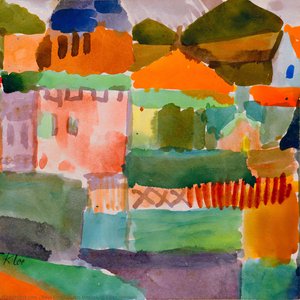 In the Houses of Saint Germain - Paul Klee
What story does the rhythmic architecture and vibrant geometry of In the Houses of Saint Germain by Paul Klee tell us about the pulse of urban life? In this captivating masterpiece, Klee transcends mere landscape to present a whimsical, musical arrangement of color and form. Emerging from his profound exploration of Expressionism and Cubism, this work breaks ground by replacing realistic depiction with an emotional resonance that feels both childlike and deeply sophisticated.
The canvas is a symphony of hues—striking reds, deep blues, and sun-drenched oranges—where houses cluster together in a dance of geometric shapes. A solitary figure stands amidst the colorful structures, inviting us to lose ourselves in this bustling, abstract community. For the discerning collector, integrating such a piece into a modern interior offers more than just decor; it provides a curated escape into a world of rhythmic harmony and light. As one of the top 25 artworks of Paul Klee , this painting serves as a window into a vibrant, structured dreamscape, perfect for adding a sense of historical depth and playful energy to any refined home gallery.
Marked - Paul Klee
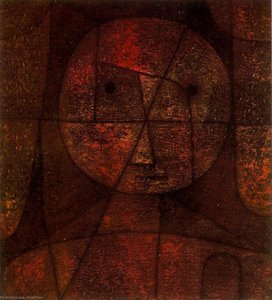 Marked - Paul Klee
To encounter Marked by Paul Klee is to stand before a profound fragment of the human psyche, an evocative masterpiece that demands a moment of silent contemplation. As one of the most significant works within the top 25 artworks of Paul Klee, this 1937 composition transcends mere abstraction, offering a window into the artist's mastery of emotional resonance and color theory. The painting vibrates with a deep, crimson luminosity, achieved through Klee’s meticulous glazing technique, which layers translucent washes to create an ethereal, inner glow.
The stylized, fragmented face emerges from the bold red background, embodying a delicate tension between vulnerability and resilience. For the discerning collector or interior designer, Marked offers more than visual intrigue; it provides a sophisticated focal point that anchors a modern luxury space with historical weight and intellectual depth. Its rhythmic geometry and emotive palette serve as a timeless testament to Klee’s ability to translate the chaos of a turbulent era into a harmonious, transcendent visual language that continues to inspire refined aesthetic sensibilities worldwide.
Aroundfish - Paul Klee
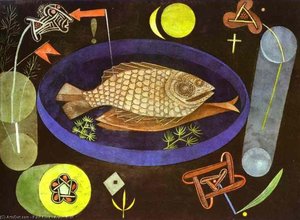 Aroundfish - Paul Klee
In Aroundfish , the lines of Paul Klee are not merely drawn; they are choreographed . This 1926 masterpiece is not a simple composition; it is a dance frozen in time , where the whimsical placement of a central fish, arrows, and avian figures creates a rhythmic pulse across the canvas. As one of the most captivating entries in our collection of the top 25 artworks of Paul Klee, this piece exemplifies his ability to make surreal chaos feel like absolute harmony.
Klee utilizes delicate, translucent washes to suspend symbolic objects—clocks, cups, and knives—within a dreamlike, geometric landscape. The interplay of directionality through scattered arrows invites the eye on a journey of introspection, much like a musical arrangement unfolding in silence. For the discerning collector, Aroundfish offers more than visual intrigue; it asks: What if your walls could breathe rhythm? Bringing this piece into your home allows you to hold that same profound balance, transforming a modern space into a sanctuary of curated, abstract emotion.
Crystalline Landscape - Paul Klee
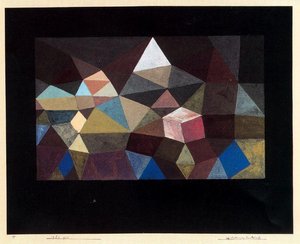 Crystalline Landscape - Paul Klee
What story does the rhythmic geometry of Crystalline Landscape by Paul Klee tell about the hidden architecture of our world? Emerging from the transformative decades between 1930 and 1940, this masterpiece represents a pivotal moment in modernism where the artist moved beyond mere observation to capture the spiritual essence of terrain. As one of the top 25 artworks of Paul Klee, this piece broke ground by replacing traditional vistas with a sophisticated language of interconnected triangles and a singular, celestial circle that balances the composition.
For the discerning collector, this work offers more than just an aesthetic; it provides a curated escape into a meditative, monochromatic realm. The interplay of light through layered gouache creates a luminous depth that breathes life into the abstract forms, making it a profound addition to any sophisticated interior. Integrating such a piece into a modern home allows for a sense of intellectual movement and historical continuity, inviting the viewer to find peace within its structured, rhythmic beauty.
Embrace - Paul Klee
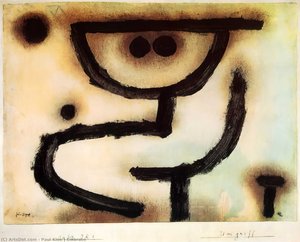 Embrace - Paul Klee
In the quiet corridors of modernism, Paul Klee’s Embrace stands as a profound meditation on the essence of connection. This is not merely a monochrome painting; it is a visceral encounter with the soul. Through a stark, soulful palette of black and white, Klee strips away the distractions of the physical world to reveal a realm where the boundaries between sight and emotion dissolve. The composition, a masterful blend of Cubist structure and Surrealist dreamscapes, features abstracted features—eyes and a mouth emerging from a void—that pulse with an unexpected, haunting vitality.
For the discerning collector, Embrace offers more than visual intrigue; it provides a transformative focal point that brings intellectual depth and quiet drama to a curated interior. Much like a musical composition, Klee uses delicate washes and subtle gradations to create a rhythmic, textured depth. To possess such a work is to invite a piece of the Bauhaus legacy into your home, turning a private space into a gallery of the soul where every brushstroke whispers of the eternal dance between form and feeling.
Still Life - Paul Klee
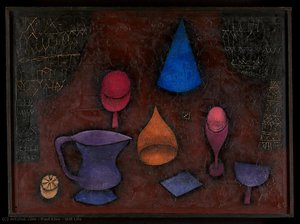 Still Life - Paul Klee
What story does the arrangement of silent objects in Still Life by Paul Klee tell about the delicate balance between chaos and order? Created in 1927, this masterpiece emerged from a period of profound experimentation where Klee sought to translate the rhythmic soul of music into visual geometry. As one of the most essential entries in our collection of the top 25 artworks of Paul Klee , this piece breaks ground by transforming mundane items—a goblet, an onion slice, and dice—into a symbolic symphony of primary colors and textured forms.
The painting offers more than just a study of Cubist influence; it provides a curated escape for the modern collector. In an era of digital noise, the tactile, stone-like texture achieved through Klee’s meticulous hatching invites a sense of historical grounding and quiet contemplation. Integrating such a work into a sophisticated interior allows one to evoke a sense of intellectual depth, where the interplay of light and geometric shapes creates a timeless, atmospheric sanctuary within the home.
Chinese porcelain - Paul Klee
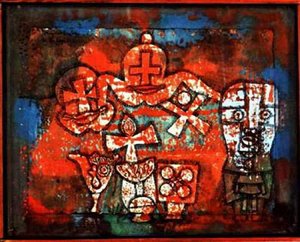 Chinese porcelain - Paul Klee
What story does the delicate interplay of geometry and memory tell in Chinese porcelain by Paul Klee? Created in 1940, during the profound shadows of World War II, this work emerges from a period where the artist sought refuge in the purity of form. As one of the top 25 artworks of Paul Klee , this piece transcends its title, moving beyond mere porcelain to explore a rhythmic, symbolic language that bridges Eastern elegance with Western abstraction.
The composition functions as a visual symphony; Klee utilizes a vibrant, pulsing background to set a stage where fragmented faces and central symbols emerge like precious artifacts. For the modern collector or interior designer, this painting offers more than decoration; it provides a curated escape into a world of structured serenity. The way the light seems to dance across the interlocking shapes evokes a sense of historical depth, making it an essential masterpiece for those seeking to infuse their homes with the intellectual and emotional resonance of the Bauhaus era.
The Lamb - Paul Klee
 The Lamb - Paul Klee
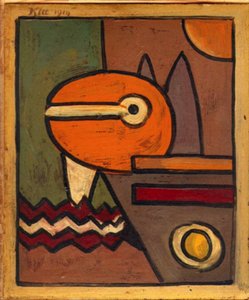
To encounter “The Lamb” is to step into a sacred, kaleidoscopic realm where the boundaries of modernism and mysticism dissolve. As one of the most profound entries in our curation of the top 25 artworks of Paul Klee , this 1920 masterpiece functions less like a painting and more like a luminous window into the divine. Klee employs a breathtaking, stained-glass aesthetic, utilizing bold, black outlines to compartmentalize a vibrant mosaic of blues, golds, and soft pinks. The composition—featuring stylized hands cradling a simplified lamb beneath a subtle cross—evokes the Agnus Dei with an unparalleled emotional intelligence.
For the discerning collector, this work offers a masterclass in controlled fragmentation, marrying the structural rigor of Cubism with the soulful warmth of Expressionism. Its rhythmic, geometric energy provides a sophisticated focal point for refined interiors, bringing a sense of meditative peace and historical legacy to any space. It is not merely an exploration of form, but a timeless testament to the beauty found within spiritual abstraction.
Astrological Fantasy Portrait - Paul Klee
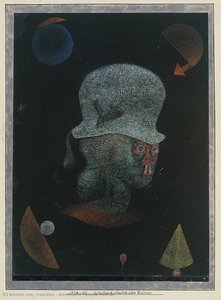 Astrological Fantasy Portrait - Paul Klee
Before the world recognized him as a master of abstraction, Paul Klee lived through a period of profound sensory translation, where the boundaries between musical notation and visual rhythm began to dissolve. In his 1924 masterpiece, Astrological Fantasy Portrait , this metamorphosis reaches a celestial peak. Set against an abyssal, midnight black, the work presents a surrealist dreamscape where an amorphous gray figure, crowned by a delicate perched bird, drifts through a cosmic sea of crimson circles and golden triangles.
The technical genius of this piece lies in Klee’s use of gouache and fine stippling , creating a rhythmic, breathing texture that feels both ancient and avant-garde. This meticulous layering of geometric constellations—crescent moons and star-like beacons—transforms the paper into a window of quiet introspection. For the discerning collector, integrating such a profound meditation on the human condition into a modern study or home office provides more than mere decoration; it establishes an atmosphere of intellectual depth and cosmic wonder, inspiring a space of focused, sophisticated thought.
Conclusion
As the light fades on this retrospective journey through Paul Klee’s visionary world, we are left with more than just a memory of shapes and colors; we carry away a renewed sense of how much beauty resides in the unseen rhythms of life. To walk through these twenty-five masterpieces is to realize that Klee’s work was never truly about static images, but about the pulse of movement, the architecture of dreams, and the profound music found within a single line. His canvases do not belong solely to the halls of museums or the annals of art history; they remain living, breathing presences that continue to whisper to us in the quiet corners of our modern existence.
Whether it is the rhythmic geometry that anchors a contemporary study or the vibrant, sun-drenched hues that breathe vitality into a grand salon, Klee’s legacy offers a timeless bridge between the abstract and the emotional. His ability to translate the intangible—the feeling of a melody, the warmth of North African light, the delicate balance of a thought—ensures that his art remains an active participant in our homes and our hearts. As you depart from this exploration, we invite you to bring a piece of this rhythmic harmony into your own space. We invite you to discover the full collection of his works, where every hand-painted reproduction serves as a testament to the enduring power of a vision that refuses to be still.