Brittany’s Daughter: The Life and Artistic Origins of Yvonne Jean Haffen
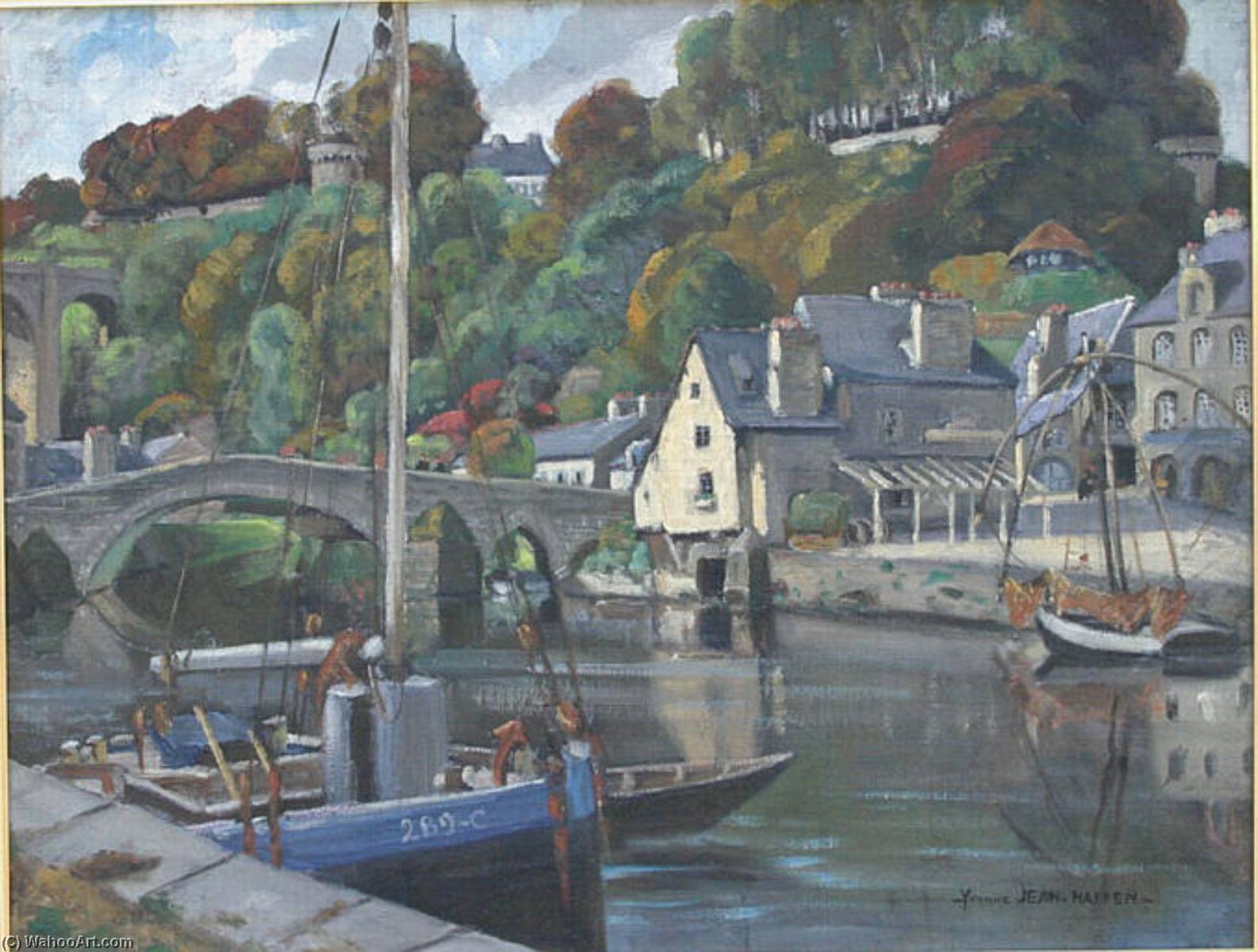 yvonne jean haffen
Discover Yvonne Jean-Haffen’s captivating Breton paintings! Explore her landscapes & portraits of Brittany's rural life, showcasing Art Deco influences.
Yvonne Jean Haffen, a name resonating with increasing prominence within the circles of discerning art collectors, represents a fascinating intersection of Breton heritage, post-war introspection, and a quietly powerful abstract sensibility. Born in 1895 into a family deeply rooted in the cultural landscape of Brittany, France, her artistic journey was not one of immediate acclaim but rather a gradual unfolding—a testament to sustained dedication and an evolving vision. Unlike artists who sought metropolitan centers for inspiration, Haffen remained profoundly connected to her homeland, allowing its rugged coastlines, ancient traditions, and unique light to permeate every facet of her work. Her early life, steeped in the folklore and natural beauty of Brittany, provided a foundational aesthetic that would later be distilled into increasingly abstract forms. While formally trained, it was the immersive experience of Breton life—the vibrant markets, the stoic fishermen, the ever-present sea—that truly shaped her artistic eye. This deep connection to place is not merely biographical; it’s intrinsic to understanding the emotional weight and symbolic richness found within her canvases.
From Impressionism to Introspection: Early Influences and the Development of a Unique Style
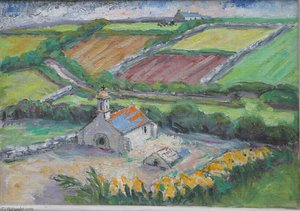
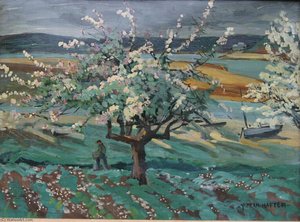 Pommiers en fleur au bord de la Rance
Discover Yvonne Jean Haffen’s "Pommiers en fleur" – an Impressionistic oil painting of a blossoming tree & serene landscape. Explore its textured brushstrokes & rural beauty.
Haffen's initial forays into painting were understandably influenced by the prevailing currents of early 20th-century French art. The luminous palettes and broken brushstrokes of Impressionism, so readily apparent in works like “Pommiers en fleur au bord de la Rance,” reveal a clear engagement with the movement’s emphasis on capturing fleeting moments of light and atmosphere. However, Haffen quickly moved beyond mere imitation. A subtle shift began to occur—a growing interest in simplifying forms, intensifying color relationships, and exploring the emotional resonance of composition itself. This transition wasn't abrupt; it was a gradual distillation of Impressionistic techniques into something more personal and introspective. Her still lifes, such as “Les Tas de Pois,” demonstrate this evolution beautifully. While retaining a sense of realism, they are imbued with a heightened awareness of texture, pattern, and the inherent geometry of everyday objects. These early works served as crucial stepping stones, laying the groundwork for her later explorations into abstraction.
A Dialogue with Abstract Expressionism: Exploring Haffen's Post-War Aesthetic
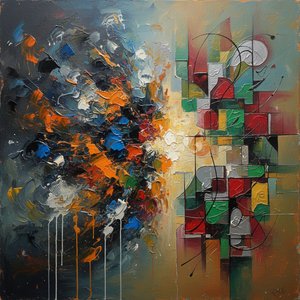
Abstract expressionism in the United States emerged as a distinct art movement in the aftermath of World War II and gained mainstream acceptance in the 1950s, a shift from the American social realism of the 1930s influenced by the Great Depression an...
The aftermath of World War II proved to be a pivotal moment in Haffen’s artistic development. While geographically removed from the epicenter of the American Abstract Expressionist movement, its influence nonetheless permeated the art world, prompting artists across Europe to re-evaluate established norms and explore new modes of expression. Haffen's response was not one of direct imitation but rather a nuanced dialogue—a translation of abstract principles through the lens of her Breton sensibility. Unlike the often large-scale, gestural paintings of Pollock or de Kooning, Haffen’s works tend to be more contained, more deliberate in their application of paint. There's a sense of quiet contemplation, a restrained energy that sets her apart. This is not to say her work lacks emotional intensity; rather, it suggests a different kind of engagement—one rooted in personal experience and a deep connection to the natural world. The post-war period, marked by uncertainty and societal upheaval, found expression in Haffen’s increasingly symbolic use of color and form.
Color as Subject: The Poetics of Palette in Haffen’s Oeuvre
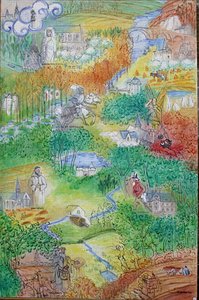
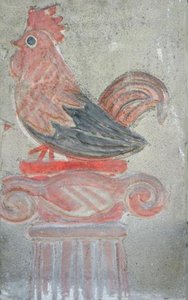 Coq sur sa colonne
Explore Yvonne Jean Haffen’s ‘Coq sur sa colonne,’ a rustic, folk-art painting of a rooster on a Corinthian column. Stone texture & vibrant red/black palette – a unique art piece.
Perhaps the most striking aspect of Yvonne Jean Haffen's work is her masterful command of color. She wasn’t simply *depicting* colors; she was exploring their inherent emotional and symbolic power. Her palette, often characterized by rich reds, deep blacks, and earthy ochres, evokes a sense of both warmth and melancholy—a reflection of the Breton landscape itself. Consider “Coq sur sa colonne,” where the vibrant red of the rooster is juxtaposed against the somber tones of the stone column. This isn’t merely a rustic folk-art scene; it's a carefully orchestrated interplay of color and texture, imbued with symbolic weight. The reds suggest vitality and passion, while the blacks hint at mortality and the passage of time. Haffen’s use of layering—building up successive washes of paint—creates a depth and luminosity that draws the viewer in, inviting contemplation of the subtle nuances within each hue. Her color choices are rarely arbitrary; they are deliberate attempts to evoke specific moods and emotions.
Beyond the Landscape: Recurring Motifs and Symbolic Language in Her Paintings
While Haffen’s early work is often associated with Breton landscapes and rural life, her later paintings reveal a growing interest in recurring motifs and symbolic language. Roosters, columns, and abstracted floral forms appear repeatedly throughout her oeuvre, each carrying layers of meaning that extend beyond simple representation. The rooster, for example, can be interpreted as a symbol of resilience, vigilance, or even the enduring spirit of Breton culture. Columns, often rendered with a rough, stone-like texture, suggest both strength and antiquity—a connection to the region’s rich history and ancient traditions. These motifs aren't presented in a literal manner; they are fragmented, abstracted, and recontextualized within dynamic compositions. This deliberate ambiguity invites viewers to engage with her work on a deeper level, prompting personal interpretations and fostering a sense of emotional resonance. Her paintings become less about *what* is depicted and more about *how* it’s felt—a testament to the power of abstract symbolism.
Yvonne Jean Haffen in the Contemporary Market: A Rising Star for Collectors
As interest in post-war European art continues to grow, Yvonne Jean Haffen is increasingly recognized as a significant and compelling voice. Her works, once relatively unknown outside of Brittany, are now attracting attention from collectors worldwide. The scarcity of her paintings—a result of her sustained but relatively private practice—further enhances their desirability. MutualArt data confirms a steady increase in auction prices over the past decade, indicating a growing demand for her unique aesthetic. Investing in Yvonne Jean Haffen is not merely acquiring a beautiful object; it’s supporting an artist whose work embodies a profound connection to place, a nuanced engagement with abstract principles, and a quietly powerful emotional sensibility. ArtsDot offers a curated selection of her paintings, providing collectors with the opportunity to experience the beauty and depth of this remarkable Breton artist firsthand.