Menu
FREE ART CONSULTATION

agasias of ephesus

Quick Facts

  • Nationality: Greece
  • Copyright status: Under copyright
  • Born: Greece
  • Top 3 works: Cast of the Borghese Gladiator; Discobolus; Fighting Gladiator; Hector; Héros Combattant; Borghese Warrior; Original in Musée du Louvre, Paris; Warrior of Agasias
  • More…

Art Quiz

There is only one correct answer for each question.

Question 1:
What is Agasias of Ephesus best known for sculpting?
Question 2:
In what city was Agasias primarily active as a sculptor?
Question 3:
What artistic style characterizes Agasias' work?
Question 4:
Where is the Borghese Warrior statue currently housed?
Question 5:
Agasias's sculptures are notable for their focus on:', 'choices': ['A. Abstract Expressionism', 'B. Anatomical Accuracy and Dynamism', 'C. Surrealist Imagery']

Agasias of Ephesus: The Sculptor Behind the Borghese Warrior

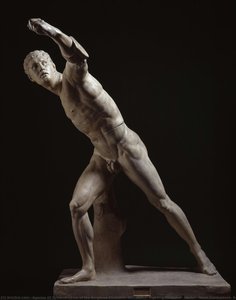
Agasias of Ephesus, a Greek sculptor active in the first century BC, remains an enigmatic figure despite his enduring legacy as creator of one of Hellenistic sculpture’s most iconic masterpieces – the Borghese Gladiator. Little is known about his personal life beyond fragmentary inscriptions hinting at his involvement in Delos during Roman rule, yet his artistic output speaks volumes about the intellectual and aesthetic currents shaping ancient Greece. He stands as a testament to the dynamism and naturalism that characterized the period following Alexander the Great’s death, embodying the ambition to represent human form with unprecedented realism.

Early Life and Artistic Training

Information regarding Agasias' birthdate and family is scarce. Evidence suggests he hailed from Ephesus, a thriving port city at the crossroads of Greek and Roman cultures—a location that fostered artistic innovation and patronage. He was likely the son of Dositheus, another sculptor known for his work on monumental sculptures in Ephesus, establishing him within a lineage dedicated to crafting impressive representations of gods and heroes. While precise details about his formative years are elusive, it’s plausible he received training under prominent sculptors of his time, absorbing techniques honed by masters like Lysippos—a figure whose influence is palpable in Agasias' stylistic choices.

The Borghese Gladiator: A Pinnacle of Hellenistic Style

The Borghese Gladiator, housed in the Louvre Museum, represents Agasias’ magnum opus and arguably embodies the very essence of Hellenistic sculpture. Completed around 100 BC, this colossal bronze statue depicts a warrior engaged in combat—a subject favored by sculptors during this era who sought to capture movement and emotion with remarkable accuracy. Unlike idealized depictions prevalent in Classical art, Agasias' Gladiator is imbued with palpable tension and physicality; muscles ripple beneath the skin, conveying the strain of exertion. The sculptor meticulously studied anatomy, utilizing techniques honed by Lysippos—a master known for his anatomical precision—to achieve a level of realism previously unattainable. The statue’s pose—the warrior leaning forward, one arm outstretched—is deliberately asymmetrical, reflecting the Hellenistic preoccupation with dynamism and conveying an impression of immediacy. Agasias skillfully employed bronze casting techniques to capture this movement, demonstrating mastery over material science alongside artistic vision. The sculpture's surface is polished to a gleaming sheen, enhancing its visual impact and highlighting the sculptor’s meticulous attention to detail—a hallmark of Hellenistic artistry.

Beyond the Gladiator: Temple Sculpture and Artistic Legacy

While the Borghese Gladiator secures Agasias’ place in art history, his contribution extends beyond this single monumental work. He played a crucial role in decorating the Temple of Artemis at Ephesus—one of the Seven Wonders of the Ancient World—a project that showcased his skill in crafting large-scale sculptures for religious contexts. The temple complex was adorned with statues depicting gods and heroes, reflecting the artistic sensibilities of the time and demonstrating Agasias’ ability to execute ambitious commissions. Agasias' style—characterized by naturalism, dynamism, and anatomical precision—influenced subsequent sculptors throughout antiquity and beyond. His work served as a model for artists striving to emulate Lysippos’ achievements and solidified Ephesus’ reputation as a center of artistic excellence. Though Agasias himself remains shrouded in obscurity, his legacy persists through the enduring beauty and intellectual depth of his sculptures—particularly the Borghese Gladiator—a testament to the transformative power of Hellenistic art and its lasting impact on Western artistic tradition.