Agnieszka Czop & Joanna Rusin: Weaving Dreams into Textiles
Polish textile artists Agnieszka Czop and Joanna Rusin, born in Warsaw in 1986, represent a vibrant and playful force within contemporary art. Their collaborative journey, beginning in 2006 after years of individual work, has established them as masters of innovative textile design – transforming humble materials like felt into captivating works that blur the lines between art, craft, and interactive experience. Their shared vision centers on injecting imagination and a sense of wonder into everyday objects, particularly through their celebrated carpets, which are more than just floor coverings; they’re portals to imaginative worlds.
Early Influences & Artistic Beginnings
Joanna Rusin's artistic foundation was firmly rooted in traditional textile techniques. Graduating from the Faculty of Textiles and Clothing at the Academy of Fine Arts in Łódź in 2002, she honed her skills in both Carpet & Tapestry and Painting & Drawing workshops. This dual training provided a crucial understanding of structure, color theory, and visual storytelling – elements that would later inform her distinctive approach to design. Her early work focused on creating alternative carpets, a departure from conventional patterns, driven by a desire to explore unconventional forms and textures. Simultaneously, she headed a designer studio since 2004, solidifying her expertise in the field. Agnieszka Czop’s artistic path mirrored this dedication to craft, completing her studies at the same academy in 2003 with a focus on painting, decorative fabrics, and carpets. This shared academic background provided a common language and creative synergy that would prove invaluable as they began their collaborative practice.
The Rise of ‘Cars Carpet’ & Collaborative Innovation
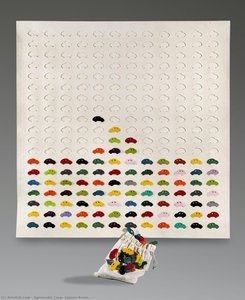
The duo's breakthrough came with “Cars Carpet” (2006), an explosion of color and playful imagery that quickly gained recognition across Poland and Europe. This piece, and many others like it, exemplifies their signature style: a bold combination of vibrant hues, intricate patterns, and unexpected textures. Rusin’s expertise in felt manipulation – its plasticity, versatility, and ability to be intricately cut and shaped – combined seamlessly with Czop's eye for composition and design. They frequently experiment with layering, embroidery, metal accents, and even incorporating found objects, creating tactile experiences that invite interaction. Their work isn't simply decorative; it’s an invitation to play, a celebration of color, and a testament to the transformative power of textiles. The ‘Cars Carpet’ specifically demonstrates their ability to take familiar imagery – in this case, automobiles – and reimagine them through a distinctly artistic lens.
Recognition & Exhibitions
Agnieszka Czop and Joanna Rusin's innovative work has garnered significant acclaim and recognition throughout Poland and Europe. Rusin’s individual achievements include receiving the prestigious “Młoda Polska” scholarship in 2010, awarded by the Minister of Culture and National Heritage to promising young Polish artists. Their collaborative efforts have resulted in numerous awards and distinctions, including the "Best Young Designer" award from Elle Decoration in 2004 for their carpet-jigsaw puzzles. Their pieces are held in prominent collections, including those of the National Museum in Warsaw, the Central Museum of Textiles in Łódź, and the Museum of Toys and Fun in Kielce – a testament to the enduring quality and artistic merit of their work. They have participated in over 80 exhibitions, solidifying their position as key figures in the contemporary textile art scene.
Beyond Decoration: A Dialogue with Tradition & Innovation
Rusin’s deep appreciation for natural materials, particularly wool felt, is central to her artistic philosophy. She often combines this traditional medium with unexpected elements – embroidery, lacework, metal, and even rivets – creating a dialogue between established techniques and contemporary design sensibilities. Influenced by folk traditions, as seen in the “Pasanka” carpet (inspired by striped fabrics), their work frequently incorporates rhythmic patterns and spatial illusions. The duo’s collaborative spirit allows them to push boundaries, experimenting with interactive elements, three-dimensional designs, and a playful approach to form and function. Their art isn't just about creating beautiful objects; it’s about sparking imagination, challenging conventions, and celebrating the enduring power of textiles to transform our surroundings.