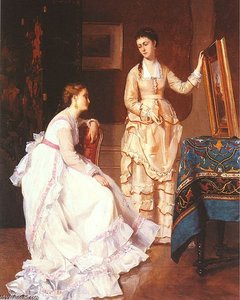
The Fleeting Brilliance of Albert Roosenboom
In the vibrant, shifting landscape of the late nineteenth-century Belgian art scene, few names evoke such a poignant sense of lost potential as Albert Roosenboom. Born in Brussels in 1845, Roosenboom emerged during an era of profound transition, where the rigid structures of academic tradition were beginning to dissolve into the luminous, atmospheric experiments of Impressionism and the honest, unvarnished observations of Realism. Though his life was tragically truncated by his death at the tender age of thirty in 1875, the canvases he left behind serve as a window into a world of domestic intimacy and public spectacle, captured with a mastery that suggests a much longer career lay ahead.
Roosenboom’s artistic journey was deeply rooted in the prestigious Académie Royale des Beaux-Arts in Brussels. It was here that he began to refine a technique that would become his hallmark: a sophisticated blend of academic precision and a burgeoning interest in the play of light. He studied under the influential sculptor and painter Constantin Meunier, a mentor whose commitment to the realistic depiction of contemporary life left an indelible mark on Roosteenboom’s soul. From this lineage, Roosenboom inherited a profound respect for the dignity of everyday subjects, moving away from grand historical allegories toward the subtle beauty found in the mundane and the momentary.
A Mastery of Light and Narrative
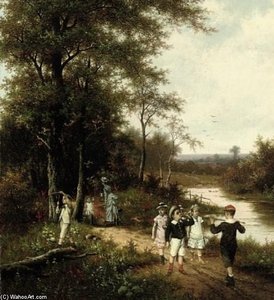
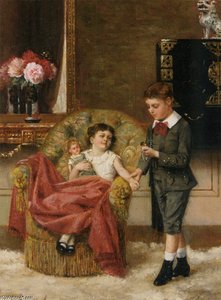
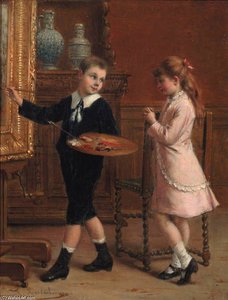
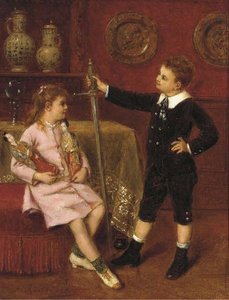
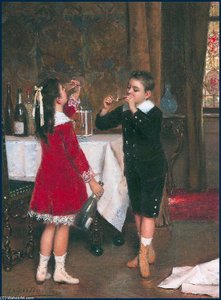
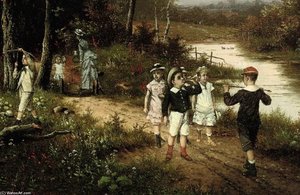
What distinguishes Roosenboom from his purely academic contemporaries was his ability to infuse genre scenes with a palpable sense of atmosphere and psychological depth. While he possessed the technical skill to render the fine details of fashion and architecture, he was never content with mere imitation. Instead, he utilized loose, painterly brushstrokes and a vibrant palette to convey the ephemeral qualities of light and emotion. His work often oscillates between the quietude of indoor domesticity and the kinetic energy of urban celebrations.
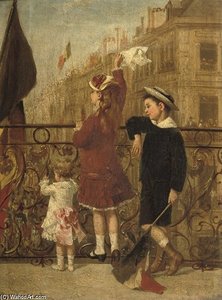
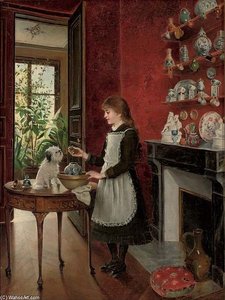
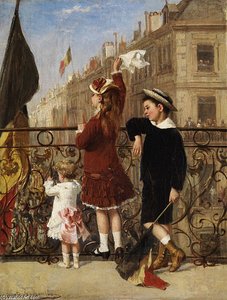
In his more intimate works, such as Young Girl With Her Dog, one finds a tender exploration of innocence and the quiet sanctity of the home. These pieces are characterized by a soft, luminous quality that draws the viewer into a private, almost sacred space. Conversely, when Roosenboom turned his gaze toward the streets of Brussels or Paris, his canvases erupted with life. In monumental works like Waving To The Procession and Children Waving At A Festival In The City, he captures the rhythmic pulse of the belle epoque, portraying crowds not as anonymous masses, but as collections of individual joys and shared cultural experiences. He had a unique talent for capturing the "vignette"—a single, unposed moment taken from the flow of modern life, much like a snapshot from a camera that had yet to become commonplace.
Legacy and Historical Resonance
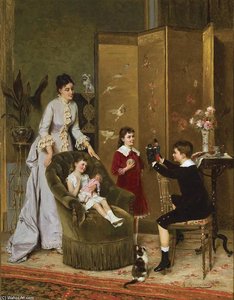
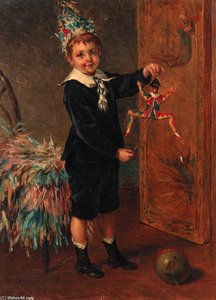
The historical significance of Albert Roosenboom lies in his role as a bridge between eras. He stood at the crossroads of the Realist movement’s commitment to truth and the Impressionist fascination with optical sensation. His ability to weave narrative elements—such as the theatrical charm found in The Puppet Show—into landscapes and portraits allowed him to maintain a sense of storytelling that many later Impressionists would abandon. He did not merely paint what he saw; he painted how it felt to witness the world in motion.
Though his physical presence in the art world was brief, his influence echoed through the Belgian school and beyond. His work remains a testament to a period of intense creativity and social change, offering collectors and historians alike a glimpse into the heart of nineteenth-century European life. Today, his paintings are cherished not only for their technical excellence but for the enduring warmth and nostalgia they radiate, reminding us of a world captured in its most beautiful, fleeting moments.