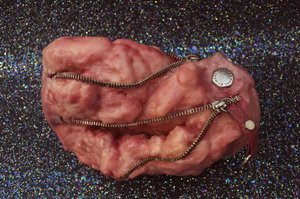
The Visceral Allure of Andrea Hasler
Born in Zurich, Switzerland, in 1975, Andrea Hasler has emerged as one of the most provocative voices in contemporary sculpture, crafting a visual language that sits uncomfortably at the intersection of luxury and decay. Her work does not merely invite observation; it demands a visceral reaction, often triggering a profound tension between attraction and repulsion. Through her mastery of materials, Hasler transforms the familiar into the unsettling, creating objects that appear to pulse with a life of their own, yet remain frozen in a state of fleshy, organic simulation. Her practice is a deep dive into the complexities of human desire, consumption, and the fragile boundaries of identity.
Hasler’s artistic journey was shaped by rigorous academic training, earning her MFA from the Chelsea College of Art and Design in London in 2002. This foundational period allowed her to refine a technical precision that is essential to her conceptual goals. While her work often explores the intersection of art and science, it is deeply rooted in the sculptural traditions of masters such as Louise Bourgeois, Berlinde De Bruyckere, and John Isaacs. From these influences, she draws a fascination with the body, the psychological weight of objects, and the way materiality can evoke deep-seated emotional responses.
The Alchemy of Wax and Flesh
At the heart of Hasler’s practice lies a remarkable manipulation of medium. She utilizes wax, frequently encased in resin, to achieve an astonishingly realistic texture that mimics the appearance of raw meat or living tissue. This choice of material is far from accidental; it serves as a powerful metaphor for the vulnerability and permeability of the human form. By applying heat guns and intricate molds to everyday items—ranging from designer handbags and tents to architectural elements—she deconstructs the symbols of status and stability, reassembling them into bulging, pink, organic masses.
This process of transformation creates a striking juxtaposition. In her celebrated 2013 solo exhibition, Burdens of Excess, Hasler re-imagined high-end luxury accessories as grotesque, fleshy globs studded with brand-name zippers and handles. This technique forces the viewer to confront the "meat" within our consumerist culture, questioning how much of our identity is constructed through the acquisition of objects that we treat as extensions of our own bodies. The resulting sculptures are both beautiful in their meticulous detail and disturbing in their simulated biological presence.
Legacy and Artistic Impact
Hasler’s career is marked by significant milestones that have cemented her place in the contemporary art dialogue. Her ability to engage with social and political histories is evident in works like The Matriarch, created for the Greenham Common Commission in 2014, which drew inspiration from the history of the Women’s Peace Camp. Such projects demonstrate that her work is not solely focused on the aesthetic of the grotesque, but also on using sculptural form to explore themes of resistance, gender, and communal memory.
Throughout her development, Hasler has continued to expand her reach through prestigious residencies and exhibitions across the globe:
- The 3-D Foundation Artist Residency in Verbier, Switzerland, where she contributed site-specific works to the exhibition Mutations: Contemporary Sculpture in Context.
- Time + Space NYC Residency, which allowed her to present installations like Avant/Après N°5 in New York, further exploring the boundaries between the internal and external body.
- A diverse exhibition history including galleries in London, Los Angeles, and Zurich, establishing a global presence for her unsettlingly beautiful vision.
Ultimately, Andrea Hasler’s significance lies in her ability to make the invisible visible—to take the hidden biological realities of our existence and project them onto the polished surfaces of modern luxury. Her work remains a haunting meditation on what it means to consume, to belong, and to exist within a world that is simultaneously seductive and decaying.