Early Life and Artistic Beginnings
Anne Marguerite Hyde de Neuville, born Henriette Anne Marguérite Rouillé de Marigny on May 10, 1771, in Saire-le-Châtel, France, descended from a noble family steeped in tradition. Her upbringing instilled in her a refined sensibility and fostered an early fascination with the arts—a passion that would define her life’s trajectory. Unlike many women of her era whose ambitions were constrained by societal expectations, Anne Marguerite possessed an innate curiosity and determination to cultivate her talent independently. Evidence suggests she began drawing at a young age, honing her skills in watercolor painting through self-directed study. Her family's connections within the Parisian artistic milieu undoubtedly provided opportunities for observation and inspiration—a crucial element in shaping her distinctive style.- Her grandmother, Anne Marguérite Perrinet de Longuefin Rouillé de L’Etang, was a prominent figure in French society, known for her patronage of the arts.
- She received instruction from Maurice Quentin de La Tour, who produced several portraits of her family members.
Travels and Artistic Inspiration: America (1807-1822)
The pivotal moment in Anne Marguerite’s artistic journey arrived with her marriage to Jean Guillaume Hyde de Neuville in 1794—a union that brought her into contact with a fervent Royalist who challenged the prevailing political climate. Following Napoleon's ascent to power, their family faced upheaval and exile, forcing them to relocate to Europe where they diligently documented their experiences. However, it was their journey to America in 1807 that truly ignited Anne Marguerite’s creative spirit.- Driven by Jean Guillaume’s diplomatic ambitions, she traveled extensively along the northeastern coast of the United States, immersing herself in the burgeoning culture and landscape of the young republic.
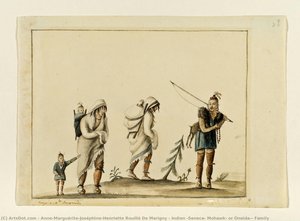
- Her observations were meticulously recorded through watercolor sketches—a medium perfectly suited to capturing the ephemeral beauty of American vistas and the nuanced expressions of its inhabitants.
Artistic Style and Technique
Anne Marguerite’s artistic style is characterized by a remarkable sensitivity to light and color, achieved through masterful use of watercolor pigments.She favored a delicate palette—often incorporating muted greens, blues, and browns—to evoke the atmosphere of her subjects. Her technique involved layering washes of pigment to build up tonal gradations and textures, resulting in images that possess an unparalleled sense of depth and realism. Unlike many artists of her time who adhered to rigid conventions, Anne Marguerite embraced spontaneity and experimentation.- Her sketches were notable for their detailed observation—capturing not only the visual appearance of landscapes but also subtle gestures and expressions indicative of human emotion.
- She meticulously documented architectural details—particularly those found in New York City’s elegant residences—demonstrating a keen eye for composition and perspective.
Notable Works and Legacy
Anne Marguerite Hyde de Neuville left behind an impressive oeuvre of over 200 watercolors and drawings, representing a singular contribution to American art history.- Among her most celebrated works are depictions of Seneca Falls—a pivotal site in the burgeoning women’s suffrage movement—where she sketched the homes of prominent figures like Lucretia Mott and Elizabeth Cady Stanton.
- Her meticulous botanical studies—particularly those undertaken during her travels to New Jersey—offer invaluable insights into the flora of the early republic.
Recognition and Influence
Anne Marguerite’s artistic achievements garnered considerable acclaim during her lifetime, securing her place among the pioneering women artists of the 19th century.Her unwavering commitment to self-education—a rare accomplishment for women at the time—served as an inspiration to future generations. Today, her work is housed in museums across France and America, including Musée Flaubert - D’histoire de la médecine in Rouen, where it continues to captivate audiences with its evocative beauty and historical significance.- Her legacy extends beyond her artistic output—she championed the cause of female education and advocated for greater opportunities for women in intellectual pursuits.