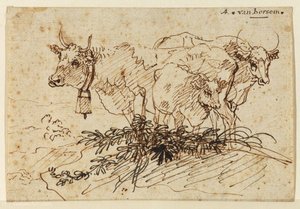
The Luminous Legacy of Anthonie van Borssom
In the heart of the Dutch Golden Age, a period defined by unparalleled cultural prosperity and artistic innovation, the name Anthonie van Borssom resonates with the quiet majesty of the landscapes he so lovingly rendered. Born in Amsterdam on January 2, 1631, van Borssom emerged from a city that was then the beating pulse of European commerce and creativity. His life, though spanning only forty-six years until his death in 1677, was a profound journey through light, shadow, and the pastoral beauty of the Low Countries and beyond. To study his work is to step into a world where the atmosphere itself feels tangible, captured through a masterful command of tone and texture.
The foundations of van Borssom’s artistry were likely laid in the shadows of one of history's greatest masters. Scholars suggest that between 1645 and 1650, he may have been apprenticed to Rembrandt Harmenszoon van Rijn. This formative connection is etched into the very DNA of his technique; from Rembrandt, he inherited a sophisticated understanding of chiaroscuro—the dramatic interplay of light and dark—and an ability to imbue even the most tranquil scenes with a sense of psychological depth and emotional resonance. While he moved away from the intense human drama of Rembrandt’s portraiture, he carried forward that same reverence for how light interacts with the physical world.
A Journey Through Light and Landscape
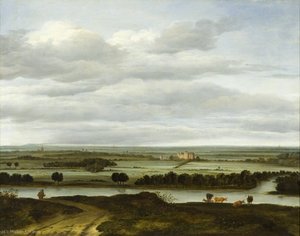
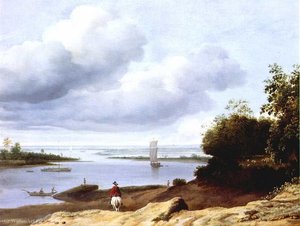
Van Borssom’s artistic evolution was significantly shaped by his travels, most notably a pivotal journey to the Rhineland between 1650 and 1655. This exposure to the diverse vistas of the German riverlands broadened his visual vocabulary, encouraging him to explore more expansive, dramatic compositions. It was during this period that he began to refine his signature style, which aligned beautifully with the Italianate tradition popular in Amsterdam. This movement sought to infuse Northern landscapes with a warmer, more Mediterranean glow, often characterized by soft, golden light and idealized pastoral settings.
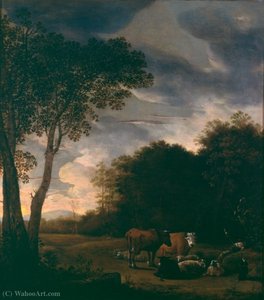
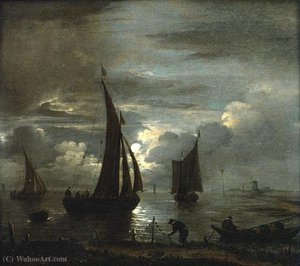
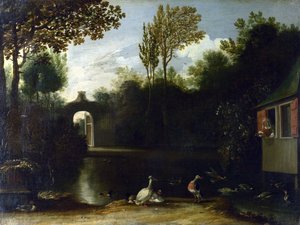
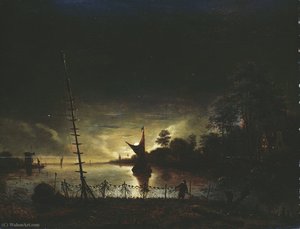
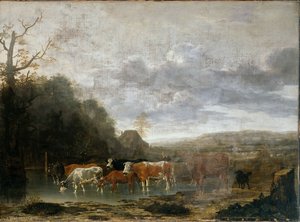
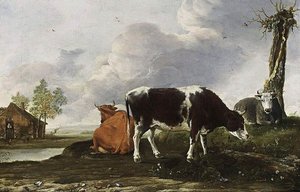
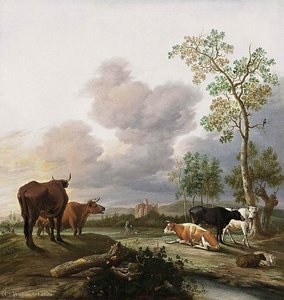
His technical prowess is perhaps most evident in his ability to emulate and pay homage to the titans of his era. Van Borssom was a meticulous observer who studied and copied the works of celebrated masters such as Jacob van Ruysdael, Paulus Potter, and Aelbert Cuyp. Rather than mere imitation, his work represents a sophisticated dialogue with these predecessors. He mastered the art of the moonlit nocturne, drawing inspiration from Aert van der Neer to create scenes like “A River Scene by Moonlight,” where silvery luminescence dances across water, and he captured the rustic charm of the countryside in works such as “Sheltered Pasture with Cattle.”
Artistic Mastery and Historical Significance
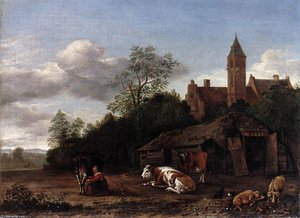
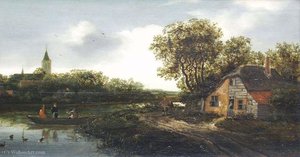
The enduring appeal of van Borssom’s oeuvre lies in its ability to evoke a sense of timelessness. Whether he was depicting a bustling barnyard or a serene, mist-covered meadow, his use of impasto—the thick, textured application of paint—added a physical dimension to the light, making the atmosphere feel heavy with moisture or bright with sun. His compositions often guide the viewer’s eye through layered perspectives, from detailed foreground elements like grazing livestock to the hazy, ethereal silhouettes of distant trees and riverbanks.
Ultimately, Anthonie van Borssom stands as a vital link in the chain of Dutch landscape painting. He bridged the gap between the rugged realism of early 17th-century masters and the more idealized, luminous Italianate styles that would follow. His contribution to the Golden Age was not merely in the creation of beautiful images, but in his ability to capture the very soul of the landscape—a feat of technical brilliance and poetic sensitivity that continues to captivate art lovers centuries after his passing.