The Artivism of Ashmina Ranjit: A Politics of Being
In the vibrant yet turbulent landscape of contemporary Nepalese art, few figures command as much profound presence as Ashmina Ranjit. Born in Kathmandu in 1966, Ranjit has carved out a unique identity not merely as a visual artist, but as an artivist—a term that seamlessly blends the creative impulse with the urgent necessity of social activism. Her practice is a visceral response to the sociopolitical upheavals of her homeland, particularly during the Nepalese Civil War and the nation's complex transition toward democracy. To encounter Ranjit’s work is to enter a space where the boundaries between the personal body and the political body dissolve, revealing the raw textures of human rights, gendered struggle, and class inequality.
Ranjit’s artistic journey is marked by an international academic rigor, having earned her Master of Fine Arts from Columbia University. This global perspective, blended with her deep roots in Nepal and her studies in Australia, has allowed her to develop a conceptual language that is both locally resonant and universally understood. Her work does not merely observe social injustice; it inhabative it. By moving beyond traditional media, she challenges the conventional limits of art, utilizing performance, installation, and sculpture to confront the viewer with the realities of existence under systemic pressure.
The Body as a Canvas of Resistance
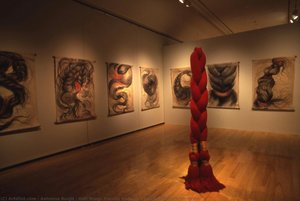
What distinguishes Ranjit’s practice is her radical use of materials that are intimately connected to the human form. Rather than relying on traditional pigments or stone, she seeks out elements that carry the weight of lived experience: hair, blood, clothing, and accessories associated with the limbs and neck. These materials serve as potent symbols of the female experience, evoking both the beauty and the biological realities that society often seeks to regulate or hide. In her hands, a strand of hair or a piece of fabric becomes a vessel for memory and a tool for critique.
Her exploration of feminist ideology is deeply embedded in these tactile choices. Through the use of objects like menstrual products or items related to bodily adornment, she addresses culturally sensitive topics such as menstrual discrimination and the social constraints imposed upon women. Her work does not always depict the female body directly; instead, it uses its traces to evoke the uncontrollable energy of women—a force that seeks to overcome social restrictions and reclaim agency. In pieces like Hair Warp: Travels through Strands of Universe, she finds a spiritual and physical strength in the everyday objects of womanhood, transforming the mundane into the monumental.
Legacy and Global Resonance
The historical significance of Ashmina Ranjit lies in her ability to document the pulse of a changing nation through the lens of the individual. Her contributions to contemporary Nepalese conceptual and performance art have provided a vital archive of the country's political transitions. Her major achievements reflect a career dedicated to collective action and visibility:
- A Happening: Nepal’s Present Situation (2004): A landmark public performance involving 100 volunteers that utilized sound and collective participation to reflect on the trauma of the Nepalese Civil War.
- 52 Artists 52 Actions (2018): The initiation of a large-scale, collaborative Asian art project designed to foster cross-cultural dialogue through artistic intervention.
- Womb Room (2022): A powerful installation exhibited at the Kathmandu Triennale, further cementing her role in the international contemporary art circuit.
- Literary Contributions: The publication of Silence No Longer: Artivism of Ashmina, which serves as a testament to her dual role as a creator and a voice for the marginalized.
Today, Ranjit’s work resides in prestigious collections such as the Fukuoka Asian Art Museum, ensuring that her message of resistance and resilience reaches a global audience. She remains a pivotal figure whose art continues to demand that we look closely at the politics of being, reminding us that true creativity is inseparable from the struggle for justice.