

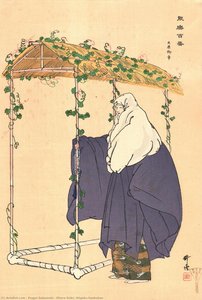
kogyo sakamaki
Kōgyo Sakamaki (1869–1927): The Poet of Noh Kōgyo Sakamaki, whose name translates to “Moonlit Harvest,” stands as one of Japan’s most revered printmakers of the Meiji era (1868–1912), a period marked by rapid modernization and cultural introspection. Born Henyu Bennosuke in Nihonbashi, Tokyo—a bustling district at the heart of Edo’s commercial center—his artistic journey began under the tutelage of Tsukioka Yoshitoshi, arguably Japan's foremost ukiyo-e artist, a figure who profoundly shaped Sakamaki’s aesthetic sensibilities and lifelong devotion to Noh theatre. This dedication would define…
The Subject Atlas
A chart of kogyo sakamaki's corpus mapped not by date but by subject. Spokes are what they painted; rings are when; and the threads between stars reveal the patrons and places that secretly connect them.
Spokes — Subject
Each arm of the atlas gathers works by what they depict: portraits, sacred scenes, mythologies, and the scientific studies. Click a spoke to swing that cluster to the top.
Rings — Career Period
Distance from the center marks time. The innermost ring is the earliest period; the outermost, the final years. Style matures as you move outward.
Threads — Shared Context
Coloured lines link works bound by the same patron, commission, or theme. Trace a context to watch related clusters light up across subjects.

