The Luminous Legacy of Baron de Forna
In the grand tapestry of Spanish art history, few threads shimmer with as much delicate brilliance as those woven by José Antonio González de la Peña y Rodríguez de la Encina. Known to the world through his noble title as Baron de Forna, this Madrid-born master (1887–1961) possessed a rare ability to translate the ephemeral dance of light onto canvas. His life was a journey of profound artistic evolution, beginning in the hallowed halls of the Real Academia de Bellas Artes de San Fernando under the guidance of Alejandro Ferrant. While his roots were firmly planted in Spanish tradition, his spirit was inherently cosmopolitan, driven by an insatiable hunger to engage with the burgeoning modernism sweeping across Europe.
The year 1908 marked a pivotal turning point in his creative odyssey when he relocated to Paris. This move was far more than a change of scenery; it was an immersion into the very heart of the avant-garde. Amidst the vibrant energy of the French capital, the Baron found himself navigating the same intellectual and artistic currents as Pablo Picasso and Maurice Utillo. These encounters with the giants of modernism did not lead him to abandon realism, but rather to refine it, infusing his work with a sophisticated understanding of form and atmosphere that would become his signature. His time in Paris allowed him to bridge the gap between classical Spanish precision and the experimental spirit of the early 20th century.
A Master of Atmosphere and Detail
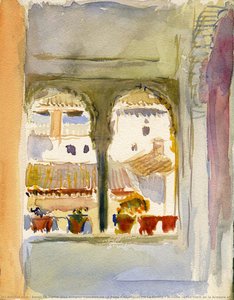
To gaze upon a work by Baron de Forna is to experience a profound sense of presence. He was, above all, a painter of light. His technique relied on an almost scientific observation of how illumination interacts with the world—how it softens the edges of a distant landscape or how it glints off the ornate textures of an architectural interior. His landscapes are not merely topographical records but emotional evocations; they capture the intangible essence of a place, imbuing scenes like the Generalife with a dreamlike, ethereal quality.
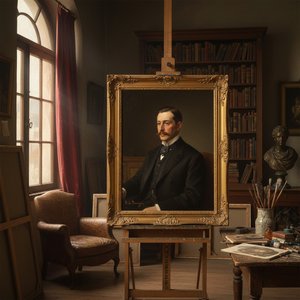
His mastery extended deeply into the realm of interiors and portraiture, where his dedication to meticulous realism shone brightest. He possessed an uncanny ability to render the weight of velvet, the cold smoothness of marble, and the warmth of aged wood. This technical prowess was matched by a deep respect for his subjects, whether they were grand historical vistas or intimate portraits of friends and family. His work often features:
- Luminous Landscapes: Capturing the diffusion and refraction of light to create atmospheric depth.
- Architectural Precision: Detailed depictions of Spanish heritage, focusing on texture and structural elegance.
- Intimate Portraiture: Evocative studies of individuals, such as his celebrated portrait of Ángel Lizcano, which showcase both character and light.
Recognition and Enduring Significance
The Baron’s contributions to the arts were recognized not only by his peers but also by the highest institutions of his homeland. His devotion to culture was so profound that he left a significant legacy to the Academia de Bellas Artes de San Fernando, an act of generosity that cemented his place in Spanish academic history. For his service and artistic merit, he was honored with prestigious distinctions, including the Grand Cross of Alfonso X el Sabio and appointments as a Commander of the Order of Civil Merit and the Order of Isabel la Católica.
Beyond the medals and titles, the true significance of Baron de Forna lies in his ability to preserve the soul of Spanish light through a lens of modern sophistication. He remains a pivotal figure who connected the traditionalist foundations of Madrid with the revolutionary movements of Paris. Today, his works serve as windows into a vanished era, offering contemporary viewers a chance to rediscover the quiet majesty of a world captured with unparalleled clarity and grace.