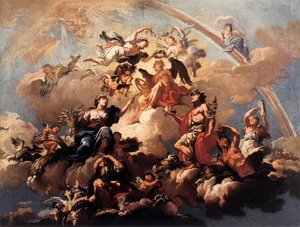
The Grandeur of a Baroque Legacy
In the twilight of the Baroque era, as the delicate and playful flourishes of Rococo began to sweep across Europe, there remained a steadfast guardian of tradition: Bartolomeo Altomonte. Born in Warsaw on February 24th, 1694, Altomonte—also known by his German name, Bartholomäus Hohenberg—was an artist of profound scale and allegorical depth. His life was a bridge between the intense, dramatic shadows of the 17th century and the evolving tastes of the 18th, yet he remained anchored to the monumental grandeur that defined his lineage. As the son of the talented painter Martino Altomonte, Bartolomeo did not merely inherit a name; he inherited a visual language of light and movement that would eventually adorn the most sacred spaces in Austria.
His artistic journey was one of constant movement and cosmopolitan refinement. While his roots were Polish, his soul was shaped by the great artistic hubs of Italy. After an early apprenticeship under Daniel Gran, Altomonte sought the mastery of the masters, traveling to Rome to study under Benedetto Luti and to Naples to absorb the vibrant, dramatic energy of Francesco Solimena. This period of intense study left an indelible mark on his technique; a sketchbook from his time with Luti, now preserved in the Albertina Museum, serves as a silent witness to his intellectual curiosity and his meticulous pursuit of anatomical precision and compositional harmony.
Mastery of the Fresco and Sacred Spaces
From 1722 onwards, Altomonte’s career found its true home in Austria. Settling primarily in Linz, he became the preeminent architect of celestial visions, specializing in large-scale frescoes that transformed the ceilings of monasteries and cathedrals into windows to the divine. His work was characterized by an ability to command vast architectural expanses, using color and perspective to dissolve the physical boundaries of stone and plaster. He did not merely paint walls; he expanded them, creating illusions of infinite heavens that invited the viewer to look upward in awe.
His most significant achievements can be found within the hallowed halls of the Austrian monastic tradition:
- St. Florian’s Priory: Perhaps his most celebrated site, where his 1747 ceiling fresco, “The Four Seasons Paying Homage to Chronos,” stands as a masterpiece of allegorical storytelling, blending the passage of time with the eternal beauty of nature.
- Admont Abbey: A monumental undertaking that showcased his ability to integrate complex theological narratives into grand architectural settings.
- Seitenstetten Abbey: Where his frescoes on the Grand Staircase demonstrate a breathtaking command of light and movement.
- Ecclesiastical Commissions: His influence extended through the convents of Wilhering and Herzogenburg, as well as the cathedral of Sankt Pölten and various churches in Vienna.
A Final Sentinel of the Baroque
What distinguishes Altomonte from his contemporaries is his remarkable stylistic steadfastness. While many artists of his generation succumbed to the lighter, more ornamental whims of the Rococo style, Altomonte remained a devotee of the Baroque allegory. He preferred the weight of meaning and the drama of composition over mere prettiness. His work retained a certain gravity—a sense that every figure and every cloud held a philosophical or spiritual significance. This resistance to changing trends solidified his reputation as one of the last great painters capable of executing the complex, multi-layered narratives that the Baroque tradition demanded.
By the time of his death in Sankt Florian on November 11th, 1783, Altomonte had completed a life's work that served as a final, glorious crescendo for an era. He left behind a legacy of painted heavens that continue to inspire wonder, reminding us of a time when art sought not just to decorate, but to elevate the human spirit toward the sublime. Through his mastery of scale, color, and allegory, Bartolomeo Altomonte ensured that the monumental spirit of the Baroque would endure long after the era itself had passed into history.