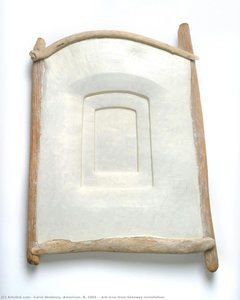
Carol Newborg: Sculpting Sanctuary Through Texture and Form
Carol Newborg (American, b. 1954) is an artist whose work explores themes of resilience, transformation, and the profound connection between humanity and nature—particularly through immersive installations utilizing natural materials like beeswax and paper mache. Born in the United States, Newborg’s artistic journey began with a formative experience studying ceramic sculpture at UC Berkeley in 1981, amidst a landscape largely dominated by male artists. This initial encounter sparked her passion for creating art that transcends conventional boundaries and fosters contemplation about our relationship with the environment.
- Early Influences: Newborg’s artistic sensibilities were shaped by encounters with influential figures in the Bay Area arts community, including William James Association, where she honed her skills as an instructor and exhibit coordinator focusing on Arts-in-Corrections programs. These experiences instilled in her a deep conviction that art possesses the capacity to catalyze positive change within individuals and communities.
- The Sanctuary Installations: Her signature style emerged from a series of “Sanctuary” installations—large-scale textile artworks designed to evoke feelings of peace and reflection. Inspired by natural forms like pods, cocoons, and waterfalls, these pieces utilize hundreds of meticulously crafted paper mache components, each unique in its texture and color palette.
- Exploring Trauma Through Materiality: Recent works delve into personal narratives—specifically the experiences of her Jewish family during World War II—expressed through mixed media wall-based installations. “Flying Souls,” for example, incorporates wire forms representing years served by incarcerated individuals, interwoven with textiles symbolizing healing and growth.
- Recognition & Awards: Newborg’s dedication to artistic exploration has garnered considerable acclaim, including a Pollock-Krasner Foundation Grant and numerous artist residencies across the United States. Her commitment to fostering accessibility within the arts continues to inspire her practice and advocacy for Arts-in-Corrections initiatives.
Career Highlights & Artistic Evolution
Newborg’s artistic trajectory has been marked by a consistent focus on materiality—particularly beeswax and paper mache—as mediums for conveying complex emotional and conceptual ideas. Her exploration of natural forms reflects a broader interest in the symbolic power of nature to represent resilience, transformation, and spiritual contemplation. From her early explorations of ceramic sculpture at UC Berkeley to her ongoing involvement in Arts-in-Corrections programs, Newborg’s artistic endeavors have been driven by a desire to engage audiences on an emotional level while simultaneously advocating for social justice. Her installations serve as powerful reminders that art can offer solace, provoke dialogue, and inspire action—all rooted in the fundamental belief that creativity holds transformative potential.
Notable Projects & Exhibitions
Carol Newborg’s artistic output has spanned decades of creative exploration, resulting in impactful exhibitions both nationally and internationally. Her work has been showcased at venues such as the de Young Museum (as part of an artist-in-residency), SFMOMA Rental Gallery, and The Tides Foundation. Furthermore, her commitment to Arts-in-Corrections extends beyond teaching; she actively coordinates exhibit programs within California prisons, demonstrating a profound dedication to broadening access to artistic experiences for marginalized populations. Her installations are frequently described as immersive and meditative, inviting viewers to contemplate the interplay between natural elements and human emotion—a testament to Newborg’s enduring vision of art as a catalyst for personal growth and societal betterment.
Legacy & Continuing Influence
Carol Newborg's contribution to contemporary art is characterized by her unwavering belief in the transformative power of artistic expression, particularly within contexts of vulnerability and resilience. Her pioneering work in Arts-in-Corrections has established a precedent for utilizing creative endeavors as tools for healing and fostering empathy—a legacy that continues to inspire artists and educators alike. By prioritizing accessibility and engaging audiences with emotionally resonant imagery rooted in natural symbolism, Newborg’s artistic practice embodies a timeless commitment to enriching human experience and promoting social responsibility. Her enduring influence underscores the importance of art as a vehicle for confronting difficult truths and cultivating compassion within communities—a message that resonates powerfully across generations.