Chang Guen-Hua/Guen-Hao: A Visual Commentary on the Digital Age
The work of Chang Guen-Hua, often referred to as Chang Guen-Hao, presents a singular and increasingly resonant voice within contemporary Chinese art. Emerging from Beijing in the early 21st century, this artist has quickly established themselves through a distinctive style characterized by cartoon animation, stark white palettes, and a potent use of visual metaphor. While biographical information remains relatively scarce – reflecting a common trend among emerging artists navigating the complexities of the global art market – the impact of Guen-Hua’s work is undeniable, particularly in his evocative piece, ‘No Thank You Long-Legged Uncle.’ This artwork, and indeed much of his oeuvre, serves as a pointed commentary on humanity's relationship with technology, prompting viewers to consider the ways we both embrace and resist its pervasive influence.
Guen-Hua’s artistic journey is intertwined with that of Zhang Huan, a prominent figure in China’s contemporary art scene. The connection isn’t merely familial; Zhang Huan's early performance art, rooted in East Village experimentation during the 1990s, profoundly shaped the landscape of Chinese art and influenced Guen-Hua’s approach. Like Zhang Huan before him, Guen-Hua embraces a raw, almost primal energy within his work, drawing inspiration from traditional Chinese aesthetics while simultaneously engaging with modern anxieties. His early explorations mirrored the post-modern movement in China, utilizing body art to express personal perspectives on societal and environmental issues – a lineage that continues subtly through his later, more stylized works.
The Style and Technique of White Space
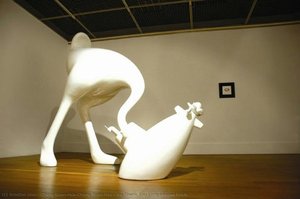
Guen-Hua’s artistic style is immediately recognizable. He predominantly employs acrylic as his medium, creating images with a striking simplicity: almost entirely white backgrounds punctuated by bold, cartoonish figures and objects. This deliberate use of negative space isn't merely aesthetic; it’s a crucial element of the artwork’s meaning. The starkness forces the viewer to confront each detail, amplifying its impact and drawing attention to the symbolic weight of every element. The animation style, reminiscent of classic cartoons, adds an immediate layer of accessibility while simultaneously hinting at a deeper, more complex narrative.
The choice of white as a dominant color is particularly significant. It can be interpreted as a rejection of traditional Chinese art’s rich palettes and symbolic colors. Instead, Guen-Hua utilizes the purity of white to represent a blank slate – an invitation to project one's own interpretations onto the artwork. It also speaks to a sense of detachment, suggesting a deliberate distancing from conventional artistic representation.
‘No Thank You Long-Legged Uncle’: A Metaphor for Digital Disengagement
The centerpiece of Guen-Hua’s current body of work, ‘No Thank You Long-Legged Uncle,’ offers a particularly compelling example of his thematic concerns. The image depicts an ostrich, its head buried deep within a submerged submarine, while a human figure extends a hand in protest. This seemingly simple scene is laden with symbolic weight. The ostrich, traditionally associated with flight and vigilance, represents humanity’s supposed awareness of technological advancements. The submarine, however, symbolizes the act of willful avoidance – a deliberate retreat from confronting the impact of technology on our lives.
The humor inherent in the image—the oversized ostrich, the absurd scenario—serves to heighten the artwork's message. It’s not simply a didactic statement; it’s a provocative invitation to consider our own complicity in this cycle of avoidance. The exaggeration and cartoonish style further underscore the absurdity of the situation, making the underlying critique all the more potent.
Historical Context and Contemporary Relevance
Guen-Hua's work resonates powerfully within the context of China’s rapid technological development and its subsequent social shifts. The country has experienced an unprecedented digital transformation in recent decades, leading to both immense economic opportunity and significant cultural anxieties. Guen-Hua’s art reflects this tension, capturing a sense of unease and questioning the direction of societal progress. His work speaks to a broader global concern about the role of technology in shaping human experience – a theme that has only become increasingly relevant in the 21st century.
While further research into Chang Guen-Hua’s life and artistic development is ongoing, his distinctive style and thought-provoking themes ensure that he will continue to be a significant voice within contemporary Chinese art. His work invites us to engage with complex questions about technology, human connection, and the future of our world – all rendered in the deceptively simple language of white space and cartoon animation.