The Alchemist of Light: The Life and Legacy of Christian Berentz
In the grand, sweeping tapestry of the Baroque era, few threads are as intricately woven as those of Christian Berentz. Born in the industrious city of Hamburg in 1658, Berentz emerged from the German tradition not merely as a student of form, but as a bridge between disparate worlds. His early years were defined by rigorous discipline under the tutelage of masters such as Hermann Kamphusen and Georg Hainz, providing him with a foundational mastery of the Northern European penchant for precision. Yet, the soul of an artist often craves the horizon, and for Berentz, that horizon lay far beyond the borders of Germany. His subsequent journeys through the Netherlands and Venice acted as a transformative pilgrimage, exposing him to the luminous palettes of the Mediterranean and the profound, quiet realism of the Dutch Golden Age.
By the time Berentz established himself in Rome, he had become a true cosmopolitan of the canvas. He did not merely adopt the Roman style; he synthesized it with his Northern roots to create something entirely singular. His residency in the Eternal City allowed him to absorb the grandeur and theatricality of the Italian Baroque, most notably through his involvement in the prestigious studio of Carlo Maratta. This period of collaboration was instrumental in refining his ability to marry the meticulous, almost scientific observation of Dutch still life with the sweeping, emotive energy of Roman classicism. In doing so, Berentz became a vital conduit for the dissemination of Northern stylistic nuances into the heart of Italy.
A Symphony of Texture and Symbolism
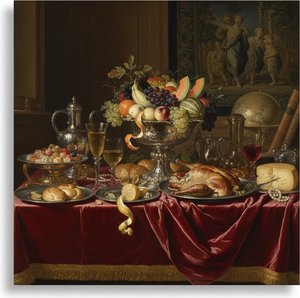
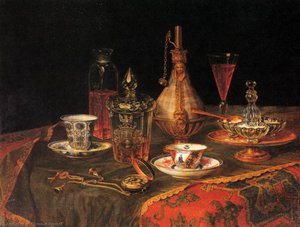
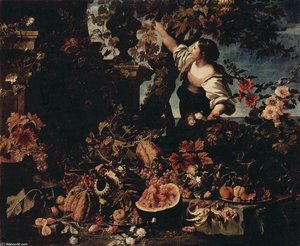
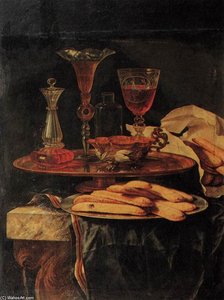
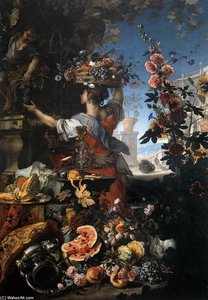
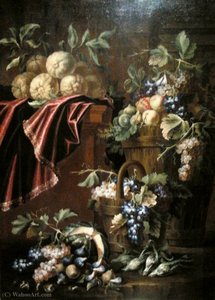
To gaze upon a Berentz masterpiece is to enter a world where time seems to suspend itself in a moment of exquisite decay and eternal beauty. He was a master of the still life, a genre that, under his brush, transcended simple representation to become a profound meditation on existence. His compositions are often characterized by a sophisticated use of chiarosc Century, where deep, velvety shadows provide a dramatic stage for the sudden, brilliant emergence of light upon a dew-kissed petal or a translucent grape. This interplay of light and dark does more than create depth; it breathes life into the inanimate.
His technique, often described with a touch of mannerist elegance, reveals a conscious effort to distill the essence of nature into highly stylized yet breathtakingly realistic forms. One might observe:
- The tactile richness of heavy drapery and dark cloths that anchor his compositions.
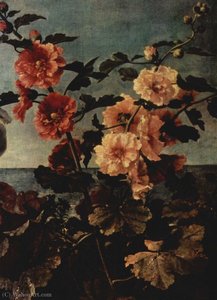
- The delicate, almost fragile rendering of floral motifs that suggest the fleeting nature of life.
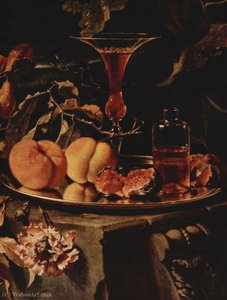
- The masterful depiction of glass and liquid, capturing the way light refracts through wine and crystal.
Historical Significance and Artistic Endurance
The historical importance of Christian Berentz lies in his role as an artistic mediator. He stood at the crossroads of Northern realism and Southern grandeur, proving that these seemingly opposing movements could be harmonized into a cohesive visual language. His ability to navigate the technical demands of the Dutch masters—such as the precision of Pieter Claesz—while embracing the atmospheric depth of the Roman school, allowed him to occupy a unique niche in the Baroque hierarchy. Furthermore, his legacy extends through his role as an educator; by training figures such as Pietro Navarra, he ensured that his particular brand of stylistic synthesis would ripple through subsequent generations of painters.
Today, Berentz’s contributions are preserved in some of the world's most esteemed institutions, including the Hermitage Museum. His works remain vital touchstones for anyone seeking to understand the complexity of the Baroque period—a time when art was not merely a mirror held up to nature, but a sophisticated dialogue between the seen and the unseen, the fleeting and the eternal. Through his meticulous observation and emotive execution, Berentz continues to invite viewers into a silent, beautiful conversation with the ephemeral wonders of the natural world.