The Master of Atmospheric Drama: The Life and Legacy of Daniel Jansz Thievaert
In the vibrant, salt-sprayed era of the Dutch Golden Age, few artists captured the mercurial temperament of the natural world as poignantly as Daniel Jansz Thievaert. Born in Amsterdam around 1613, Thievaert emerged during a period of unparalleled commercial prosperity and artistic experimentation. While the biographical shadows surrounding his early years remain somewhat elusive—a common challenge when reconstructing the lives of seventeenth-century masters from fragmented archives—his brushwork provides a vivid testament to his presence in the heart of Dutch culture. His life, which concluded around 1657, was defined by an unwavering commitment to capturing the profound interplay between light, shadow, and the elements.
Thievaert’s artistic journey was shaped by the prestigious lineage of Dutch landscape painting. He honed his technical prowess under the guidance of Willem van Delft, a master renowned for landscapes imbued with humanist ideals. This foundational training, likely supplemented by the enduring influence of Pieter Bruegel the Elder, instilled in Thievaert a deep respect for compositional balance and narrative depth. As he matured, his style evolved beyond mere topographical accuracy, moving toward a more emotive and atmospheric approach. He became a specialist in the dramatic, particularly through his command of atmospheric perspective—a technique that allowed him to render turbulent, cloud-heavy skies and shafts of sunlight piercing through gloom with breathtaking realism.
Narrative Grandeur and Technical Mastery
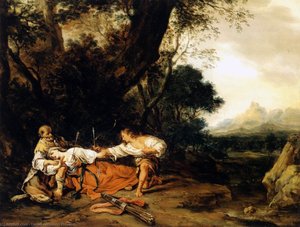
The true brilliance of Thievaert lies in his ability to transform a seascape or a woodland scene into a stage for human drama. His works are rarely static; they breathe with the tension of an unfolding story. In masterpieces such as Silvio en Dorinda, the artist moves away from the open sea to explore the intimate, shadowed depths of a dense forest. Here, he utilizes a rich, tonal palette and the dramatic chiaroscuro characteristic of the Baroque period to guide the viewer’s eye through a landscape of vulnerability and tension. A single, sharp detail—perhaps a sword resting on the earth—serves as a silent narrator, hinting at recent violence and heightening the emotional stakes of the scene.
This mastery of light was not merely decorative but served a psychological purpose. Thievaert’s skies are often ablaze with movement, reflecting the turbulent spirit of an age of maritime exploration. Whether depicting the rhythmic swell of the North Sea or the heavy, overcast canopy of a forest, his technique involved layering thin glazes to create a sense of depth and luminosity. This meticulous attention to detail allowed him to capture:
- The translucent quality of light filtering through thick maritime mist.
- The tactile textures of weathered robes, white garments, and rugged terrain.
- The profound emotional resonance found in the faces of figures caught in moments of crisis or prayer.
A Lasting Impression on the Dutch Golden Age
Thievaert’s contribution to the visual culture of seventeenth-century Holland extends far beyond the depiction of ships and coastlines. By infusing maritime scenes with a sense of psychological depth, he elevated the genre from mere documentation to high art. His ability to weave biblical narratives—seen in works like Paulus en Barnabus and Abraham en Isaak in gebed van dankbaarheid—into landscapes of immense scale ensured that his work resonated with both the religious and secular sensibilities of his time.
Though his career was relatively brief, the historical significance of Daniel Jansz Thievaert remains etched in the annals of Dutch art. He stands as a bridge between the structured landscapes of his predecessors and the more emotive, atmospheric explorations that would follow. Today, his paintings continue to captivate collectors and historians alike, offering a window into a world where the boundaries between the natural environment and human emotion were beautifully, and often dramatically, blurred.