The Plasticity of Modernity: The Visionary World of debora delmar corp.
Born in the vibrant metropolis of Mexico City in 1980, debora delmar corp. has emerged as a profound voice in contemporary art, navigating the complex currents of our globalized era. Her work serves as a mirror to a society caught between the tangible weight of physical waste and the ephemeral glow of digital existence. Through a practice that seamlessly blends the tactile nature of sculpture with the fluid dynamics of social media, she explores how consumer culture shapes our identity and our environment. Delmar does not merely create objects; she constructs narratives that challenge the viewer to confront the remnants of their own consumption.
The foundation of her sophisticated aesthetic can be traced back to her rigorous academic journey in the United States. After earning a Bachelor of Fine Arts from The School of Art Institute of Chicago (SAIC) in 2006, she continued her evolution at CalArts, completing her Master of Fine Arts in 2011. These institutions, renowned for fostering conceptual depth, provided the intellectual scaffolding for her later explorations. At SAIC, she learned to look beyond the surface of beauty, while her time at CalArts equipped her with the advanced fabrication techniques necessary to transform mundane materials into high-concept art. This academic lineage is evident in the meticulous detail and unsettling realism that define her sculptural output.
Materiality and the Echo of Consumption
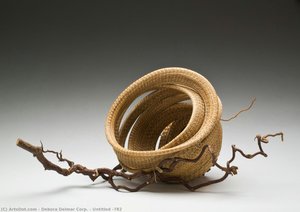
At the heart of Delmar’s practice lies a provocative investigation into the lifecycle of materials, specifically the ubiquitous presence of plastic. Her sculptures often breathe new life into discarded items, repurposing the detritus of modern life into striking, organic forms. This choice of medium is deeply symbolic; by utilizing plastic—a material synonymous with both convenience and ecological catastrophe—she forces an encounter with the uncomfortable truths of sustainability. There is a haunting beauty in her work, where textures and contours mimic natural biological structures, yet are composed entirely of man-made waste.
This juxtaposition creates a powerful tension within her oeuvre:
- The Illusion of Nature: Her ability to replicate organic textures through synthetic means provokes a deep contemplation on the degradation of our natural world.
- The Weight of Waste: Each sculpture acts as a physical manifestation of the invisible mountains of trash produced by global consumption habits.
- Technological Precision: The use of advanced fabrication methods allows for an almost hyper-realistic finish that blurs the line between the synthetic and the living.
The Digital Frontier and Global Resonance
In an era defined by connectivity, Delmar recognizes that art no longer exists solely within the white walls of a gallery. She has masterfully integrated social media platforms like Instagram and Twitter into her very creative process, treating the digital landscape as an extension of her sculptural space. For Delmar, the digital realm is not just a tool for promotion but a vital medium through which she explores how information and imagery circulate in our interconnected world. This dual presence—the physical sculpture and the digital image—allows her work to achieve a global reach, resonating with audiences far beyond the traditional art market.
The historical significance of debora delmar corp. lies in her ability to bridge the gap between the ecological crisis and the digital revolution. As she continues to evolve, her work remains a critical touchstone for understanding the intersection of technology, consumerism, and environmental responsibility. She stands as a pivotal figure in contemporary art, reminding us that even in a world of fleeting pixels, the physical consequences of our actions remain indelibly etched in the fabric of our planet.