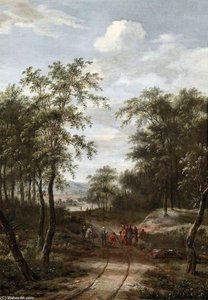
The Quiet Mastery of Dionijs Verburgh
In the grand, often tumultuous tapestry of the Dutch Golden Age, certain artists emerge not through thunderous drama or epic scale, but through a profound, whispered intimacy with the natural world. Dionijs Verburgh (1655–1722) was precisely such a master. A painter of subtle detail and atmospheric nuance, Verburgh possessed an uncanny ability to transform the mundane into the monumental. While his contemporaries often sought to capture the sweeping narratives of history or the grandeur of myth, Verburgh turned his gaze toward the delicate interplay of light upon a leaf, the soft mist clinging to a Dutch meadow, and the quiet dignity of everyday life.
Born in the vibrant mercantile hub of Rotterdam, Verburgh’s early life was shaped by a unique blend of international commerce and deep-seated tradition. His father, Ruth Jansz. Verburgh, was a cloth merchant whose involvement in global trade routes likely exposed the young artist to a breadth of perspectives far beyond the borders of the Netherlands. This exposure to diverse textures and distant horizons may have subtly informed the richness of his later compositions. Complementing this worldly influence was the moral and spiritual foundation provided by his mother, Maria Tielemans, whose presence instilled in him a sense of piety that would later manifest in the serene, almost meditative quality of his religious-themed landscapes.
Artistic Evolution and Technical Brilliance
The technical foundation of Verburgh’s style was laid under the watchful eye of Gerrit Battem, a landscape painter renowned for his meticulous observation of nature. From Battem, Verburgh inherited a devotion to capturing atmospheric conditions—the way sunlight filters through a canopy of trees or how the dampness of a morning fog alters the color of the earth. This training allowed him to move beyond mere representation, enabling him to paint not just objects, but the very air that surrounds them.
As his career progressed, Verburgh’s reach extended far beyond the Dutch Republic. His time in Surinam proved to be a pivotal chapter, where he acted as a prolific chronicler of the colonial environment. This period of exploration added a new layer of botanical and topographical complexity to his repertoire. However, it was upon his return to his homeland that his reputation truly solidified. He became celebrated for his genre paintings—scenes of Dutch interiors and rural landscapes that captured the soul of the Netherlands. His mastery of chiaroscuro—the dramatic tension between light and shadow—allowed him to imbue even the simplest domestic scene with a sense of profound emotion and spiritual weight.
Legacy and Lasting Significance
The enduring fascination with Verburgh’s work lies in his ability to evoke emotion through subtlety rather than spectacle. One of his most breathtaking achievements, “Wooden Landscape with Christ and the Apostles,” serves as a testament to this skill. In this work, he utilizes light not merely as a tool for visibility, but as a divine presence, weaving biblical narrative into the very fabric of the landscape itself. He avoids the overt theatricality common in religious art of his era, opting instead for an ethereal atmosphere that invites the viewer into a moment of quiet contemplation.
Today, Verburgh is remembered as a vital link in the evolution of Dutch landscape and genre painting. His contributions to the art world include:
- Atmospheric Precision: A pioneering ability to render complex weather patterns and light qualities.
- Genre Innovation: The elevation of everyday Dutch life into subjects of high artistic merit through detailed observation.
- Global Perspective: The integration of colonial observations from Surinam into the traditional Dutch landscape canon.
- Emotional Depth: A unique command of shadow and light to convey spiritual and psychological states without reliance on grand gestures.
Through his delicate brushwork and profound sensitivity, Dionijs Verburgh remains a cornerstone of 17th-century art, reminding us that the most significant truths are often found in the smallest, most quiet corners of our world.